
Williams Lake Timber Supply Area
 Last updated on August 24, 2026
The Williams Lake Timber Supply Area (TSA) lies in the central Cariboo Region, straddling the Fraser Basin and the Interior Plateau between the Coast Mountains on the west and the Cariboo Mountains on the east. It's bounded by the Quesnel TSA to the north and 100 Mile House and Lillooet TSAs to the south.
One of the largest TSAs in the province, it covers about 4.93 million hectares and includes the City of Williams Lake and the communities of Horsefly, Alexis Creek, Anahim Lake and Tatla Lake. The Williams Lake TSA is administered by the Cariboo Chilcotin Natural Resource District in Williams Lake.
Tsilhqot’in Nation v. British Columbia (Tsilhqot’in decision)
On June 26, 2014, the Supreme Court of Canada (SCC) released its decision on Tsilhqot’in Nation v. British Columbia (Tsilhqot’in decision). In that decision the SCC outlined areas over which the Tsilhqot’in Nation had proven Aboriginal title. Proven Aboriginal title lands are not considered Crown land. As such, those lands have been excluded from the AAC determination, as have the areas that the courts determined were outside of the actual claim area but met the criteria for proof of aboriginal title.
Partition
Under Section 8(5) of the Forest Act the chief forester in determining an AAC can specify a portion of the AAC that is attributable to certain types of timber, terrain, or areas of the TSA.
Effective February 25, 2015, the AAC for the Williams Lake TSA was 3,000,000 cubic metres. This includes a partition of a maximum of 1,500,000 cubic metres per year for live volume which means the remainder of the AAC is for salvaging dead trees. Non-pine leading stands will contribute a maximum of 880,000 cubic metres to the AAC of this TSA.
Adjusted Allowable Annual Cut (AAC)
Effective April 4, 2017 the allowable annual cut (AAC) for the Williams Lake TSA is 2,937,509 cubic metres due to Allowable Annual Cut Administration Regulation, First Nations Woodland Licence (FNWL) N2K (Esk'etemc).
In-progress Timber Supply Review
Current Timber Supply Review
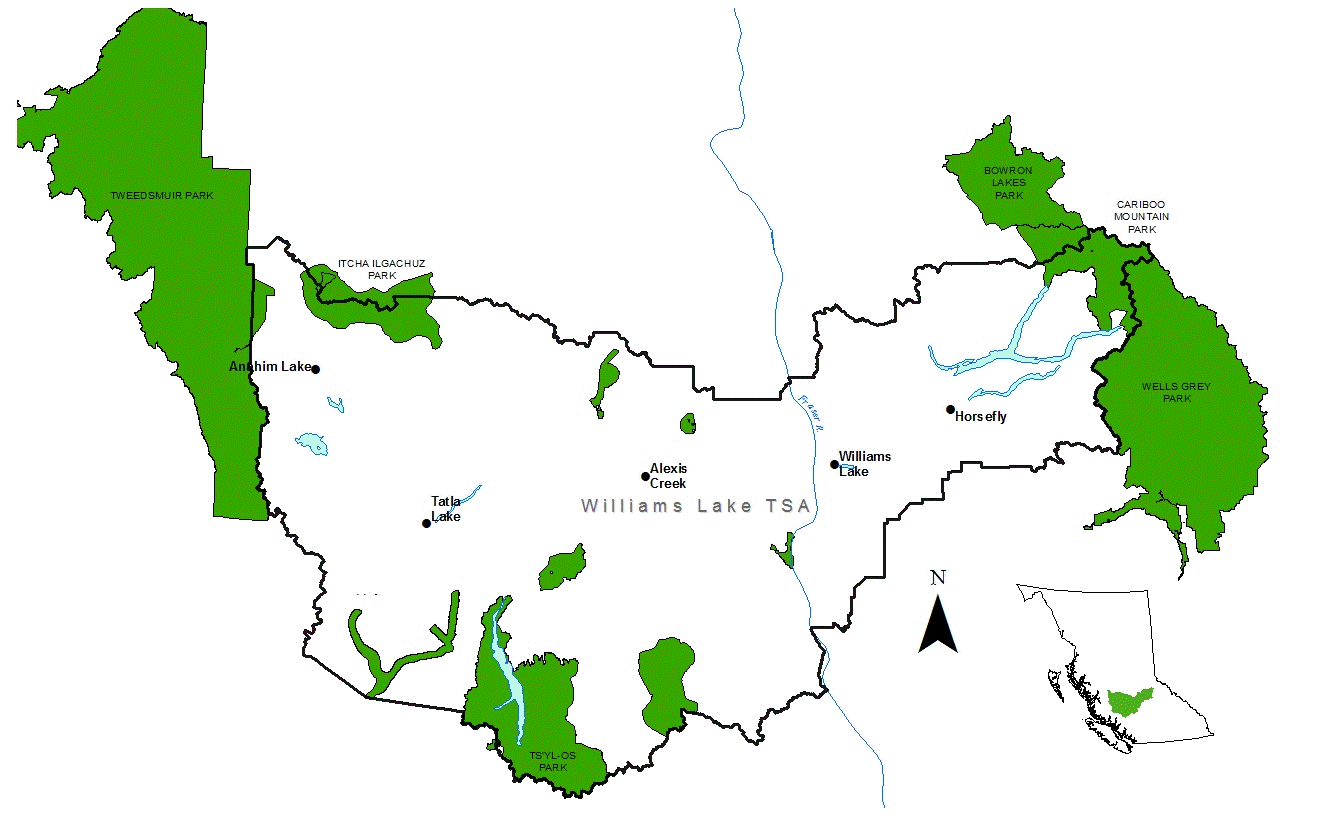
Williams Lake TSA straddles the Fraser Basin and the Interior Plateau in the central Cariboo Region.
Contact information
Feedback is welcome on any issues related to the Williams Lake TSA timber supply review. Public input is vital to the timber supply review process.