
Cascadia Timber Supply Area
 Last updated on June 15, 2026
The Cascadia Timber Supply Area (TSA) differs from most other management units in British Columbia in that its constituent timber supply blocks are widely dispersed, and the block groupings are managed by four BC Timber Sales (BCTS) business areas.
Effective January 23, 2020 the new allowable annual cut (AAC) for the Cascadia Timber Supply Area (TSA) was 356 230 cubic metres.
Partition
Under Section 8(5) of the Forest Act the chief forester in determining an AAC can specify a portion of the AAC that is attributable to certain types of timber, terrain, or areas of the TSA.
The Cascadia TSA is assigned to BC Timber Sales (BCTS) and consists of 11 timber supply blocks. The new cut level includes the following partitions:
- 101,420 cubic metres for the BCTS Kootenay Business Area;
- 63,000 cubic metres for the BCTS Okanagan-Columbia Business Area;
- 65,740 cubic metres for the BCTS Cariboo-Chilcotin Business Area; and
- 126,070 cubic metres for the BCTS Skeena Business Area.
Adjusted Allowable Annual Cut (AAC)
Immediately following this decision, the chief forester had issued a written order under Chief Forester Order Section 173 of the Forest Act, reducing the new Cascadia TSA AAC attributable to the BCTS Skeena Business Area by 9310 cubic metres per year. This order will remain in effect until the Kitsumkalum‑Kitselas Designated Area No. 1 expires or the Kitsumkalum Treaty is ratified. Once the Kitsumkalum Treaty takes effect, the AIP lands will no longer be provincial land and will be removed from the Cascadia TSA for future AAC determinations.
Effective January 23, 2020, the allowable annual cut for the Cascadia Timber Supply Area (TSA) is 346,920 cubic metres per year.
News release
New Cascadia TSA cut level focused on sustainability
Reference #2020FLNRO010-000106* Released on January 23, 2020
Current Timber Supply Review
- Chief Forester Order Section 173 of the Forest Act (PDF, 16KB) January, 2020
- Rationale for AAC Determination (PDF, 1.8MB) January, 2020
- Analysis Report (PDF, 5.3MB) February, 2019
- Information Package (PDF, 2.7MB) June, 2018
Learn more about the area removed:
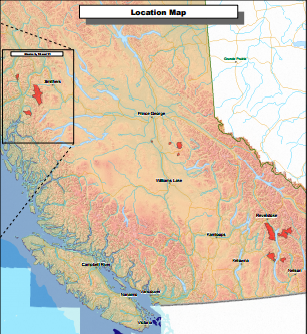
Cascadia TSA includes lands in northwest, central and southeast B.C.
Contact information
Feedback is welcome on any issues related to this timber supply review. Public input is a vital part of the timber supply review process.