
Cassiar Timber Supply Area
 Last updated on June 15, 2026
The Cassiar Timber Supply Area (TSA) in northwestern British Columbia is B.C.’s largest and least populated TSA. Covering 13.1 million hectares, or one-sixth of the province, its boundaries coincide with those of the Skeena Stikine Natural Resource District.
Administered by the Skeena Stikine Natural Resource District office in Smithers, communities in the Cassiar TSA include Dease Lake, Atlin, Telegraph Creek, Iskut, Good Hope Lake and Lower Post.
Partition
Under Section 8(5) of the Forest Act the chief forester in determining an AAC can specify a portion of the AAC that is attributable to certain types of timber, terrain, or areas of the TSA.
On March 5, 2015, an AAC was established of 196,000 cubic metres, that included a partition of 80,000 cubic metres attributable to the Iskut “A” operable block.
Adjusted Allowable Annual Cut (AAC)
Effective February 1, 2020, the Cassiar TSA allowable annual cut (AAC) is 119,791 cubic metres accounting for First Nation Woodlands Licence (FNWL) N3E adjustment.
Postponement Order
The Forest Act — Section 8 (3.1) of the Forest Act stipulates in part that: If… the chief forester considers that the allowable annual cut…is not likely to be changed significantly with a new determination, then…the chief forester by written order may postpone the next determination…to a date that is up to 15 years after the date of the relevant last determination and must give written reasons for the postponement.
Effective January 24, 2024, a Chief Forester Order (Postponement Order) was established, as outlined in Section 8 (3.1) of the Forest Act.
Current Timber Supply Review
- Rationale for AAC Determination (PDF, 607KB)
- Public Discussion Paper (PDF, 749KB)
- Data Package (PDF, 1.6MB)
Postponement Order
The Forest Act — Section 8 (3.1) of the Forest Act stipulates in part that: If… the chief forester considers that the allowable annual cut…is not likely to be changed significantly with a new determination, then…the chief forester by written order may postpone the next determination…to a date that is up to 15 years after the date of the relevant last determination and must give written reasons for the postponement.
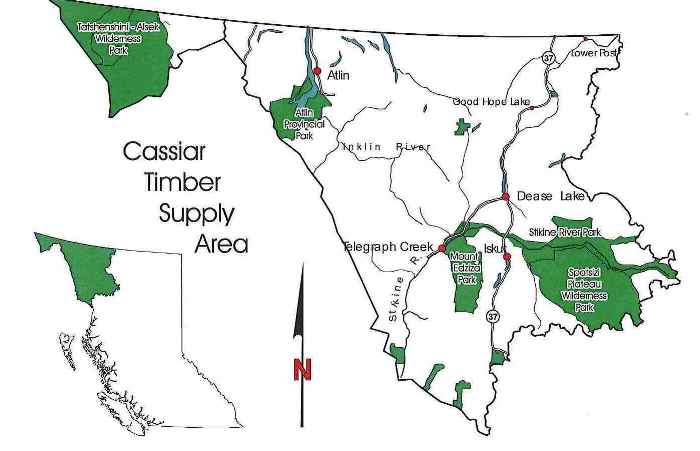
Taking in one-sixth of B.C.’s land, Cassiar TSA is the province’s largest.
Contact information
Feedback is welcome on any issues related to this timber supply review. Public input is a vital part of the timber supply review process.