
Information Bulletin RLCF-032: Chain of Custody Requirements
 Last updated on October 27, 2026

1. Introduction
This bulletin provides guidance to fuel producers, suppliers, and other entities involved in the supply of fuels into British Columbia (BC). It clarifies the BC Low Carbon Fuel Standard’s (BC LCFS) requirement for fuels to be considered “reportably supplied” under section 6(2) of the Low Carbon Fuels Act (Act). This bulletin specifically addresses which chain of custody models are acceptable when determining fuel volumes supplied to BC.
For a fuel to be considered reportably supplied in BC and have its quantity counted towards the Renewable Fuel Requirements (RFR) and specific Carbon Intensity (CI) count toward the Low Carbon Fuel Requirements (LCFR) of the Act, the fuel must be physically delivered into BC. Additionally, to be eligible for credit generation, the fuel must be supplied for use in transportation or other prescribed purposes.
The BC LCFS applies chain of custody concepts consistent with ISO 22095:2020 to ensure transparency and verifiability of reportably supplied fuels. Parties subject to the Act must apply a chain of custody model appropriate to the fuel and supply chain, maintain records demonstrating physical delivery into BC, and retain sufficient documentation to support compliance and prevent double counting
2. Definitions
The following terms and definitions are adopted from ISO 22095:2020 for application under the BC LCFS.
Chain of custody: Process by which inputs and outputs and associated information are transferred, monitored, and controlled as they move through each step in the relevant supply chain.
Chain of custody system: Set of measures designed to implement a chain of custody, including documentation of these measures.
Specified characteristic: Set of product and/or production characteristics that the chain of custody is designed to maintain [e.g., CI, feedstock type, renewable content].
Input: Material or product that enters an organization or part of an organization [e.g., feedstocks, upgraded feedstocks, fuels].
Output: Material or product that leaves an organization or part of an organization [e.g., feedstocks, upgraded feedstocks, fuels].
Chain of custody models
- Identity preserved model (ISO22095:2020 3.3.1): A chain of custody model in which the materials or products originate from a single source and their specified characteristics are maintained throughout the supply chain.
- Segregated model (ISO22095:2020 3.3.2): A chain of custody model in which specified characteristics of a material or product are maintained from the initial input to the final output. The segregated model allows for material from more than one source to contribute to the chain of custody provided the characteristics of the contributing materials [e.g. CI] are the same.
- Controlled blending model (ISO22095:2020 3.3.3): A chain of custody model in which materials or products with a set of specified characteristics are mixed according to certain criteria with materials or products without that set of characteristics, resulting in a known proportion of the specified characteristics in the final outp
- Mass balance model (ISO22095:2020 3.3.4): A chain of custody model in which materials or products with a set of specified characteristics are mixed according to defined criteria with materials or products without that set of characteristics, with proportions typically varying across outputs.
- Book and claim model (ISO22095:2020 3.3.5): A chain of custody model in which the administrative record flow is not necessarily connected to the physical flow of material or product throughout the supply chain.
System boundary: The defined portion of the fuel supply chain within which relevant fuel inputs, outputs, transfers, inventories, losses, gains, and associated information are tracked, measured, monitored, controlled, and reconciled for the purpose of applying a chain of custody model and determining reportable fuel quantities or characteristics.
3. Application under BC LCFS
The Low Carbon Fuel Standard includes fuel reporting obligations to satisfy Renewable Fuel Requirements (RFR) and Low Carbon Fuel Requirements (LCFR) (see Table 1). Fuel suppliers should use the same chain of custody model for RFR and LCFR reporting for a given fuel.
| Fuel | RFR | LCFR |
|---|---|---|
| Base fuels and fossil-derived components of base fuels | All supplied in BC | Fuel supplied for applicable purposes in BC |
| Other type A fuels | Eligible renewable fuel (section 4 of Low Carbon Fuels (Technical) Regulation) | Fuel supplied for applicable purposes in BC |
| Type B fuels (Electricity, Propane, Natural Gas, Hydrogen) | Not applicable | Fuel supplied for applicable purposes in BC |
For more information about supplying liquefied or compressed natural gas in BC, including physical delivery requirements for gaseous fuels supplied through pipeline systems, see Information Bulletin RLCF-023.
For more detailed information on eligible renewable fuel for the RFR, see Information Bulletin RLCF-003. “Applicable purposes” for the LCFR refers to transportation and other prescribed purposes.
For more information on prescribed purposes, see Information Bulletin RLCF-022.
Fuel suppliers are responsible for determining the quantity of fuel supplied for applicable purposes. Where fuel is supplied to downstream suppliers, distributors, retailers, or other parties, fuel suppliers should make reasonable efforts to obtain information from those parties to determine the quantity of fuel used for applicable purposes.
Reasonable efforts may include obtaining information through contracts, invoices, product transfer documents, customer declarations, sales records, or other records available in the ordinary course of business.
Fuel suppliers must maintain records supporting data, assumptions, and methodologies used to determine fuel quantities.
3.1. Selecting a chain of custody model
The selection of an appropriate chain of custody model for tracking fuels and determining fuel quantities for RFR and LCFR purposes depends on the nature of the fuel, the characteristics of the supply chain, and the availability and practicality of measurement and data systems.
Fuel suppliers may select from the Identity preserved, Segregated, Controlled blending or Mass balance chain of custody models (Figure 1). Where fuel supplier operations and data availability support the use of more than one chain of custody model, the Ministry prefers models with a higher rank of physical presence, which generally indicates a stronger connection between the specified characteristics and the physical fuel supplied.
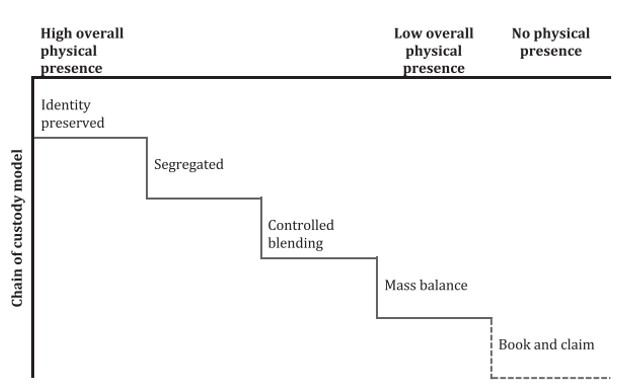
Figure 1: Indicative illustration of chain of custody models ranked according to the physical presence of specified characteristics (ISO 22095)
The book-and-claim chain of custody model is not acceptable for reporting under BC LCFS. It must not be used to assert that fuel was physically supplied into BC, to determine reportable fuel quantities, or to assign specified characteristics such as carbon intensity or renewable content.
Fuels supplied without mixing, such as electricity, propane, and hydrogen from a single source, should be tracked using either the identity-preserved or segregated chain of custody models.
The following requirements apply to all chain of custody models:
- Define the system boundary for the applicable supply chain activities;
- Track and record all relevant inputs, outputs, transfers, and inventories within the system boundary;
- Measure or calculate relevant quantities using a consistent and transparent methodology;
- Reconcile reported fuel quantities over the compliance period, including opening inventory, inputs, outputs, and closing inventory, as applicable, and ensure any shorter internal accounting intervals are consistent with reported quantities over the compliance period;
- Ensure that only fuels physically supplied to BC for transportation or other prescribed purposes are reported;
- Apply a consistent and transparent methodology that prevents double counting across jurisdictions, facilities, compliance periods, or reporting parties; and
- Maintain complete, accurate, and auditable records to support reported fuel quantities, calculations, allocations, and reconciliation.
3.2. Supply of Blended or Co-processed Liquid Fuels
Where a supplied fuel is co-processed or blended from multiple fuels with different CIs, including fuels associated with approved fuel codes or default CIs, the volumes supplied into BC should be tracked using either the controlled blending or mass balance chain of custody model.
3.2.1. Controlled Blending
The controlled blending model applies where a fuel supplier has measurement and accounting systems that can track relevant inputs and outputs within a defined system boundary in the supply chain.
This model establishes a direct, measurable, and auditable relationship between inputs and outputs. It can be used to determine the proportion and quantity of each fuel type, including the applicable fuel code and carbon intensity, in a final blended or co-processed fuel based on actual blending or co-processing activities.
Fuel suppliers using this model must determine and report the quantity of each fuel physically supplied into BC based on its proportional contribution to the final blended or co-processed fuel, supported by blending or co-processing records for the compliance period.
3.2.2. Mass Balance
The mass balance model applies where fuels with specified characteristics, such as carbon intensity or renewable content, are mixed with other fuels within a defined system boundary.
This model establishes an accounting-based relationship between inputs and outputs. It can be used to assign specified characteristics to outputs based on the quantity of inputs and outputs over the compliance period. The characteristics assigned to a particular output may not exactly reflect their physical composition. Fuel suppliers using the mass balance model must ensure that:
- The total quantity of the relevant fuel type or specified characteristic assigned to outputs does not exceed the quantity available within the system boundary during the compliance period, after accounting for opening inventory, production or receipts, outputs, volumes supplied to other jurisdictions, and closing inventory;
- Specified characteristics are allocated only among fuels physically supplied into BC during the compliance period;
- The total volume reported as renewable fuel supplied into BC does not exceed the total volume of renewable fuel physically supplied into BC;
- The model is not applied across unrelated facilities, jurisdictions, or supply chains based solely on administrative or contractual allocation;
- Facilities, entities, or supply chain activities are included within the same system boundary only where they operate as part of an integrated physical system and are supported by shared inventory controls, auditable transfer records, and reconciliation documentation; and
- The defined system boundary supports physical delivery into BC and prevents double counting across jurisdictions, facilities, compliance periods, or reporting parties.
4. Documentation Requirements
Parties that market fuel in BC are responsible for maintaining sufficient records to demonstrate compliance with the Low Carbon Fuels Act and regulations, including the applicable chain of custody model and physical delivery requirements. The Ministry does not require internal accounting systems or chain of custody documentation to be submitted as part of compliance reporting; however, fuel suppliers must maintain adequate systems and retain documentation so that supporting information is available upon request for audit, verification, or compliance review. Documentation should be consistent with the documented information requirements of ISO 22095:2020, Clause 6.6, for the chain of custody model used.
Fuel suppliers may rely on existing business records, inventory systems, certification documents, or verification materials where those records are sufficient to demonstrate compliance with the Act, regulations, and this bulletin.
Where reporting relies on information from an upstream producer, downstream supplier, distributor, retailer, or other third party, the fuel suppliers should retain documentation showing how that information was obtained, reviewed, and relied upon. Fuel suppliers remain responsible for ensuring that reported quantities are supported by complete, accurate, and auditable records.
Consistent with section 35 of the Act, parties must retain records for six years after the compliance date of the applicable compliance period or six years after submission of a carbon intensity record application. Suppliers must make records available to the Director upon request.
At a minimum, records should be sufficient to demonstrate:
- the volume of fuel physically supplied into BC;
- the volume of fuel supplied for transportation or other prescribed purposes;
- the applicable chain of custody model and defined system boundary;
- the methodology used to determine reported quantities, including any allocation methodology applied under controlled blending or mass balance;
- reconciliation of relevant inputs, outputs, transfers, production, losses, inventories, and allocations within the defined system boundary;
- prevention of double counting of fuel quantities or attributes across jurisdictions, facilities, compliance periods, or reporting parties; and
- the fuel codes, default carbon intensities, or other specified characteristics associated with the reported fuel quantities, where applicable.
Supporting documentation may include, as applicable:
- contracts, invoices, purchase records, and bills of lading;
- transportation, delivery, and physical transfer records;
- product transfer documents or custody transfer records;
- blending, co-processing, production, or receipt records;
- inventory records and reconciliation worksheets;
- allocation calculations used for controlled blending or mass balance;
- carbon intensity records, fuel code information, or default CI references;
- carbon-14 test results or other technical evidence for co-processed fuels, where applicable; and
- customer declarations, downstream supplier information, or other records used to determine whether fuel was supplied for transportation or other prescribed purposes.
For fuel producers, supporting documentation may also include, as applicable:
- feedstock purchase records, feedstock receipt records, and production logs;
- process data used to support production and attribution, including yields, coproduct handling, conversion efficiencies, and mass or energy balance calculations;
- certificates of analysis, laboratory test results, carbon-14 test results, or other technical evidence used to validate specified characteristics, such as renewable content, feedstock type, or carbon intensity; and
- records supporting the allocation of fuel quantities, fuel codes, carbon intensities, renewable content, or other specified characteristics to finished fuel outputs.
This information is for your convenience and guidance only and does not replace or constitute legal advice. It is recommended that parties who may be a fuel supplier review the Low Carbon Fuels Act, Low Carbon Fuels (General) Regulation and the Low Carbon Fuels (Technical) Regulation and seek independent legal advice to confirm their status, legal obligations and opportunities.