
Information Bulletin RLCF–030: Use Carbon Intensity (UCI) for Liquified Natural Gas (LNG) used in dual-fuel marine vessels
 Last updated on October 8, 2026
On this page:
1. Background
The B.C. Low Carbon Fuel Standard (LCFS) was updated on January 1, 2024, when the Low Carbon Fuels Act (Act), Low Carbon Fuels (General) Regulation (LCFGR), and Low Carbon Fuels (Technical) Regulation (LCFTR) came into effect. The updated LCFS includes a new factor – Use Carbon Intensity (UCI). UCI accounts for additional emissions resulting from fuel use in non-road transportation applications and is used to calculate the number of compliance units (debits/credits) generated annually. Six UCI values are available for marine dual fuel internal combustions engines that use LNG as the primary fuel. These UCI values reflect various engine loads of vessels operating with and without a methane slip reduction kit. UCI values are included in the Schedule 2 Table 4 of the LCFTR.
2. Who should use this guidance
This bulletin should be used by suppliers of LNG for use in marine vessels with dual fuel compression ignition engines. The bulletin defines a methane slip reduction “kit”, explains acceptable methods for determining annual average engine load, and outlines the supporting information that suppliers must include in annual compliance reports.
3. Professional reliance
Supporting documentation described in this bulletin must be signed and sealed by an appropriately qualified professional. The qualified professional must be a registrant in good standing with a relevant regulatory body governed by the BC Professional Governance Act (e.g. P.Eng). Similarly qualified professionals registered in other Canadian jurisdictions are also acceptable.
4. Methane slip reduction kit requirements
A methane slip reduction kit may be integral to the engine as originally designed and manufactured or retrofitted to an existing engine. In either case, to qualify under LCFS, the methane slip reduction kit must include the following:
Cylinder deactivation
The kit must deactivate engine cylinders when engine output drops below 20% of the rated maximum output.
Optimization of cylinder flame propagation
The kit must include equipment, technologies, or other strategies that optimize flame propagation through the combustion cylinder. These strategies must, at minimum, optimize the following parameters:
Pilot fuel (diesel) injection:
- Injection timing
- Injection mass/volume
Primary fuel (LNG) to combustion air mapping:
- Charge air pressure and mass/volume
- Fuel injection pressure, mass/volume and timing
Permanence
Once installed, the methane slip reduction kit must be in continuous operation. It must not be disengaged our deactivated - either intentionally or inadvertently - during normal operation of the engine.
5. Calculating annual average engine load
Fuel suppliers must determine the annual average engine load using operational data whenever possible. When limited data is available an alternative method may be used. An explanation of the method used to calculate annual average engine load, and any assumptions made, must be provided. The results and explanation must be signed and sealed by an appropriately qualified professional (as defined in Section 3).
Operational Data – Full Year
The annual average engine load is calculated as an average of engine load data gathered throughout the full compliance period.
Operational Data – Partial Year
If operational data for the entire compliance period is not available, the annual average may be determined based on a subset of data. An explanation must be provided outlining how the data was extrapolated to account for the full compliance period. An explanation of the representativeness of the subset must be included and must account for any factors that could affect or change engine loading (e.g. seasonal variation, maintenance issues/disruptions, etc.) throughout the compliance period.
Alternative Methods
If engine load data is not available, the annual average engine load may be determined using alternative methods. These may include, but are not limited to:
- Extrapolation of engine load data from one vessel to another based on similar use scenarios (i.e. different vessel types used for same route), with adjustments made to reflect differences in vessel propulsion configuration, engine size/type, etc.
- Using other available data, such as fuel consumption and engine operating hours, to calculate a representative average engine load.
- Other analytical calculations or derivations based on application of engineering principles and professional expertise.
6. UCI selection and reporting
6.1 UCI Selection
A UCI must be selected based on the annual average engine load for each vessel.
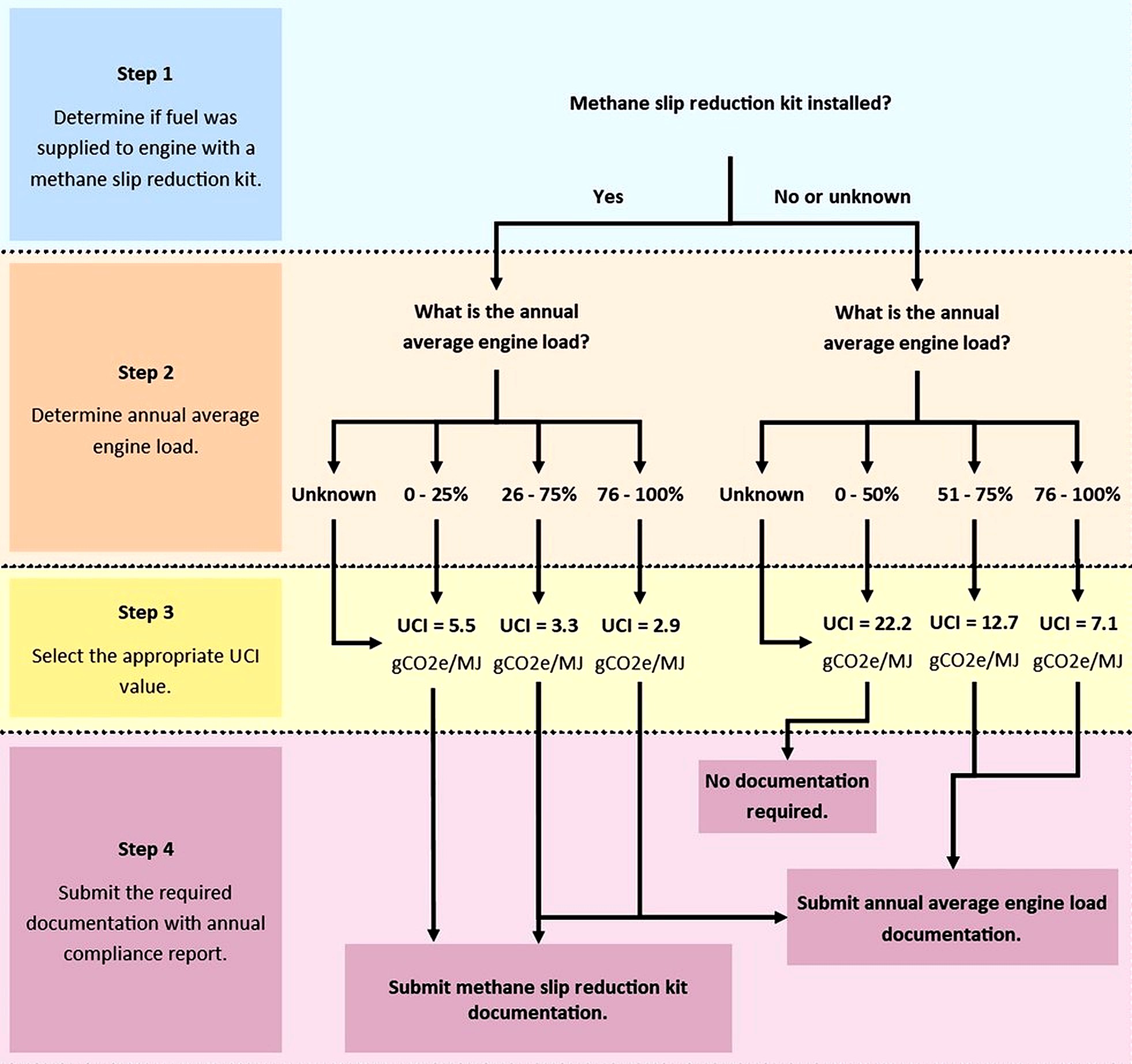
Table 1 and Table 2 below outline the UCI values for vessels with and without methane slip reduction kits, respectively. If the presence or permanence of a methane slip reduction kit cannot be confirmed, fuel suppliers must select UCI values for fuel supplied to vessels without a methane slip reduction kit (Table 2).
See Appendix 1 for a flowchart outlining the UCI selection methodology.
| Annual Average Engine Load | 76-100% | 26-75% | 0-25% or unknown |
| UCI (gCO2e/MJ) | 2.9 | 3.3 | 5.5 |
| Documentation Required | Per Section 7.1 & 7.2 | Per Section 7.1 & 7.2 | Per Section 7.1 |
| Annual Average Engine Load | 76-100% | 51-75% | 0-50% or unknown |
| UCI (gCO2e/MJ) | 7.1 | 12.7 | 22.2 |
| Documentation Required | Per Section 7.2 | Per Section 7.2 | None |
6.2 UCI Reporting
Fuel suppliers must consolidate the quantities of fuel supplied under each UCI; fuel supplied to multiple vessels with the same UCI must be reported as a single, combined volume in the compliance report using the LCFS Portal compliance reporting system.
7. Required documentation
The required documentation should be attached to the annual compliance report as a single stand-alone report using the LCFS Portal compliance reporting system. The report must address each of the applicable topics outlined in this guidance document in a clear and logical manner with a single qualified professional signing off on the report. The report must have a descriptive title that includes the term ‘UCI’.
Though the supplied quantities of fuel must be consolidated to the total volume supplied for each distinct UCI within the LCFS Portal, the report must detail the UCI determination and volume of LNG supplied for each vessel. This will provide enhanced transparency and facilitate compliance staff in their review of this supporting material.
7.1 Methane slip reduction kit
Fuel suppliers must include the following documentation with their annual compliance report if selecting UCI values from Table 1. The documentation must be signed and sealed by an appropriately qualified professional (as defined in Section 3).
Original Equipment
Methane slip reduction implemented by the engine manufacturer when the engine was built.
- Engine identification information (make/model/series etc.).
- Methane slip reduction kit description and specifications including a description of the cylinder deactivation protocol and how cylinder flame propagation is optimized.
- Confirmation statement that:
- The methane slip reduction kit/components were operated in accordance with the manufacturer’s requirements throughout the compliance period.
- The methane slip reduction kit was in continuous operation for the entirety of the applicable compliance period. Or confirmation that the design of the methane slip reduction kit prevents it from being disengaged or deactivated.
Retrofit Equipment
Methane slip reduction implemented through refit or overhaul of existing engines previously installed in a marine vessel.
- Engine identification information (make/model/series etc.).
- Methane slip reduction kit description and specifications including a description of the cylinder deactivation protocol and how cylinder flame propagation is optimized.
- Confirmation statement that the methane slip reduction kit was:
- Installed in accordance with the kit manufacturer’s requirements.
- Operated in accordance with the kit manufacturer’s requirements.
- In continuous operation for the entirety of the compliance period. Or confirmation that the design of the methane slip reduction kit prevents it from being disengaged or deactivated.
7.2 Annual average engine load
Fuel suppliers must include the following documentation with their annual compliance report to apply for 26% or greater engine load UCI values in Table 1, and/or 51% or greater engine load UCI values in Table 2. The documentation must be signed and sealed by an appropriately qualified professional (as defined in Section 3).
Operational Data
- Engine load data for the full compliance period and the calculated annual average engine loading, or
- A representative subset of engine load data accompanied by a report outlining how the data was manipulated to determine the annual average, and confirming it is representative of the full compliance period.
Alternative Method
- A report explaining the analytical method used and any assumptions made.
Appendix 1 UCI selection and required documentation
This information is for your convenience and guidance only and does not replace or constitute legal advice. It is recommended that parties who may be a fuel supplier review the Low Carbon Fuels Act, Low Carbon Fuels (General) Regulation and the Low Carbon Fuels (Technical) Regulation and seek independent legal advice to confirm their status, legal obligations and opportunities.