
Information Bulletin RLCF-009: Reporting Responsibility for Type B Fuels
 Last updated on October 26, 2026

On this page
Background
Certain organizations that supply type B fuels are subject to the Low Carbon Fuels Act (Act). The Act and its regulations set the legal framework for the Low Carbon Fuel Standard (LCFS). Under the LCFS, type B fuels are electricity, natural gas, propane, and hydrogen. This information bulletin clarifies when the LCFS applies to a type B fuel and provides information on the obligations of organizations that supply the fuel.
Organizations that supply type B fuels in the province are encouraged to refer questions about the LCFS to the Ministry of Energy and Climate Solutions (Ministry). The Ministry’s Low Carbon Fuels Branch administers the LCFS and can be contacted at lcfs@gov.bc.ca. LCFS Information Bulletins are published on the Renewable and Low Carbon Fuel website, available at www.gov.bc.ca/lowcarbonfuels.
LCFS Application to Type B Fuels
The LCFS only applies to a type B fuel if the fuel is considered to be an alternative to a base fuel. Under the LCFS, fuels are grouped into three categories defined by fossil-derived base fuels. Each fuel category consists of the base fuel, its components of, and alternatives to the base fuel. Base fuels under the Act are fossil-derived diesel, gasoline, and jet fuel.
Alternatives to a base fuel – transportation
Section 3 of the Low Carbon Fuels (Technical) Regulation (LCFTR) prescribes the following rules for type B fuel used for transportation purposes:
- If the end use of the type B fuel is use in a light-duty motor vehicle for the purpose of transportation by road, then the fuel is considered to be an alternative to fossil-derived gasoline.
- If the end use of the type B fuel is use in a heavy-duty motor vehicle for the purposes of transportation by road, then the fuel is considered to be an alternative to fossil-derived diesel. For type B fuel supplied for any other transportation purposes, then the fuel is considered to be an alternative to the base fuel that would most likely be used if the only useable fuels were base fuels.
For type B fuel supplied for any other transportation purposes, then the fuel is considered to be an alternative to the base fuel that would most likely be used if the only useable fuels were base fuels.
Alternatives to a base fuel – non-transportation purposes
For non-transportation purposes, a fuel is considered to be an alternative to a base fuel if the base fuel would most likely be used for that purpose if the only useable fuels were base fuels and electricity.
Information Bulletin RLCF-022: Prescribed Purposes other than Transportation describes the non-transportation purposes included under the LCFS (i.e., use in cargo handling equipment, ground support equipment, and certain forklifts).
Low carbon fuel target
If the LCFS applies to a type B fuel, then the organization that markets that fuel must meet the low carbon fuel targets unless it is otherwise exempted. If the fuel is marketed for an applicable purpose, it will generate positive or negative compliance units (credits or debits, respectively) in relation to the base fuel's carbon intensity reduction targets.
The applicable purposes under the LCFS are:
- Transportation
- Use in cargo handling equipment
- Use in ground support equipment
- Use in a forklift
Marketing fuel
An organization markets type B fuel in a compliance period if:
- The fuel is reportably supplied in the period
- And the organization is responsible for the fuel at the end of the compliance period
Marketing fuel – reportable supply
A type B fuel is considered reportably supplied if it has not been previously reportably supplied and it is used or supplied in British Columbia (B.C.) through final supply equipment (FSE).
FSE is the final equipment through which fuel is dispensed for use in applicable purposes under the Act. FSE can include, and is not limited to, charging equipment, fuel dispensers, compressed or liquified gas dispensers, or large tanks fitted with appropriate valves.
Marketing fuel - responsibility
An organization is responsible for type B fuel if it supplies the fuel through FSE in B.C. This person is the entity that owns the fuel when it passes through the FSE, and the fuel owner can be identified by receipts, invoices, or evidence that establishes fuel ownership at the FSE’s location.
Despite the above, public or local utilities are responsible for the following electricity supply:
- Vehicle charging at a residential building that includes fewer than five (5) dwelling units; and
- TransLink trains and electric trolley routes that were in operation on December 31, 2020.
An organization is also responsible for type B fuel if it accepts responsibility for the fuel under an allocation agreement.
Exclusion from the LCFS – electricity
The LCFS does not apply to the supply or export of electricity by an organization in a compliance period if:
- The organization does not market or reportably export any other fuel in the compliance period; and
- The total amount of electricity supplied or exported does not exceed 15,000 kWh.
Despite the above, the LCFS applies to the supply of electricity by an organization if:
- The organization allocates responsibility for the electricity under an allocation agreement; and
- The responsibility for electricity has been allocated to an organization who, in the compliance period, markets or reportably exports fuel other than electricity and/or markets or reportably supplies at least 15,000 kWh of electricity.
Compliance reporting obligations
An organization must file an annual compliance report if, during the compliance period, it:
- Markets type B fuel
- Reportably exports type B fuel1; or
- Allocates responsibility for a type B fuel other than electricity
For more information, see Information Bulletin RLCF-003: Compliance Reporting Requirements and Part 4 of the LCFTR.
Responsibility for type B fuel
Figure 1 provides an overview of how responsibility is determined for type B fuel other than electricity. The figure is intended as a general guide and should be read together with the Act, regulations, and the detailed guidance in this bulletin. For information about electricity, see Information Bulletin RLCF-020: Electricity Supply and Reporting Requirements. For information about reporting responsibility for type A fuel, see Information Bulletin RLCF-003: Compliance Reporting Requirements.
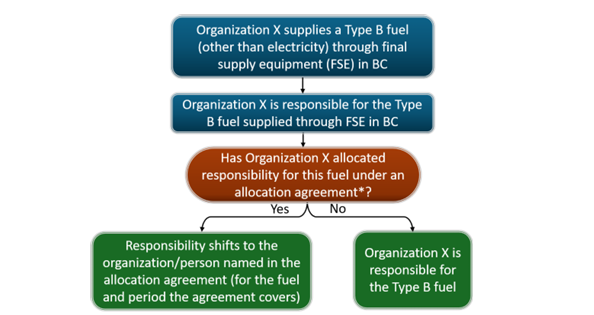
*Allocation agreement limits
1) Non-electric Type B: responsibility may be allocated only (i) to the person the allocating party supplies the fuel to; or (ii) to the person who supplied the fuel to the allocating party if responsibility has not previously been allocated under (i).
2) Electricity: responsibility may be allocated to any person.
Figure 1. Responsibility for Type B fuel (other than electricity) under the BC LCFS
Record keeping obligations
Organizations subject to the Act must maintain records sufficient to verify the information required to be reported in a compliance report and other information listed in section 35 of the Act.
Organizations that only supply electricity and have allocated the responsibility for the fuel to another organization do not need to file a compliance report. However, they still need to maintain records of their allocation agreements and other obligations under the Act. For more information, see Information Bulletin RLCF-015a: Allocation Agreements, sections 25 and 26 of the Low Carbon Fuels (General) Regulation.
Best practices for fuel documentation
Sections 14-18 of the LCFTR provide the information requirements for compliance reporting. Organizations responsible for type B fuels must identify the fuel’s carbon intensity, fuel quantities, and applicable purposes, such as the end uses for the.
Fuel quantities
Fuel quantities dispensed from FSE can be measured using physical or software-based meters or an approved fuel estimation methodology received before the March 31 deadline for compliance reporting. It is recommended that applications for a fuel estimation methodology be completed by January 31, following the compliance year. To apply for approval of a fuel estimation methodology, submit a detailed proposal that includes supporting documentation to lcfs@gov.bc.ca.
Fuel carbon intensity
When reporting fuel in compliance reports, organizations may use a published carbon intensity on the Renewable and Low Carbon Fuel website, if one exists. Otherwise, the default carbon intensities available in the LCFTR must be used. For more information, see Information Bulletin RLCF-012: Approved Carbon Intensities – Current, Information Bulletin RLCF-024: Proxy Carbon Intensities, and section 10 and schedule 2-3 of the LCFTR.
1. An organization reportably exports fuel if the person exports the fuel out of B.C., and the fuel was previously marketed in B.C. for an applicable purpose.
This information is for your convenience and guidance only and does not replace or constitute legal advice. It is recommended that parties who may be a fuel supplier review the Low Carbon Fuels Act, Low Carbon Fuels (General) Regulation and the Low Carbon Fuels (Technical) Regulation and seek independent legal advice to confirm their status, legal obligations and opportunities.