
Information Bulletin RLCF-015: Allocation Agreements
 Last updated on October 1, 2026
On this page
Background
Under the Low Carbon Fuels Act, Low Carbon Fuels (General) Regulation, and Low Carbon Fuels (Technical) Regulation, compliance with renewable and low-carbon fuel requirements is the responsibility of the person marketing fuel in British Columbia. This responsibility may be transferred to another party through an allocation agreement.
Allocation Agreements
Under Section 7 of the Act, an organization that is responsible for fuel can transfer that responsibility to another organization through an allocation agreement. An organization that takes on responsibility for fuel under an allocation agreement assumes all responsibility for the fuel, including compliance with the renewable and low carbon fuel requirements (as required) and requirements to maintain records. Organizations may enter into an allocation agreement if they meet the prescribed criteria to receive or transfer responsibility for the fuel, and include the required information prescribed in sections 9-11 of the LCFGR in the agreement. These agreements have no predefined writing format or standardized template.
Allocating responsibility for fuel 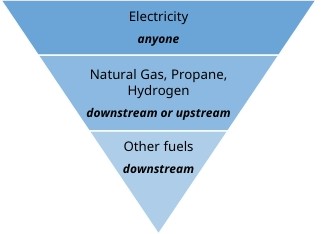
Allocating responsibility for fuel Responsibility for different fuel types can be allocated as follows:
- Electricity: responsibility may be allocated to anyone, regardless of whether they supply fuel or not. Electricity anyone
- Type B fuels that are not electricity (compressed natural gas, liquified natural gas, propane, and hydrogen): responsibility may be allocated either to the recipient of the fuel (downstream purchaser) or to the supplier of the fuel (upstream seller).
- Type A fuels (diesel, gasoline, jet fuel and any other non-type B fuel): responsibility may be allocated to the recipient of the fuel (downstream purchaser).
Information requirements for allocation agreements
Allocation agreements must specify the identifying information of the fuel, including the fuel name (e.g., ethanol), fuel category (e.g., gasoline), and the fuel code as published in the Information Bulletin RLCF-012: Approved Carbon Intensities – Current at the time the agreement is signed. If there is no fuel code, the prescribed or default carbon intensity of the fuel as set out in Section 10 or Schedule 3 of the LCFTR must be specified.
In addition, an allocation agreement must have:
1. Contact information for each person subject to the agreement1, including:
a. the legal and operating name
b. telephone number
c. an address for service, including both a postal address in B.C. and an email address.
2. For allocation agreements that include electricity, the following information:
a. identifying information for each piece of final supply equipment (FSE) through which electricity will be supplied, or an explanation as to why this information is unavailable:
i. the address, and GPS coordinates of the FSE location (in decimal degrees)
ii. the manufacturer, serial number and the level of the FSE
iii. the intended use of the fuel (e.g., light-duty motor vehicle)
b. dates of supply under the agreement, which must be at least one day and not exceed three years;
c. a term requiring the person who is receiving the allocated fuel to provide the person who has allocated the fuel with the number of compliance units issued for the total electricity supplied and the fair market value of the compliance units (credits) on the date of issuance.
Reporting requirements
An organization that allocates all the electricity that they provide and does not supply or allocate any other fuel type is not required to submit a compliance report. This organization must maintain records of each allocation agreement for seven years after the agreement is terminated, per section 26 (2) (b) of the LCFGR.
An organization that allocates responsibility for other type B fuels, or type A fuels that are not allocated through inter-refiner agreements, is required to submit a compliance report.
For more information on reporting responsibility and requirements, see Information Bulletin RLCF-003: Compliance reporting requirements, RLCF-009: Reporting responsibility for type B fuels and RLCF-020: Electricity Supply and reporting requirements.
Inter-refiner agreements
Inter-refiner agreements are allocation agreements in relation to a base fuel or a fossil derived component of a base fuel. Organizations responsible for fuels under an inter-refiner agreement must report the fuel in their annual compliance report.
Allocating previously allocated fuel
Organizations are permitted to enter into subsequent allocation agreements to transfer responsibility for fuel that has been allocated to them by another organization. The submission of an annual compliance report is required when:
- The organization takes responsibility for electricity and then allocates that responsibility to someone else, including when the organization does not supply or allocate any other fuel type.
- The organization allocates responsibility for type B fuels other than electricity (e.g., hydrogen, natural gas, propane) and/or type A fuels that are not inter-refiner agreements.
1. This requirement does not apply to inter-refiner agreements.
This information is for your convenience and guidance only and does not replace or constitute legal advice. It is recommended that parties who may be a fuel supplier review the Low Carbon Fuels Act, Low Carbon Fuels (General) Regulation and the Low Carbon Fuels (Technical) Regulation and seek independent legal advice to confirm their status, legal obligations and opportunities.