
Information Bulletin RLCF-020: Electricity Supply and Reporting Requirements
 Last updated on November 3, 2026

On this page
Background
Certain organizations that supply electricity are subject to the Low Carbon Fuels Act (Act). The Act and its regulations set the legal framework for the Low Carbon Fuel Standard (LCFS). This Information Bulletin clarifies who is responsible for reporting electricity supply and provides details regarding electricity reporting requirements.
LCFS Application to Electricity
The LCFS only applies to electricity when it is considered to be an alternative to a base fuel and supplied for an applicable purpose. Base fuels under the Act are categorized as fossil derived diesel, gasoline, and jet fuel.
Alternatives to a base fuel – transportation
Section 3 of the Low Carbon Fuels (Technical) Regulation (LCFTR) prescribes the following rules for type B fuels, including electricity, used for transportation purposes:
- If the end use of the fuel is use in a light-duty motor vehicle for the purpose of transportation by road, then the fuel is considered to be an alternative to fossil derived gasoline.
- If the end use of the fuel is use in a heavy-duty motor vehicle for the purposes of transportation by road, then the fuel is considered to be an alternative to fossil derived diesel.
This means that the electricity used to charge passenger vehicles is reported as replacing fossil-derived gasoline, while electricity used to charge larger road vehicles, such as a box truck or a school bus, is reported as replacing fossil-derived diesel. For any other transportation purpose, electricity is considered to be an alternative to the base fuel that would most likely be used if the only useable fuels were base fuels.
Alternatives to a base fuel – non-transportation purposes
For non-transportation purposes, electricity is considered to be an alternative to a base fuel if the base fuel would most likely be used for that purpose if the only useable fuels were base fuels and electricity. See Information Bulletin RLCF-022: Prescribed Purposes other than Transportation for a list of equipment types for prescribed non-transportation purposes.
Low carbon fuel target
If the LCFS applies to electricity, then the organization that markets that electricity must meet the low carbon fuel requirements under the Act unless they are otherwise exempt. Electricity, with a low carbon intensity in relation to the base fuel’s carbon intensity, will generate positive compliance units (credits) when marketed for an applicable purpose.
The applicable purposes under the LCFS low carbon fuel targets are:
- transportation;
- use in cargo handling equipment;
- use in ground support equipment;
- use in a forklift.
Marketing fuel
An organization markets electricity in a compliance period if:
- the electricity is reportably supplied in the period; and
- the organization is responsible for the fuel at the end of the compliance period.
Marketing fuel – reportable supply
Electricity is considered reportably supplied if it is used or supplied in British Columbia (B.C.) through Final Supply Equipment (FSE) and has not previously been reportably supplied. FSE, such as electric vehicle (EV) chargers, are the final equipment through which the electricity is dispensed for use in applicable purposes under the Act.
Marketing fuel – responsibility
An organization is responsible for electricity supply if it supplies the electricity through FSE in B.C. This organization owns the electricity supplied through the FSE, such as an EV charger, and is best understood as the utility account owner at the FSE’s location. The remittance of funds to the utility account owner is insufficient to transfer reporting responsibility between organizations. This must be done through an allocation agreement.
Despite the above, the utility is considered the supplier in the following situations:
- vehicle charging at a residential building that includes fewer than five (5) dwelling units,
- TransLink trains and electric trolley routes that were in operation on December 31, 2020.
Allocation Agreements
Allocation agreements enable organizations to transfer responsibility for LCFS electricity compliance reporting to any person, provided the requirements of the Act and regulations are met. Allocation agreements relating to electricity supply must contain the mandatory information prescribed in sections 9 and 10 of the Low Carbon Fuels (General) Regulation (LCFGR). These agreements have no defined writing format or standardized template, allowing organizations to use a format that fits their needs. For more information about allocation agreements and associated record-keeping requirements, see Information Bulletin RLCF-015: Allocation Agreements.
Exclusion for electricity
Beginning in the 2024 compliance period, an organization does not submit a compliance report if they supply less than 15,000 kilowatt-hours (kWh) of electricity in a compliance period and is not responsible to report any fuels other than electricity under the LCFS.
Despite the above, the LCFS applies to the supply of electricity by an organization if:
- the organization allocates responsibility for the electricity under an allocation agreement; and
- the responsibility for electricity has been allocated to an organization who, in the compliance period, has responsibility to report fuel other than electricity and/or markets at least 15,000 kWh of electricity.
Annual compliance reporting
Organizations that market electricity during a compliance period must submit an annual compliance report on or before March 31 of the following calendar year.
For more information, see Information Bulletin RLCF-003: Compliance Reporting Requirements and Part 4 of the LCFTR.
Responsibility for electricity
The responsibility, allocation and exclusion rules described above operate together to determine whether electricity is subject to the Act and, if so, which organization is responsible for it. Figure 1 provides an overview of these rules. It is intended as a general guide and should be read together with the Act, regulations and the detailed guidance in this bulletin. For general information about reporting responsibility for type B fuels, see Information Bulletin RLCF-009: Reporting Responsibility for Type B Fuels.
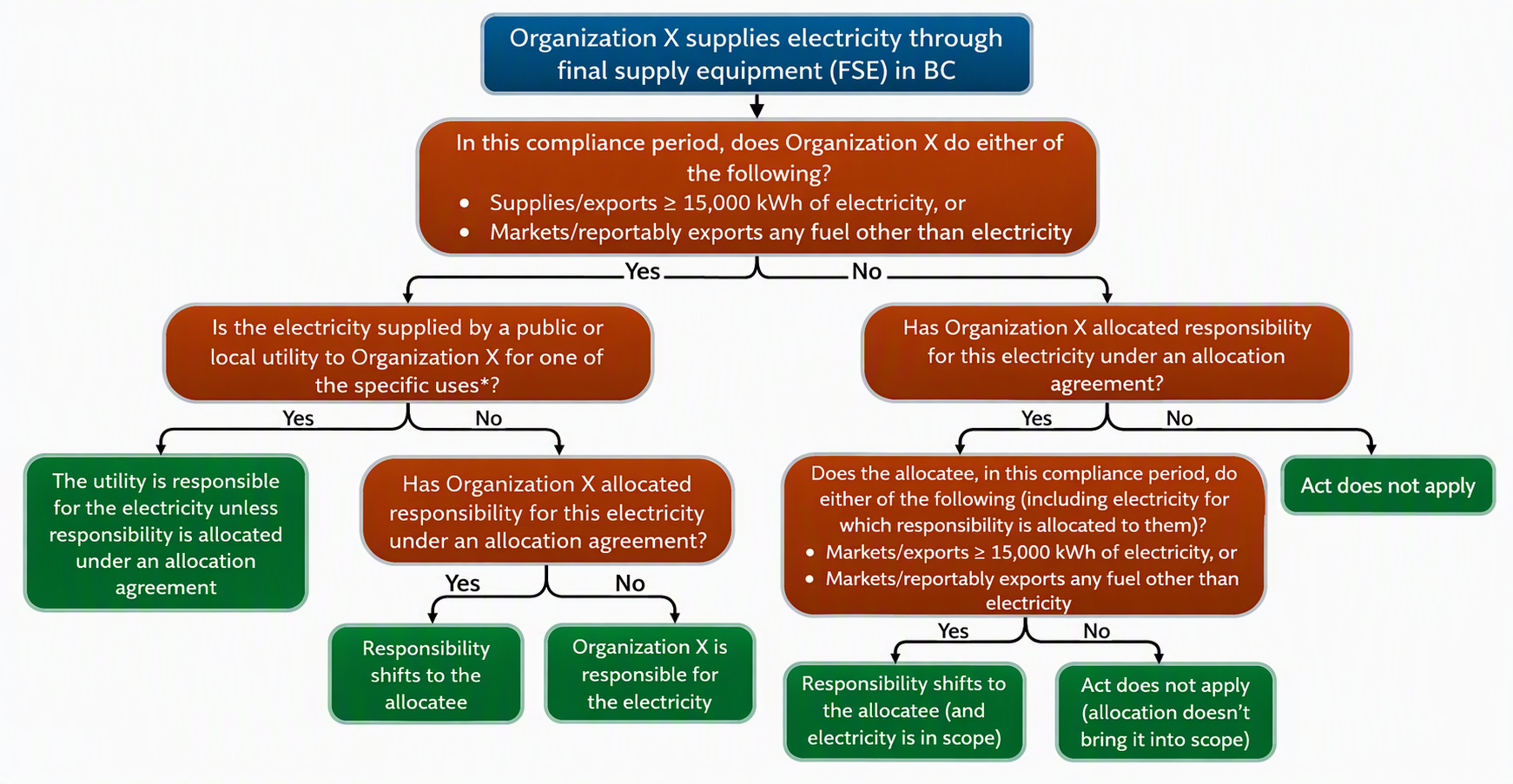
*Specific uses:
1) charging a vehicle at a residential building with fewer than 5 dwelling units, or
2) powering certain TransLink rail systems or trolley buses described in the legislation.
Figure 1. Responsibility for Electricity under the BC LCFS
Best practices for fuel documentation
Under section 35 of the Act, organizations must maintain records sufficient to verify the information required to be reported in a compliance report, along with other information, for 6 years after the relevant compliance period. These records must be provided upon request by the Ministry. Failure to provide appropriate records may lead to reassessments of compliance reports and may result in monetary penalties per section 38 of the Act and section 29 of LCFGR.
Fuel quantities
The quantity of electricity dispensed should be determined with reasonable accuracy. This can be achieved by installing FSE with data management capabilities or having a separate meter that records the total amount of electricity used only by EV chargers at a given location.
Where FSE with data management capabilities are used, the equipment must be capable of reliably calculating the total kWh delivered during each charging session based on measured electrical parameters. Calculations that rely on assumed, nominal, or user defined values in place of measured data will not meet the reasonable-accuracy requirement.
If electricity cannot be reported with reasonable accuracy, then the electricity should not be reported.
Transactional charge data is an important record type for verifying the quantity of electricity supply. It displays information per charge event (i.e., each time an EV is plugged into a charger dispensing electricity). See Table A: Example of Transactional Charge Data.
| Data heading: | Station Name | Start Date | End Date | Charging Time (hh:mm:ss) | Energy (kWh) |
|---|---|---|---|---|---|
| Example: |
123 Blue View Charger 01 |
2023-02-01 9:34 |
2023-02-01 15:54 |
6:18:47 | 25.029 |
The data shown in Table A is the minimum charge data the Ministry would expect to receive to verify reporting. Organizations reporting electricity should download and securely save the transaction data before submitting compliance reports to ensure access to the data is not lost, such as when changing service providers.
This information is for your convenience and guidance only and does not replace or constitute legal advice. It is recommended that parties who may be a fuel supplier review the Low Carbon Fuels Act, Low Carbon Fuels (General) Regulation and the Low Carbon Fuels (Technical) Regulation and seek independent legal advice to confirm their status, legal obligations and opportunities.