
Information Bulletin RLCF-023: Supplying Liquified or Compressed Natural Gas (LNG/CNG) in B.C.
 Last updated on September 29, 2026
On this page
1. Introduction
Provided the physical delivery requirement outlined below has been met, gaseous fuels become subject to the Act once they are compressed or liquified for use in transportation or other applicable purpose(s) prescribed in the Act.
Suppliers of gaseous fuels must report the annual quantity of fuel supplied in B.C. The ministry then uses this information to verify compliance and to calculate the compliance units the supplier generates (credits) or incurs (debits). The compliance unit calculation uses the carbon intensity (CI) of the supplied fuel. Suppliers must report either the default CI prescribed in section 10 of the Low Carbon Fuels (Technical) Regulation or the unique approved CI for the fuel (i.e. fuel code). For more information on CI see Information Bulletin RLCF-006: Carbon Intensity Records.
See Appendix A – CNG / LNG Flowchart
2. Physical delivery requirement
For a fuel to be “reportably supplied” in B.C. under section 6(2) of the Act, it must either be produced within B.C. and delivered to final supply equipment (FSE) in B.C. or, if produced outside the province, it must be physically delivered to B.C. This overarching requirement precludes the use of notional delivery as a means of supplying fuel to B.C. under the LCFS.
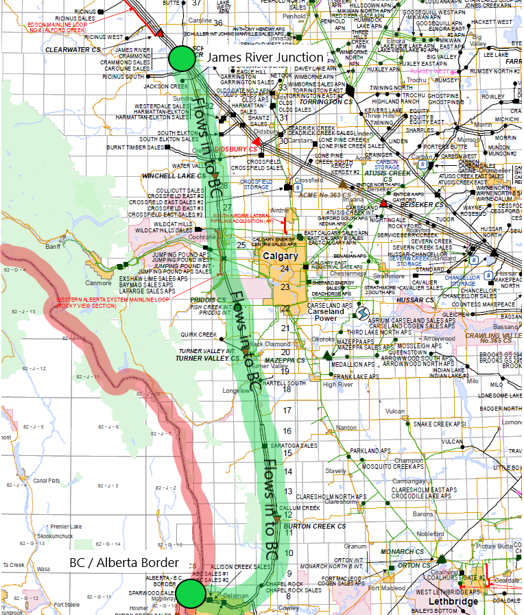
For pipeline delivery of natural gas occurring outside of B.C. into B.C. to be “reportably supplied,” the gas must be injected into a transmission pipeline, or receipt line that flows towards a transmission pipeline, that then flows into B.C. As of publication of this bulletin, the only transmission pipeline outside of B.C. meeting this requirement is the NOVA Gas Transmission Ltd. (NGTL) system’s Western Alberta System Mainline (WASML), south of the James River Junction.
3. Compliance reporting
Natural gas is a type B fuel under the LCFS. As such, the person who supplies it through final supply equipment for use in transportation or other applicable purposes is responsible for compliance reporting.
For more information on reporting responsibilities for type B fuels see Information Bulletin RLCF-009: Reporting Responsibilities for Type B Fuels.
4. Documentation requirements for CNG / LNG
To facilitate compliance verification of CNG or LNG supplied to B.C. from out of the province, the fuel supplier must retain documents containing the following information to confirm adherence to the physical delivery requirement:
- The point of injection, where the natural gas enters the pipeline or begins transportation under the specific contract
- The point of delivery, where the natural gas exits the pipeline, enters storage, or is no longer being transported under the specific contract
- Any limitations on the maximum quantity of gas that can be delivered in a specific period, for example, daily, monthly, yearly
Examples could include, but are not limited to:
- Monthly meter data for the injection point of the natural gas on the delivery pipeline
- Confirmed monthly pipeline nomination and scheduling reports for each pipeline and storage site along the delivery path
- Monthly invoices for the procurement of renewable or low carbon gas
- Contract(s) for the transportation of renewable or low carbon gas through the delivery pipeline; if no contract exists due to the ownership of the pipeline, alternative documentation may be submitted
- The natural gas procurement contract
Appendix A – CNG / LNG Flowchart
When CNG / LNG is reportably supplied
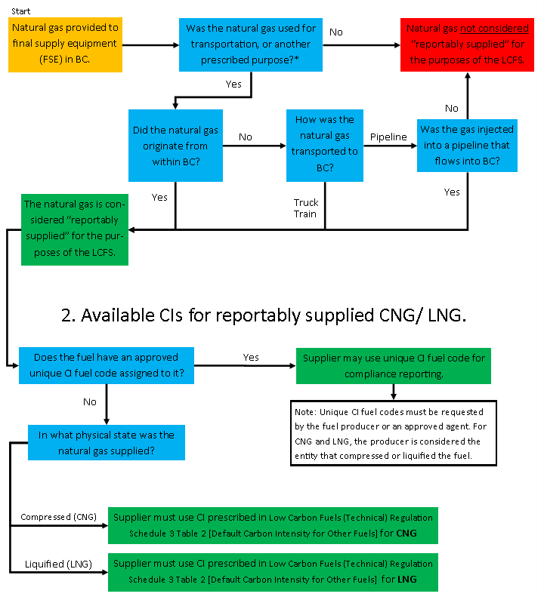
*Per Low Carbon Fuels (General) Regulation Section 2 (Applicable purpose)
Appendix B – Map of NGTL system’s WASML pipeline with flow into B.C.
The following map is an inset from TC Energy’s publicly available detailed NGTL system map at: https://www.tcenergy.com/siteassets/pdfs/natural-gas/ngtl-system/transcanada-ngtl-pipeline-system-map.pdf
This information is for your convenience and guidance only and does not replace or constitute legal advice. It is recommended that parties who may be a fuel supplier review the Low Carbon Fuels Act, Low Carbon Fuels (General) Regulation and the Low Carbon Fuels (Technical) Regulation and seek independent legal advice to confirm their status, legal obligations and opportunities.