
Information Bulletin RLCF-033: Reportable Exports and Reporting Requirements
 Last updated on November 19, 2026

On this page:
Background
Beginning in the 2024 compliance period, an organization may have reporting obligations in relation to fuel that is exported from British Columbia (B.C.). Whether an export is reportable is determined by the Low Carbon Fuels Act (LCFA) and regulations, including whether the fuel was previously marketed in BC for an applicable purpose1 and whether any exclusion applies.
When Fuel is a Reportable Export
A reportable export occurs when an organization exports fuel out of BC during a compliance period, and the fuel was previously marketed2 in B.C. for an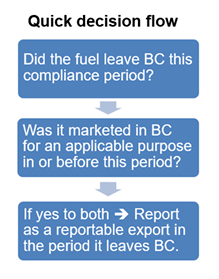 applicable purpose. This applies whether the marketing and export occur in the same compliance period or in different compliance periods.
Fuel that is transiting to other jurisdictions and has not been marketed in B.C. is not a reportable export under the LCFA and associated regulations. For example, a shipment of renewable diesel that is offloaded at a port in BC for use in another jurisdiction would not be considered a reportable export.
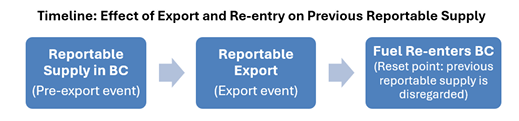
If fuel is reportably exported and later brought back into B.C., a reportable supply made before the reportable export is not considered for the purpose of determining whether the fuel has previously been reportably supplied. In practice, this means the earlier reportable supply is not counted when assessing whether the re-entered fuel has previously been reportably supplied.
Reporting Responsibility
An organization who reportably exports fuel in a compliance period is required to submit a compliance report for that period under the LCFA.
For each fuel that an organization reportably exports in a compliance period, the compliance report must include the identifying information for the fuel and the amount exported.
Considerations for Reportable Export
Organizations should consider the following impacts of reportable exports on their compliance obligations under the LCFA:
- Reportable exports are subject to the debit provisions under section 17 of the LCFA. The director may issue debits in relation to fuel that is reportably exported. The legislation does not provide for credits to be issued for export under that section.
- An organization is not eligible to submit an early issuance application if they have reportably exported, or intend to reportably export, fuel in that compliance period.
Calculating Debits on Reportable Exports
The calculation of debits for reportable exports is based on the supply of fuel calculation set out in section 13 of the LCFA, as modified for exports under section 17 of the LCFA and section 20 of the Low Carbon Fuels (General) Regulation. For reportable exports, the calculation applies as of the date the fuel is exported from BC.
For any reportable export, if the organization does not have a carbon intensity record for the fuel, the recorded carbon intensity for the export calculation is deemed to be the lowest carbon intensity that could have been recorded for that fuel in the 12 months immediately before the export date.
The additional carbon intensity attributed to use, if applicable, is determined as if the end use of the fuel were the same end use attributed to the fuel at the time of reportable supply. If the end use at the time of reportable supply is unknown, the additional carbon intensity attributed to use is zero.
Additional calculation considerations apply to Type B fuels:
- Target Carbon Intensity (TCI):
The TCI used in the calculation is the TCI for the fuel category to which the fuel was attributed at the time of reportable supply. If the fuel category at the time of reportable supply is unknown, the TCI for the diesel fuel category is used.
- Energy Effectiveness Ratio (EER):
The EER used in the calculation is based on the end use attributed to the fuel at the time of reportable supply. If the end use at the time of reportable supply is unknown, the highest EER prescribed in relation to the fuel under the Low Carbon Fuels (Technical) Regulation applies.
Activities Not Considered Reportable Exports
Fuel taken out of BC in the fuel tank, battery, or hydrogen fuel cell of a vehicle, train, vessel, or aircraft, or in a device necessary for the intended use of a vehicle, train, vessel, or aircraft, is not a reportable export because the Act does not apply in that prescribed circumstance.
1. “Applicable purpose” means transportation and certain prescribed non-transportation uses, including use in cargo handling equipment, ground support equipment, and forklifts.
2. A fuel is marketed by an organization in a compliance period only if it was reportably supplied in that period and the organization was responsible for the fuel at the end of the compliance date for that period. For more information, see Information Bulletins RLCF-003 and RLCF-009.
This information is for your convenience and guidance only and does not replace or constitute legal advice. It is recommended that parties who may be a fuel supplier review the Low Carbon Fuels Act, Low Carbon Fuels (General) Regulation and the Low Carbon Fuels (Technical) Regulation and seek independent legal advice to confirm their status, legal obligations and opportunities.