
Information bulletin RLCF-003: Compliance Reporting Requirements
 Last updated on October 8, 2026
Updates to the Renewable Fuel Requirements (February 2025)
On February 27, 2025, the Government of British Columbia announced changes to the renewable fuel requirements for the diesel and gasoline fuel categories. No changes were made to the renewable fuel requirements for the jet fuel category.
Renewable Fuel Target – Diesel Fuel Category
The renewable fuel target for the diesel fuel category is increasing from 4% to 8% for the 2025 compliance period and subsequent compliance periods.
Canadian Production Requirements – Diesel Fuel Category
Starting on April 1, 2025, the eligible renewable fuel required to meet the 8% renewable fuel target in the diesel fuel category must be produced in Canada.
Eligible renewal fuels marketed (supplied) for the diesel fuel category between January 1, 2025, and March 31, 2025, are not subject to the Canadian production requirement.
Marketers may rely on eligible renewable fuels marketed during the January to March timeframe to meet the 8% renewable fuel target for 2025.
Canadian Production Requirements – Gasoline Fuel Category
Starting on January 1, 2026, the eligible renewable fuel required to meet the 5% renewable fuel target in the gasoline fuel category must be produced in Canada
Background
Compliance with the Low Carbon Fuels Act (Act) and its associated regulations is the responsibility of the organization who markets fuel in British Columbia (BC). An organization markets fuel if it is reportably supplied in a compliance period, and the organization is responsible for the fuel at the end of the compliance period.
A fuel is “reportably supplied” when one of the following criteria is met:
-
fuel is used in BC;
-
type A fuel is supplied in BC by a person responsible for the fuel at the end of the compliance date for the period;
-
type B fuel is supplied in BC through final supply equipment
An organization that manufactures, imports, or supplies fuel is responsible for the fuel. However, the responsibility for a fuel may be transferred from one organization to another through an “allocation agreement” in accordance with section 7 of the Act (see Information Bulletin RLCF-015: Allocation Agreements).
Compliance Periods
All organizations responsible for a fuel subject to the Act are required to report to the Ministry of Energy and Climate Solutions (Ministry). The compliance period aligns with the calendar year, and compliance reports are due on or before March 31 following the end of the compliance period. Exemptions from renewable and low carbon fuel requirements are available if the supply of base fuels is below the prescribed threshold in a given compliance period, through the submission of an exemption application to the director (see Information Bulletin RLCF-005 Exemption Reports).
Renewable fuel requirements
Marketers of diesel, gasoline and jet fuel must ensure that they meet minimum renewable fuel content requirements, on an annual average basis, in the fuel category they supply during a compliance period. Marketers have the flexibility to vary blend percentages and can choose where in the province they supply renewable fuel as long as they meet the annual average requirement for renewable fuel content by fuel category.
The renewable fuel requirement is assessed against the total volume of “tracked fuel” marketed in a compliance period.
Tracked fuel is defined as:
- the base fuel for the fuel category (e.g., fossil-derived diesel, gasoline, or jet fuel),
- any fossil-derived components of that base fuel (e.g., fossil-derived naphtha, kerosene, etc.), and
- any eligible renewable fuel in the fuel category.
The renewable fuel target must be met with eligible renewable fuels. Eligible renewable fuels are prescribed under section 4 of the Low Carbon Fuels (Technical) Regulation as:
- Diesel fuel category: Biomass-derived diesel and biodiesel produced in Canada.
- Gasoline fuel category: Biomass-derived gasoline, biomass-derived ethanol, and biomass-derived naphtha produced in Canada (effective January 1, 2026).
- Jet fuel category: Biomass-derived jet fuel.
The renewable fuel target is 5% for gasoline and 8% for diesel. The renewable fuel requirement for the jet fuel category is 0% up to and including 2027, then increases to 1% in 2028, 2% in 2029 and 3% in 2030 and subsequent compliance periods.
Automatic administrative penalty rate for failure to meet renewable fuel requirements:
- 45¢/L for renewable content deficit in diesel fuel category
- 30¢/L for renewable content deficit in gasoline fuel category
- 50¢/L for renewable content deficit in jet fuel category beginning in 2028
Notional transfers of renewable fuel
Eligible renewable fuel by fuel category may be notionally transferred from one organization who markets the fuel to another who needs additional renewable fuel to meet its obligations in the compliance period. This transfer does not require a physical transfer of the fuel itself and is referred to as a notional transfer. Notional transfers must occur on or before the reporting deadline for the compliance period.
Retention of renewable fuel
An organization subject to the renewable fuel target in a compliance period may notionally retain a certain amount of its excess eligible renewable fuel. The amount that can be retained is up to 5% of the amount of eligible renewable fuel required. Organizations that are in compliance with the target have the option to retain excess renewable volumes.
Deferral of renewable fuel
An organization subject to the renewable fuel target in a compliance period that fails to meet that target, may defer a portion of the target. This deferral cannot exceed the lesser of the deficiency and 5% of the amount of eligible renewable fuel required. The deferred portion is added to the target for the next compliance period.
Low carbon fuel requirements
The low carbon fuel requirements apply to fuels marketed for transportation and other applicable purposes as prescribed in section 2 of the Low Carbon Fuels (General) Regulation. Each year, organizations subject to the low carbon fuel requirements must reduce the carbon intensity of fuel:
- The stringency of the low carbon fuel target for gasoline and diesel category fuels increases each year to reach a 30% reduction in carbon intensity by 2030, after which the 30% target remains in place for subsequent years
- The low carbon fuel target for the jet fuel category begins at 0% in 2024 and 2025, then increases 2% per year to reach a 10% reduction by 2030, after which the 10% target remains in place for subsequent years.
Positive compliance units (credits) and negative compliance units (debits) measure an organization’s compliance with the low carbon fuel requirements. Organizations subject to the low carbon fuel requirements must ensure that they do not have a negative balance of compliance units by March 31 after each compliance period, otherwise they will incur a penalty.
Credits are generated through the supply of low carbon fuels whose carbon intensity is below the low carbon fuel target, determined in accordance with the Low Carbon Fuels (Technical) Regulation (see Information Bulletin RLCF-006: Carbon Intensity Records). Credits may also be acquired from other organizations registered to participate in the credit market or through an Initiative Agreement (see Information Bulletin RLCF-013: Transfer of Compliance Units and RLCF-014: Projects Supported Under Initiative Agreements). Debits are incurred from the supply of fuel with a carbon intensity above the target.
Automatic administrative penalty for failure to meet low carbon fuel requirements:
$600 for each compliance unit below zero in an organization’s balance at the end of the compliance date for compliance period 2023 and onwards.
Low carbon fuel requirements – transportation
Low carbon fuel requirements apply to fuels marketed for transportation purposes. Transportation applications subject to the low carbon fuel requirements include on-road light-duty vehicles (e.g., cars, motorcycles), on-road heavy-duty vehicles (e.g., buses, trucks), fixed guideway systems (e.g., trains), marine vessels that primarily use fossil-derived gasoline or diesel fuel (e.g., ferries, fishing boats, tugboats), and aircraft that primarily use fossil-derived jet fuel (e.g., airplanes and helicopters with turbine engines).
Off-road applications that are considered transportation under the Act are limited to:
- haul trucks used in mining,
- yard trucks operated at ports and airports,
- specialized service vehicles at airports, including de-icers, lavatory service trucks, water service trucks, and sweepers, and
- on-road vehicles describe above that are used off-road.
Conveyor belts and other mobile equipment used primarily in industrial processes are not considered transportation under the Act.
Gasoline category fuel used in an aircraft is not subject to the Act per section 7 of the Low Carbon Fuels (General) Regulation. This includes aviation gasoline used in a piston or spark-ignition engine aircraft.
Organizations unsure about the applicability of the low carbon fuel requirements in specific applications should contact the Low Carbon Fuels Branch for clarification prior to submitting a compliance report.
Low carbon fuel requirements – non-transportation
Low carbon fuel requirements also apply to fuels reportably supplied for prescribed purposes other than transportation. These include certain types of equipment within the following prescribed non-transportation purposes:
- Cargo handling equipment: equipment used to move cargo within a port or other marine terminal,
- Ground support equipment: equipment used to service aircraft between flights, and
- Forklifts.
For more information on prescribed purposes other than transportation, see Information Bulletin RLCF-022 Prescribed Purposes other than Transportation.
Reportable Export
Any fuel reportably supplied in BC that is later transferred out of BC will need to be reported in compliance reports as a reportable export. For more information on requirements on reportable exports, see Information Bulletin RLCF-033 Reportable Exports and Reporting Requirements.
Compliance reporting
Compliance reporting is managed through the LCFS Portal. Instructions for obtaining an LCFS Portal account and the User Manual, which includes detailed guidance for filing compliance reports, can be found on the LCFS Reporting System page of the Renewable and Low Carbon Fuels website: http://gov.bc.ca/lowcarbonfuels.
For electricity supply compliance reporting, visit the Electricity page for additional information and submission requirements.
The Ministry will not accept compliance reports with inconsistent data. Paper copies of compliance reports will not be reviewed or accepted.
Responsible parties who wish to submit or update fuel supply information for past compliance periods should contact the Low Carbon Fuels Branch at lcfs@gov.bc.ca.
All reports submitted to the Ministry are confidential, per section 50 of the Act. Reported information is compiled in a confidential database and all information is held in a secure records management system.
Responsibility for Type A Fuel
An organization markets fuel in a compliance period if the fuel is reportably supplied during the period and the organization is responsible for the fuel at the end of the compliance period.
Figure 1 provides an overview of how reporting responsibility and the requirements applicable to Type A fuel are determined. The figure is for general guidance and should be read together with the Act and regulations.
Different rules apply to type B fuels, which are reportably supplied through final supply equipment. For more information, see Information Bulletin RLCF-009: Reporting Responsibility for Type B Fuels. For electricity-specific responsibility, see Information Bulletin RLCF-020: Electricity Supply and Reporting Requirements.
Figure 1. Responsibility for Type A Fuel under the BC LCFS
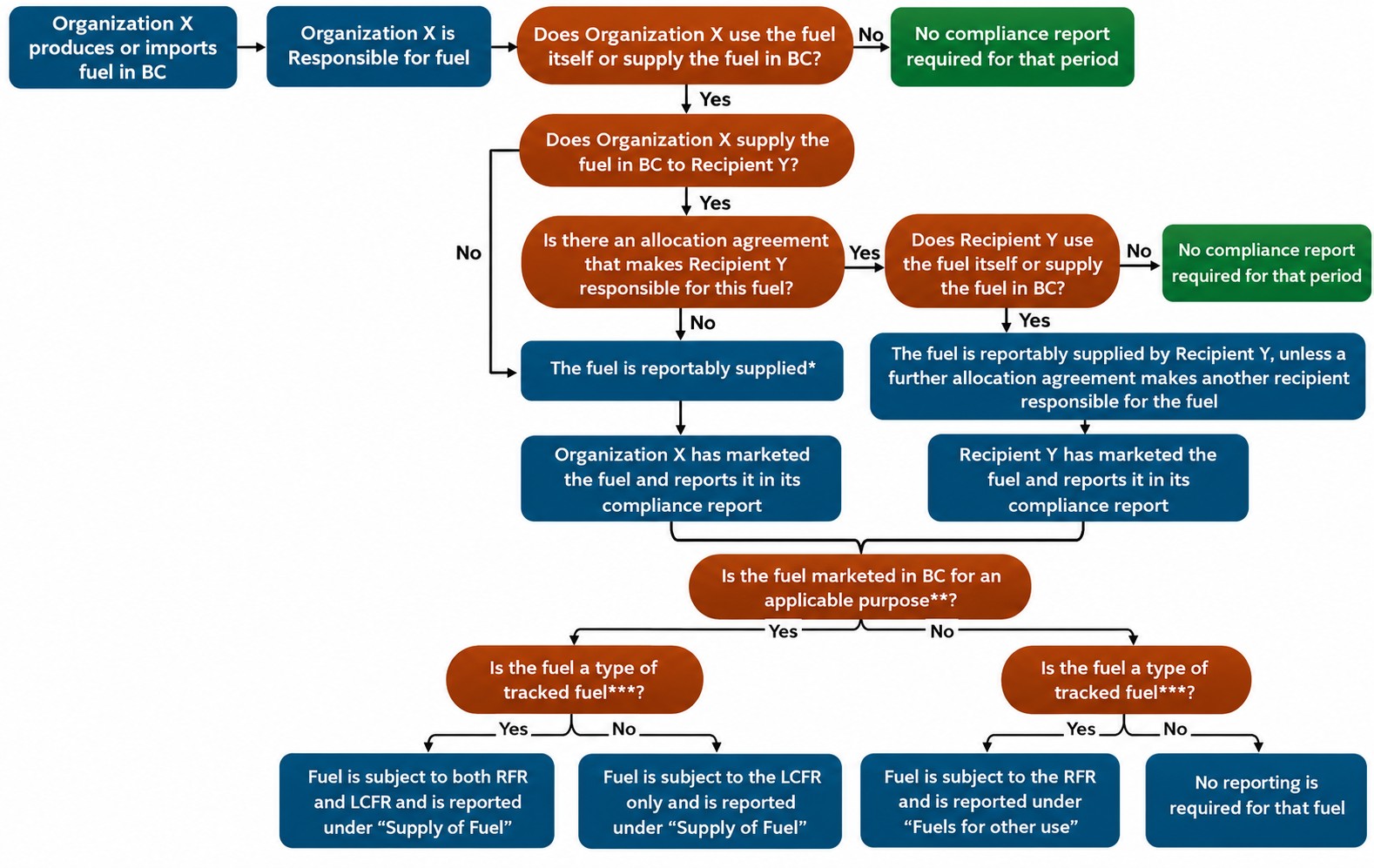
*For type A fuel, "reportably supplied" means supplied in BC in a compliance period by the person responsible for the fuel at the end of the compliance date of the compliance period.
**Applicable purpose:
- transportation;
- prescribed purposes (cargo handling equipment, ground support equipment, forklift).
***Tracked fuel: In relation to a tracked category, the base fuel for that category, fossil-derived components of that base fuel, and eligible renewable fuel in that category, where “tracked category” means the diesel fuel category, the gasoline fuel category, the jet fuel category, or a prescribed category.
This information is for your convenience and guidance only and does not replace or constitute legal advice. It is recommended that parties who may be a fuel supplier review the Low Carbon Fuels Act, Low Carbon Fuels (General) Regulation and the Low Carbon Fuels (Technical) Regulation and seek independent legal advice to confirm their status, legal obligations and opportunities.