
Add anchors to a CMS Lite webpage
 Last updated on September 21, 2026
Use anchors to link people to a specific section of a page. This is also called a jump link.
In CMS Lite, anchors appear as red flag icons in the text editor.
On this page
- How anchors work
- Choose an anchor name
- Create an anchor on the same page
- Create a link to anchored content on another page
- How to check a page's anchors
How anchors work
Anchors let you link people directly to a section of a page.
You can link to:
- An anchor on the same page
- An anchor on another CMS Lite page
- A specific page in a PDF
- A specific location in a PDF
Choose an anchor name
Choose a short, descriptive anchor name for the section:
- Use hyphens between words, not spaces
- Use lowercase letters
- Use the exact same name in the anchor and link
- Aim to keep names to three words or fewer
Anchor names are case-sensitive. Avoid uppercase letters. Using lowercase names helps prevent mismatches between the anchor and link.
For long headings, shorten the anchor name when you can.
Do not highlight the heading before creating the anchor flag.
Place the anchor flag before or after the heading. Do not highlight th
Anchor name examples
Good anchor names
- documents
- documents-you-need
- application-documents
- required-documents
Bad anchor names
- Documents
- documents you need
- required-application-documents-you-need-before-applying-for-the-grant
- heading2
Follow the UX guidelines for page anchors
Review the user experience (UX) guidelines for page anchors (PDF, 186KB)
Create an anchor on the same page
Create the anchor
To create an anchor to content on the same page:
- Navigate to the location on the page that you wish to jump to
- Select the Anchor
 icon on the toolbar
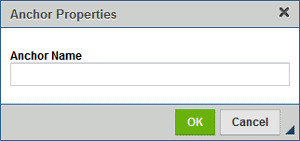
- The Anchor Properties box will be displayed
- Enter an applicable link name
- Click [OK] to complete the action
The Anchor Properties box will be closed and the anchor 'flag' will be inserted
Link to the anchor
Then, link to the anchor:
- Select the text or image that will be used to jump to the specified location
- Click on the Link icon in the toolbar
The Link box will be displayed
- Leave the Protocol default set to <other> and click in the URL field
- Enter the name of the newly created link, preceded by the #sign
Example: #anchor-name
- Leave the Target set to Same Window as per the Web Standard for Hyperlinks
- Click [OK] to complete the action
The Link box will be closed and the link will be displayed

Create a link to anchored content on another page
Create the anchor on the other page
To create an anchor to content on another page:
- Edit the page that you wish to link to from the anchor
- Navigate to the location on the page that you wish to jump to
- Select the Anchor icon on the toolbar
The Anchor Properties box will be displayed
- Enter an applicable link name
- Click [OK] to complete the action
The Anchor Properties box will be closed and the anchor 'flag' will be inserted
- Click [Save]
Link to the anchor on the other page
Then, link to the anchor that you created:
- Navigate to and edit the page that you wish to jump from
- Select the text or image that will be used to jump to the specified location
- Click on the Link icon in the toolbar
The Link box will be displayed
- Leave the Protocol default set to <other> and select the [Page Picker] action button
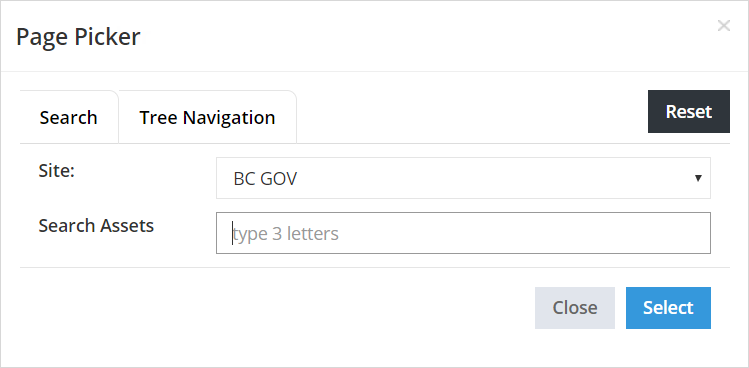
The Page Picker will be displayed
- Search or Navigate to the applicable page and click [Select] to complete the action
The picker will be closed and the Link box will be re-displayed
- Click in the URL field
- Using the keyboard arrow key or End key, scroll to the end of the URL and append with the # sign
- Enter the name of the newly created link, preceded by the # sign
Example: /gov/content/governments/services-for-government/service-experience-digital-delivery/web-content-development-guides/cms-lite-manual/ui-guidelines/text-editor/anchors#anchor-name
- Leave the Target set to Same Window as per the Web Standard for Hyperlinks
- Click [OK] to complete the action
The Link box will be closed and the link will be displayed
How to check a page's anchors
Even if you cannot edit the page you want to link to, you can still check whether its heading already has an anchor ID.
Check the 'On this page' section
- Look for an On this page section
- If the heading is listed, select its link
- Check that the page moves to the correct heading
- Look at the page address (URL). The anchor name appears after #
- Copy or note the anchor ID exactly as it appears
- Create the link using the anchor ID
Example of anchor id in page address:
The anchor ID in this address is choose-name:
https://www2.gov.bc.ca/gov/content/example-page#choose-name
Check the page code
Some anchors may not appear in the On this page section. You can also check the page code:
- Right-click the heading and select Inspect
- Find the heading in the code that opens
- Check whether the heading code is collapsed. An ellipsis (…) means some of the code is hidden. Select the right-facing arrow (▶) beside the heading to expand it.
Example of collapsed heading code:
▶ <h2 class="bc_h2">…</h2> == $0
- Look for id= or name= followed by an anchor id
- If you find an anchor ID, copy or note it exactly as it appears. If you do not find id= or name=, the heading does not have an anchor
- Create the link using the anchor ID
Example of heading code with an anchor:
▼ <h2 class="bc_h2">
::before
"Choose an anchor name"
<a id="choose-name" name="choose-name"></a>
</h2>
Example of heading code without anchor:
▼ <h2 class="bc_h2" dir="auto"> ==$0
::before
"Choose an anchor name"
</h2>