
PharmaCare Community Newsletter
 Last updated on July 20, 2026
 The PharmaCare Community Newsletter helps community organizations support their clients with BC PharmaCare coverage. It explains how B.C. residents can get the best PharmaCare coverage available to them.
On this page
- Welcome!
- Understanding BC PharmaCare
- Best first steps
- PharmaCare Coverage Compass now live!
- 6 tips to get the most out of your PharmaCare coverage
- Understanding Special Authority (SA) infographic
- PharmaCare e-learning module for nurses and staff working with seniors in long-term care
- BCCDC counterfeit pills infographic
A PDF version of this PharmaCare Community Newsletter is available to download and share.
PharmaCare Community Newsletter (PDF)
Welcome to the first PharmaCare Community Newsletter!
Covering your community
We’ve created this newsletter to help community organizations support clients with BC PharmaCare coverage. The newsletter will be published four times a year. It will share updates on PharmaCare coverage and programs.
Whether you work with youth, seniors, newcomers, low-income families, or people dealing with substance use disorders, you’ll find information and resources to help clients understand PharmaCare coverage and how to access it.
In each edition, you’ll find out who can get BC PharmaCare coverage, and how. We’ll include links to resources such as posters and FAQs to make sure you have the latest information to support your work.
If you have ideas for resources you can use in your community or organization, please get in touch. Send suggestions, comments or questions to the PharmaCare communications team at PharmaCareInfo@gov.bc.ca. We look forward to hearing from you!
Subscribe to the Community PharmaCare Newsletter so you don't miss an edition.
Kind regards,
BC PharmaCare Community Newsletter team
Feature article: Understanding BC PharmaCare
Since launching in 1974, PharmaCare has evolved from a single plan for seniors to 13 plans for people of all ages, incomes, and health needs.
Did you know?
PharmaCare helps B.C. residents pay for:
- Many prescription medications
- Many pharmacy services
- Some medical devices and supplies
What’s covered depends on the plan.
Each PharmaCare plan covers specific medications, medical supplies, or services for a defined group of people. One person can be covered under several plans.
When you fill a prescription at a pharmacy, the amount PharmaCare covers is calculated on the spot. You do not need to submit receipts, but you do need your Personal Health Number (PHN), found on your BC Services Card.
PharmaCare plans fall into four types:
- Universal – registration required for income based coverage
- Universal – no registration, 100% coverage
- Linked to other programs or organizations
- Specific to a health condition (or disease)
Universal – registration required for income based coverage
- Fair PharmaCare plan – coverage of thousands of medications and some medical devices and supplies
The Fair PharmaCare plan covers all B.C. residents that are enrolled in the Medical Services Plan of BC (MSP), with a $10,000 annual deductible. To receive coverage that matches their family income, they must register and consent to PharmaCare checking their income with the CRA. Coverage is based on family income through a higher or lower deductible and family maximum. The lower a family's income, the more help they get. A family can be a single person or a couple, with or without children. Review Fair PharmaCare Assistance Levels (PDF, 185KB) to learn how a family's net income is matched to deductibles and maximums.
Fair PharmaCare deductible: The amount a family pays on their own each year on eligible costs before PharmaCare pays 70% of eligible costs.
Fair PharmaCare family maximum: The most a family pays in a year on eligible costs on their own before PharmaCare pays 100% of eligible costs.
Register at: gov.bc.ca/ahdc or call 1-800-663-710 (more information below)
Universal plans – no registration, 100% coverage
All B.C. residents enrolled in MSP are automatically covered by these BC PharmaCare plans:
- Plan NP: National Pharmacare – 100% coverage of eligible contraceptives, diabetes medications and supplies, and menopausal hormone therapy
- Plan Z: Assurance – 100% coverage of medications for opioid use disorder, medical abortion, and medical assistance in dying (MAiD)
- Plan M: Medication Management – 100% coverage of some pharmacy services, such as vaccinations and minor ailment assessments
People present their BC Services Card and prescription at a pharmacy for a covered medication, and they pay nothing.
Plans linked to other programs or organizations
Some B.C. residents are automatically covered under these plans:
- Plan B: Long-term Care – 100% coverage for people living in long-term care facilities that offer Plan B
- Plan C: Income Assistance and Family Services – 100% coverage for people:
- receiving assistance through the Ministry of Social Development and Poverty Reduction (SDPR)
- in the care of the Ministry of Children and Family Development (MCFD), including by agreement
- in the care of an Indigenous Governing Body (IGB)
- arriving in Canada (B.C.) through the Canada-Ukraine authorization for emergency travel (CUAET)
- Plan F: Children in the At Home Program – 100% coverage for children with complex disabilities enrolled in the MCFD At Home Program
- Plan W: First Nations Health Benefits – 100% coverage for people enrolled with the First Nations Health Authority
Plans specific to a health condition (or disease)
Some plans support people with particular medication or treatment needs, such as:
- Plan D: Cystic Fibrosis – automatic with enrolment in a provincial cystic fibrosis clinic. Provides 100% coverage of eligible digestive enzymes through Plan D and other approved CF-related products through their primary PharmaCare plan
- Plan G: Psychiatric Medications – a health provider registers a client when income is a barrier to getting critical mental health medications. Provides 100% coverage of eligible psychiatric medications
- Plan P: Palliative Care – a health provider registers people who consent to palliative treatment. Provides 100% coverage of eligible medications
- Plan X: British Columbia Centre for Excellence in HIV/AIDS – automatic with enrolment in the HIV/AIDS drug treatment program provided through the Centre for Excellence
- Plan S: Smoking Cessation Program – available to people who wish to quit smoking. Clients sign up at the pharmacy for 100% coverage of nicotine replacement therapies (patch, gum, lozenges) or prescription smoking cessation medications through their primary drug plan
Best first step
For most residents of B.C., the first and most important step for medication coverage is to register for the Fair PharmaCare Plan. Coverage is based on family income. Families with lower incomes receive more help in the form of a lower or no deductible.
Everyone is encouraged to register. Coverage is for life; however, you do need to file your income taxes every year to get income-based coverage. This is the only plan that people register for on their own. Many third-party insurance drug plans require people to be registered for Fair PharmaCare before they will pay their share of prescription costs.
- Register for Fair PharmaCare online at gov.bc.ca/ahdc, or call us at 1-800-663-7100. You can also mail the paper Application for Health and Drug Coverage (PDF,1,392 KB)
- Sign and return the consent form that will arrive in the mail. This allows the Canada Revenue Agency to check your income every year. This step is critical.
- Keep filing taxes for coverage that matches your income.
The PharmaCare Help Desk offers support in more than 140 languages. Call 1-800-663-7100
PharmaCare Compass: Find your BC PharmaCare coverage

PharmaCare has 13 plans that help B.C. residents pay for prescription medications, medical devices and supplies, and pharmacy services. One person can be covered by several plans. For most plans, a person must be enrolled in MSP
If you are not sure which PharmaCare plans your clients qualify for, try using the PharmaCare Compass, a quick, simple online resource that guides you through coverage options. It shows which plans people are automatically enrolled in, and which require registration.
Staff can guide clients through 10 simple questions to help them check which benefits they may qualify for and make sure they aren’t paying more than they need to for prescriptions. Try the PharmaCare Compass today at gov.bc.ca/pharmacarecompass
The PharmaCare Compass is also available for download as a printable flowchart: PharmaCare Compass (PDF, 227 KB).
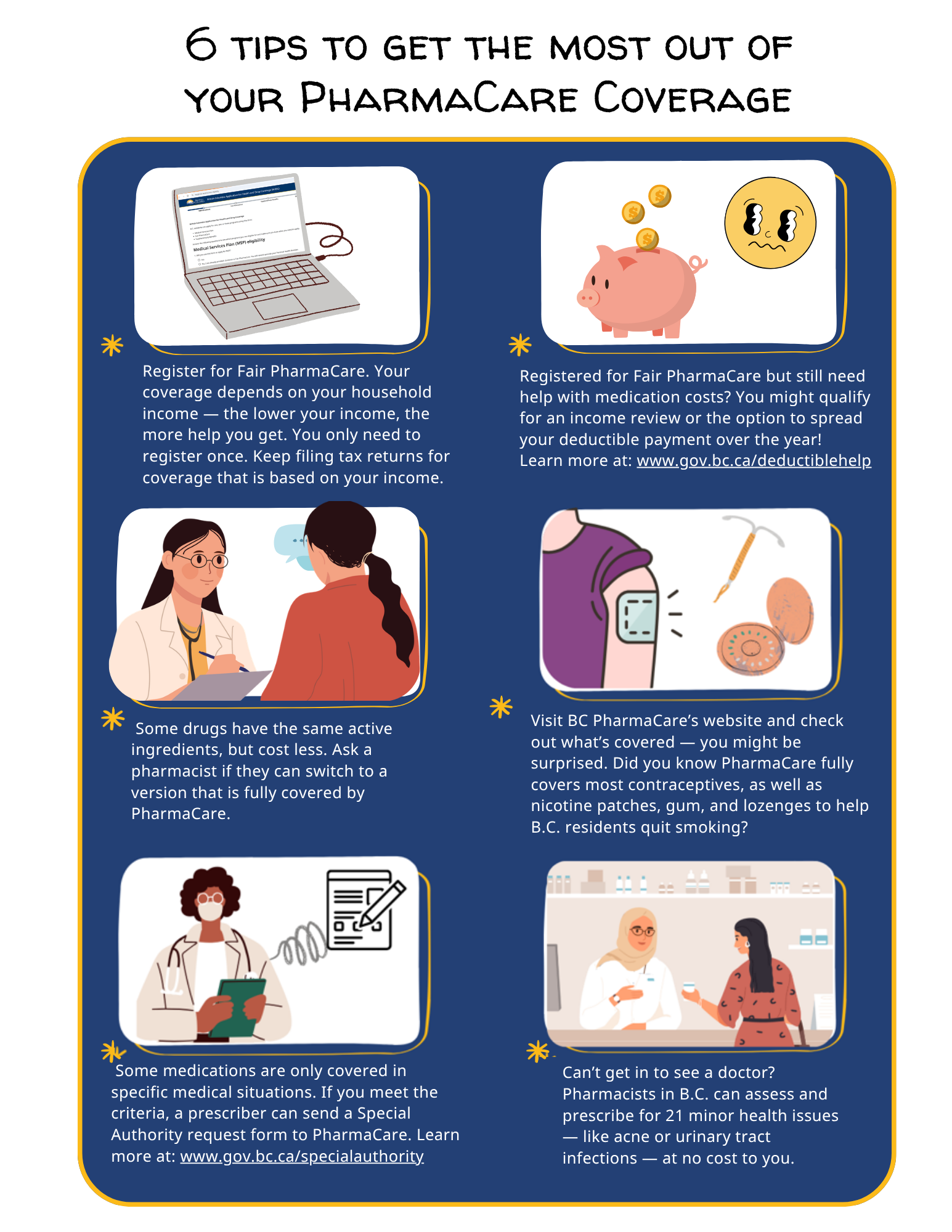
6 tips to get the most out of your PharmaCare coverage
Read 6 tips to help you and your clients get the best PharmaCare coverage possible. Download a copy of 6 quick tips to get the most out of your PharmaCare coverage (PDF, 1.2MB).
What is Special Authority (SA)?
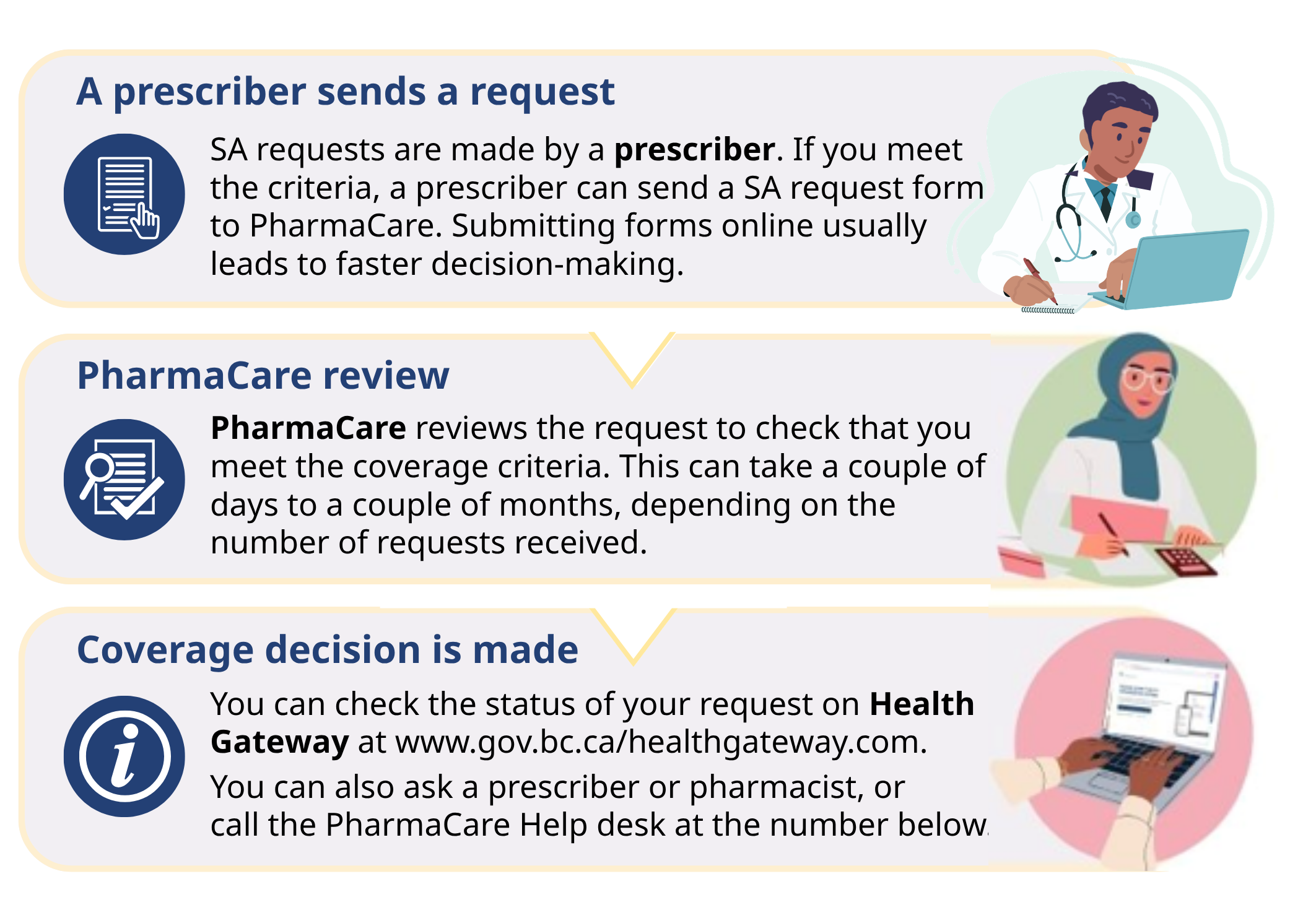
For most benefits, a person presents their eligible prescription at a pharmacy and it is covered under their coverage plan. But for some items, a health professional, like a doctor or sometimes a pharmacist, has to request Special Authority (SA) coverage. They submit a form showing that you meet the medical criteria for coverage.
SA coverage may pay some or all of the cost of a medication. Coverage starts the day a SA request is approved. Coverage is not retroactive. It takes about two weeks to find out of the request is approved. If you need medications in the meantime, these won't be covered. Consider asking the pharmacist for a small dispense.
Check the list of SA drugs and devices at:
If you are prescribed a drug or device that needs SA approval for coverage, check the criteria and talk to a prescriber to learn more.
How much does SA cover?
If your request is approved, your usual PharmaCare plan rules still apply.
- If you are on a 100% coverage plan (like Plan NP, Plan C, Plan W, or Plan G), and the drug is fully covered under that plan, you won’t have to pay
- If your only plan is Fair PharmaCare, you may still need to pay all or part of the cost until you reach your deductible and family maximum
How it works
My request was approved
When does my coverage start?
Coverage starts when it is entered into the system (PharmaNet). PharmaCare cannot cover prescriptions you purchased before the SA approval (no retroactive coverage).
Does my SA coverage end?
Some coverage lasts a set time (for example, six months). Other coverage has no end date. If yours has an end date, a prescriber may be able to re-apply before it expires.
My request was not approved
Why wasn’t my request approved?
Not all requests are approved. This could be because:
- You do not meet the criteria, or
- PharmaCare needs more information from your prescriber, or
- The product is not covered by PharmaCare
What can I do?
Talk to your prescriber about the decision. If needed, a prescriber can fax an appeal with supporting details to 1-800-609-4884
Need help?
Staff at our Help Desk can answer your questions in over 140 languages.
- Call us toll-free: 1-800-663-7100
- Monday to Friday 8 am – 8 pm
- Saturday 8 am – 4pm
- Telephone for the deaf: Dial 711
Download and share the Special Authority Understanding Special Authority poster (PDF, 234 KB), or Special Authority infographic (JPG, 356 KB).
PharmaCare e-learning module for nurses and staff working with seniors in long-term care
PharmaCare has launched an e-learning module for nurses and staff working with seniors in long-term care. The module Helping Residents Maximize PharmaCare Coverage offers practical guidance on how to help residents get the most from their drug coverage. In plain language, the module explains PharmaCare coverage plans, tips for navigating Special Authority and other PharmaCare programs, and ways to reduce medication costs for residents and families.
The module is hosted on the Ministry of Health’s Health and Human Services Library, free of charge, and does not require login or enrolment. The module is non-accredited, self-paced, and designed to support “on the go” micro-learning.
Future modules are being developed for community navigators and people supporting newcomers, youth, and low‑income families.
Access the training here: https://hhslibrary.libguides.com/ltc-pharmacare
Download and share the poster: Free e-learning for nurses and care providers (PDF, 359.3 KB)
BCCDC counterfeit pills infographic
The BC Centre for Disease Control (BCCDC) has created an infographic, Fake Pills Are Increasing in BC (PDF, 192KB), to raise awareness about counterfeit pills. We encourage community workers to share this resource with clients when appropriate. Counterfeit pills circulating in B.C. have been found to contain strong opioids and other harmful substances that can cause drug poisoning. These pills can look exactly like prescribed medications.
Fake pills sold on the streets and online commonly appear as oxycodone, alprazolam (Xanax), hydromorphone (Dilaudid), Percocet, or amphetamine (Adderall).
If appropriate for their clients, community organizations can help by:
- Sharing or displaying the infographic in spaces clients use
- Talking with clients about naloxone, and offering them naloxone kits and training
- Referring clients to their clinician or to helpstartshere.gov.bc.ca to learn about recovery supports
- Providing harm reduction information, including safer substance use education
- Advising people that the safest option is to avoid taking pills that are not prescribed to them
People who are at risk of consuming counterfeit pills are encouraged to:
- Use drug-checking services
- Carry a naloxone kit, and only use with someone who has naloxone and is trained to administer it
- Access overdose prevention services, like:
- Local overdose prevention sites
- Virtual overdose prevention services, such as National Overdose Response Service (NORS) or the Lifeguard App
- Signing up for toxic drug alerts by texting JOIN to 253787 ("ALERTS")
Resources


About the PharmaCare Community Newsletter
PharmaCare community newsletters are published quarterly. Newsletters communicate PharmaCare policy updates, and other pertinent information for B.C. residents.
Subscribe
Enter your email address to subscribe to updates of this page.
 The PharmaCare Newsletter team works from the territory of the Lekwungen People, including the Songhees and Esquimalt Nations. Our gratitude extends to them, and all the Indigenous Peoples on whose territories and lands we build relationships.