Source water
 Last updated on February 10, 2026
Learn about the waterbodies and groundwater aquifers that supply our drinking water.
On this page
- About source water
- Drinking water sources map
- Care for and maintain your groundwater well
- Care for and maintain your surface water source
- Source water protection
- Source water hazards
About source water
Source water is where drinking water comes from. There are two categories of source water: surface water (rivers, creeks and lakes) or groundwater (aquifers). Protecting source water is the first layer of protection to help ensure there is enough safe drinking water for everyone.
Drinking water sources map
The Drinking Water Sources in B.C. Map lets you view drinking water systems, source areas and protection zones in B.C.
Mapping the location of drinking water systems and source water areas is essential to inform source water protection and emergency response (such as drought, floods, wildfires, and spills).
The map shows the locations of intakes and wellheads for drinking water systems and the source areas supplying those systems. The map currently displays the portion of all the drinking water systems in B.C. for which data have been validated. It is continually being updated as more information becomes available.
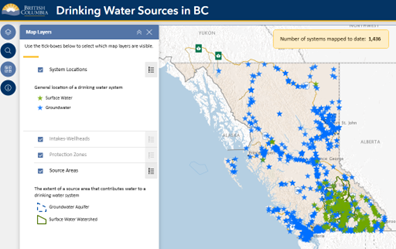
How to read the map
- Water system location: General location of a drinking water system (i.e., any domestic system servicing anything other than a single-family dwelling)
- Intake and/or wellhead location: Location of intakes and/or wellheads for each water system
- Source area: The geographical extent of a source water area that could contribute water to a water system. These source areas most often represent the entire aquifer (for groundwater systems) or the watershed upstream from the intake (for surface water systems)
- Protection zone: Zones of protection around water system intakes/wellheads; these are delineated using a variety of different methods as described in their corresponding report. Protection measures should be considered and/or implemented in these areas due to the importance of these areas supplying drinking water to their water system users. Protection Zone does not mean that protection measures have been implemented in these areas, nor that protection measures are not required beyond the boundary of these areas
Visit the B.C. Data Catalogue to download the data and access more information about the drinking water sources dataset and map:
- Drinking Water Sources – Intakes and Wellheads
- Drinking Water Sources – Source Areas
- Drinking Water Sources – Protection Zones
Care for and maintain your groundwater well
Does your drinking water come from a private groundwater well? Owners of properties that depend on well water are responsible for ensuring proper care of their well and testing the water quality.
Taking proper care of your well can help ensure that you have a safe and sustainable water supply.
Care for and maintain your surface water source
Does your drinking water come from a surface water source? Surface water quality stewardship is important to help protect the surface water source.
- Learn more about surface water quality stewardship and monitoring
- Tips to keep your lake healthy
- Understanding water quality results
- Technical guidelines for designing and implementing a water quality monitoring program (PDF, 6.5MB)
- Technical guidelines for interpreting water quality data: surface water (PDF, 6.8MB)
Source water protection
Learn how B.C. protects the availability and quality of our source water.
Source water hazards
Both natural processes and human related activities can be potential hazards for drinking water sources. Hazards can be related to contamination or the amount of source water available.
Climate change
Climate change is causing changes to source water quality and availability through events like increased wildfires and drought.
Wildfire
Wildfires can add nutrients, metals, and other contaminants to nearby groundwater and surface water:
- Wildfire and its effects on drinking water quality
- Property owners impacted by wildfire contaminants (PDF, 1.1MB)
- Fire retardants used to fight wildfires (PDF, 101KB)
Drought
Drought decreases source water availability and can also negatively impact source water quality:
- Drought and water scarcity
- Dealing with Drought and Water Scarcity: A Handbook for Water Suppliers in B.C
- View information about drought and how it may impact your source water
- Groundwater wells and drought preparation (PDF, 420KB)
- Watch videos and learn more about water conservation
Flooding
Flooding can cause contamination of surface water and groundwater wells used for drinking:
Septic systems
Improper maintenance of an onsite sewage system like a septic tank could contaminate the groundwater or surface water that you and your neighbors use for drinking:
- Onsite sewage system resources
- How to find a septic tank (PDF, 598KB)
- Fact Sheet: Onsite Sewage Systems (PDF, 180KB)
Algae blooms
Higher air temperatures and extreme heat can change source water quality and increase the number and intensity of algae blooms on lakes:
Saltwater intrusion
When saltwater is drawn into a freshwater aquifer, groundwater wells used for drinking can become unusable:
Additional source water resources
Subscribe
Enter your email address to subscribe to updates of this page.