
Step 2: Planning
 Last updated on February 26, 2026
Once you’ve done your research and chosen markets, it’s time to make a clear plan. A solid plan not only boosts your chance of success but is often required if you apply for funding or loans.
On this page
Market entry strategy
Plan to enter the market you've identified with a clear strategy.
A market-entry strategy is the plan for how you will start selling products in a new market. To avoid pitfalls, consider the path that your product will take to reach the customer.
Supply chain and logistics
Supply Chain Management (SCM) organizes all steps to get a product from its source to the customer. It allows products and services to flow smoothly from suppliers to customers, cutting costs, delays, and waste. It makes your product more competitive, reliable, and resilient.
Most food products are perishable, meaning they lose quality and spoil over time. To avoid this, you need to plan for the efficient and safe movement of the products.
Food producers often use other companies to help with supply chain and shipping. Choosing the right supply chain partner helps your product arrive on time and in good shape.
Identify a distribution channel
This is the path that products take to get from the manufacturer to the end consumer. The path is unique for different business types.
Two common distribution channels are:
Business-to-business (B2B) distribution channels
Sell your products to other businesses, instead of direct to customers. These businesses buy your products and resell them for a profit or sell them on your behalf. Examples include distributors, wholesalers, agents, and brokers.
Business to consumer (B2C) distribution channels
You sell your products direct to consumers. There’s no middleman involved. You can sell through your own website or use an online store that re-sells your products.
Customs clearance planning
Customs clearance is a must for goods entering or leaving a country. It makes sure the right taxes and fees are paid, and the country's rules are followed.
Shipping goods between countries is easy if you're well-prepared. You can take care of a foreign country’s customs procedures by yourself. Still, the most common problem with export shipments is wrong or incomplete paperwork. This often leads to delays in entering the destination country. Because of this, experts recommend working through a customs broker.
A customs broker is a licensed expert. They assist importers and exporters in meeting customs requirements for clearing goods. They serve as your link to border control agencies, including the Canadian Border Services Agency (CBSA). They handle paperwork and make sure that you follow all the rules. This helps your goods arrive on time and avoid extra costs.
Am I ready?
Understand if people want your product in the new market. Ask yourself:
- What makes my product different or better?
- Are similar products already sold there?
- Do I have an advantage over local competitors?
- Can I raise quality, lower cost, or offer something unique?
- Do I need to change the product to fit local tastes or rules?
If you need support answering these questions or building your strategy, these provincial programs can help:
Export Navigator
British Columbia’s Export Navigator program offers free guidance to help you develop your export plan and find the right services.
Trade Accelerator Program (TAP)
The Trade Accelerator Program (TAP) helps businesses scale up and overcome export barriers through training and mentorship across fields such as legal, finance, global sales & marketing, taxation, logistics, etc.
Product positioning
Product positioning is how a company describes the special role its product plays in the market and how customers see it. It helps customers see why a product is their best choice.
To help with positioning your product, aim to offer the right product, in the right place, at the right price.
The following practical elements will help with product positioning.
Pricing and costing
Smart pricing is one of the most important factors in export success. You need to set a realistic export price based on a good profit margin. Factor in production costs, delivery and distribution costs, competition, and market demand.
Also consider:
- Currency and exchange rates
- Insurance
- International postage
- Phone and internet
- Costs for local representatives: translation, commissions, training, consultants, shipping
- Duties, taxes, and tariff factors
Volume planning
Plan for the volumes you want to export. Ask yourself:
- What is the demand for your product?
- Can you increase your production to meet this demand?
Effective market research shows you how much of your product you can sell in your target market. You can adjust your production volumes based on this information.
Another element of volume planning is figuring out the timing of production. If you sell food products, fresh produce might only be available at certain times. Also, you might need to sell your final product within a set timeframe. This is important to consider.
Intellectual property
Intellectual property (IP) are legal rights that protect various ‘creations of the mind’, such as inventions, brand names, and designs. They are registered for use in a specific country.
Two important types of IP rights are trademarks and patents. For example, the name “Coca Cola” is a trademark, and the recipe for making Coca Cola is a patent.
Fact sheet - Trademarks
Fact sheet – Patents
Intellectual property violations in the destination country can affect product positioning. Make sure that your product, brand, or idea doesn’t violate any trademarks or patents.
Risk mitigation strategy
A risk mitigation strategy is a planned approach to:
- Identify risks,
- Reduce their chances of happening, and
- Minimize their impact.
Exporting has risks, but you can prepare for them and deal with problems when they happen.
Some common risks include:
Market risks
Risks related to the market include:
- Currency changes
- Changing taxes and trade barriers
- Changing customer preferences
Avoid market risks by doing good research before you start exporting.
Credit risks
Credit risks include:
- Not getting paid by new customers
- Receiving payments later than expected
- Needing more money than expected to cover costs
Use the right payment methods, like Letters of Credit, to avoid credit risks. Also, get credit risk insurance from a reliable institution.
Export Development Canada (EDC) is a valuable resource to help Canadian companies grow abroad. They offer trade support and various products to lower financial risks.
Compliance risks
Compliance risk is the risk of legal penalties, financial loss, or harm to reputation. It happens when an organization doesn’t follow laws, rules, standards, or its own policies. There is a risk that you may not know about specific rules that apply to your product.
You can reduce compliance risk by doing thorough research into potential paperwork burdens.
Some research tools are provided below.
Trade Commissioner Service of Canada (TCS)
The Trade Commissioner Service of Canada (TCS) is a federal government program that helps Canadian companies expand into international markets.
International Trade Centre’s market access map
The market access map of the International Trade Centre (ITC) is a helpful tool for researching import rules, product standards, and licensing needs of different countries.
Government of Canada’s trade data online
The Government of Canada’s trade data online is a database of export products, showing which countries import various products from Canada.
Political and other risks
Political and social factors are key in how consumers spend money in new markets. Look into these risks to make better exporting decisions.
Political risks:
- Government instability: changes in leadership, corruption, and red tape
- Policy changes: Possible shifts in trade policies, tariffs, or import rules
- Trade restrictions: Authorities may impose new limits on imports
- Security risks: Civil unrest could disrupt supply chains
Social risks:
- Cultural differences: confusion about local customs, values, or consumer preferences
- Labour issues: strikes and shortages in the local workforce
- Reputational risk: risk of negative perceptions of foreign companies
- Demographic changes: Changes in population age, income, or lifestyle
Funding and financing
Why do I need funding and financing?
You need funding and financing to get capital for your development. The most common way is to get a loan from a bank.
Funding
How you'll pay for your new export business. Use your savings, profits from your local business, or grants from the government.
Financing
Borrowing money from a bank or other financial institution.
Why capital matters
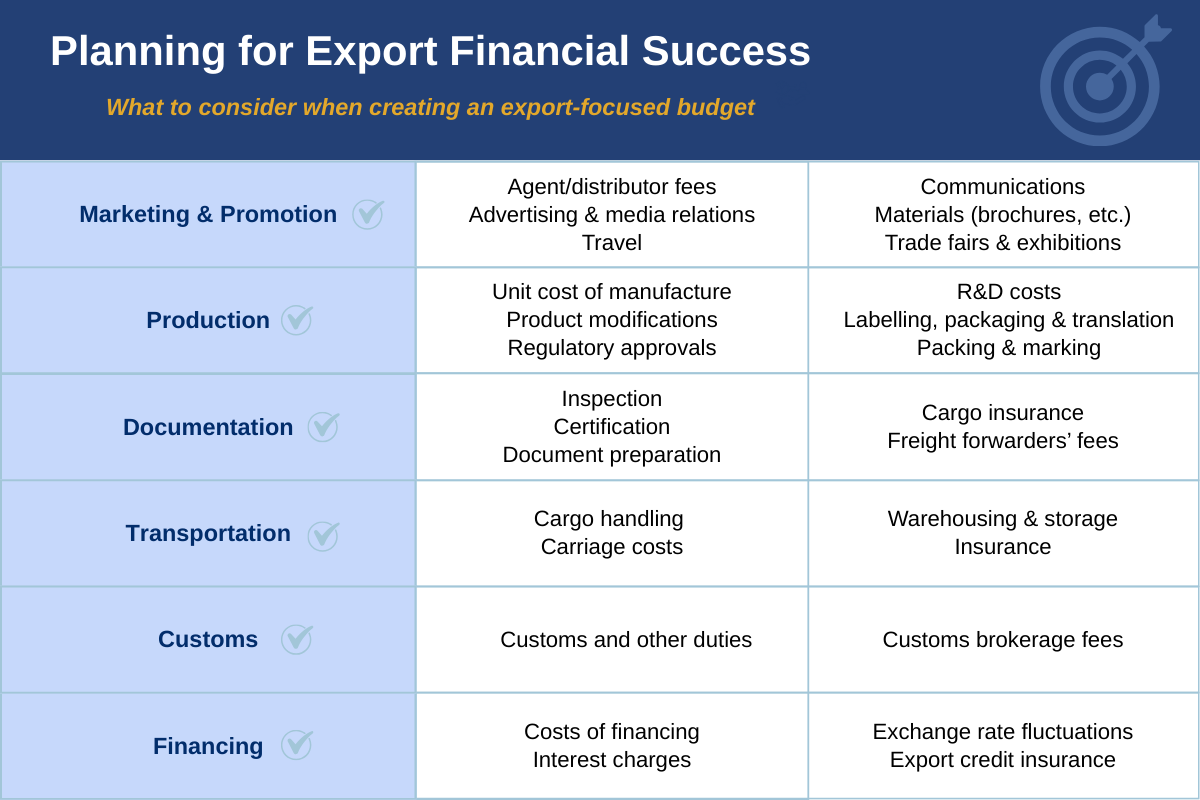
Entering a new market comes with many costly challenges:
- Increased production cost
- Delays in receiving payments
- Additional service providers required, such as brokers, agents, and freight forwarders
- Additional costs of shipping, logistics, and compliance
- Variations in exchange rate
Capital matters, because you need access to cash that will help you adapt to new challenges. You also need cash flow available. The timing of money coming in and going out can be unpredictable.
A good budget shows your financial needs based on what you expect to earn and spend.
Where to find funding and financing
You can get a loan from a commercial bank. You can also apply for one at a financial institution that focuses on export loans. Additionally, check if there are specific products available from specialized institutions such as Export Development Canada (EDC) and the Business Development Bank of Canada (BDC).
Export Development Canada (EDC)
EDC is a valuable resource to help Canadian companies grow abroad. They provide various products, including access to credit, insurance, funding, guarantees and bonds.
Business Development Bank of Canada (BDC)
BDC supports small and medium-sized businesses in Canada with financing, capital, advice, and resources.
Trade Commissioner Service of Canada (TCS)
TCS is a federal government program that helps Canadian companies expand into international markets. They can help identify potential options.
How to collect international payments
Once you’ve planned how to fund your project, consider how customers will pay you. In international trade, there are several ways for customers to pay invoices.
Cash in advance
This is the safest option, because the buyer pays you before you send the product. However, most buyers would not agree to pay you in advance, because it is too risky for them.
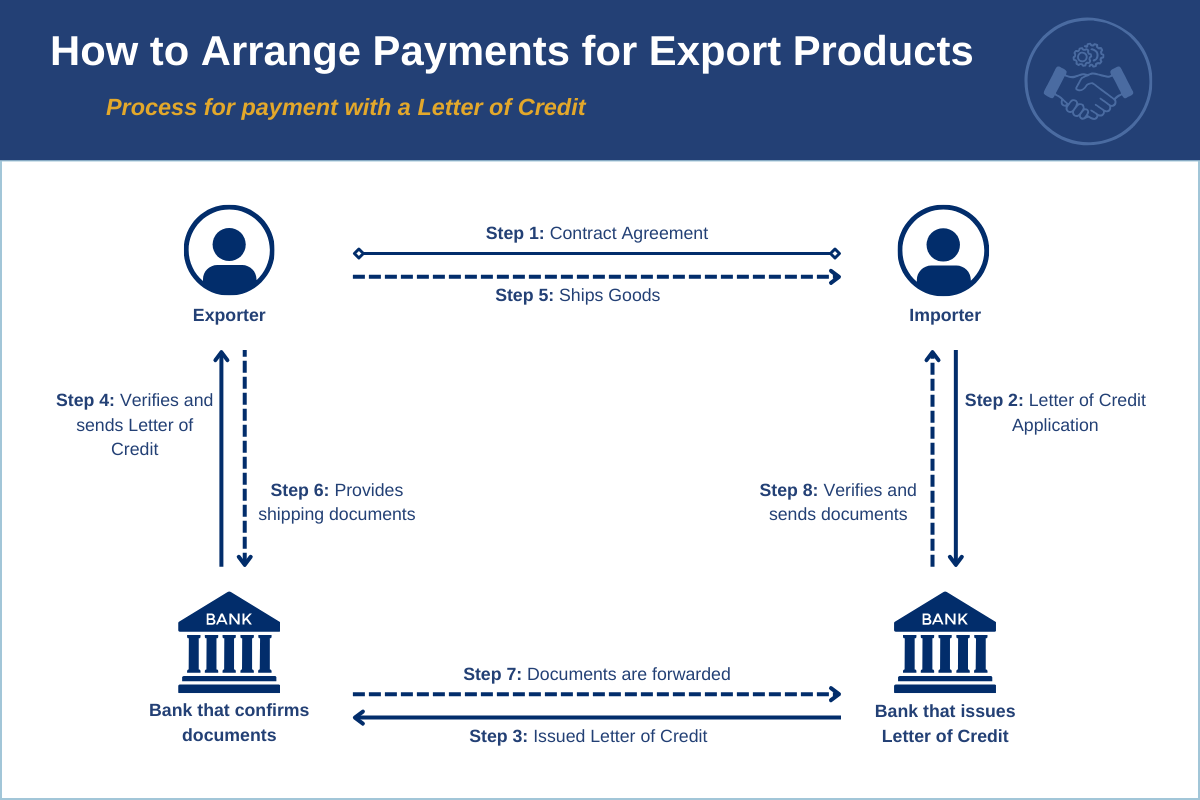
Letters of credit
When using Letters of Credit (L/Cs), you send your products to the logistics company. They give the customer’s bank a document to confirm the products are ready for shipping. Once the customer’s bank gets the shipping documents, it guarantees payment. This happens when the buyer receives the products.
A variation of this process is a documentary credit that requires a sight draft. This means the exporter gets paid when they present the documents to the bank. Another option is a documentary credit. This can allow payments to happen in 30, 60, or 90 days, or on another set future date.
Documentary collection
A documentary collection process is like the L/C process. But the bank only confirms receipt of the documents. It does not guarantee payment.
Open account
An open account requires you to ship the products before the customer pays you. Usually, the customer has 30, 60, or 90 days to pay you once you have shipped the products. If the customer decides not to pay, you will face the financial loss. This means you must cover the cost of shipping the item back. If you pick this payment method, ensure you have enough credit risk insurance. This way, you’re protected if your customer doesn’t pay.