
Step 3: Prepare for market
 Last updated on February 26, 2026
If your plan looks solid and you want to move ahead, the next step is to prepare your product for export.
These actions will help you start exporting your products successfully.
On this page
Product preparation
The next phase in getting your product ready for the market.
Useful links:
Trade and Invest BC - Connect with provincial trade experts who can help you navigate regulations and prepare your product for specific markets.
Labelling and packaging
When you know the labeling and packaging needs for your product, it is time to find service providers. They can help you create the labeling and packaging.
Ask for help to get the certifications. These show your product meets the right standards.
See below for some helpful resources:
Standards Council of Canada (SCC)
The Standards Council of Canada (SCC) provides information on agricultural standards.
International Organization for Standardization (ISO)
The International Organization for Standardization (ISO) develops and publishes standards for many countries.
Pricing strategies
Each new export market requires a different product price. Consider different pricing strategies when you develop prices.
Keep your pricing approach flexible, and consider:
- Product changes
- Shipping costs Insurance costs
- Your competitors' pricing
Some specific pricing strategies include:
- Static pricing: one price for all customers
- Flexible pricing: Adjusting prices for different types of consumers
- Full cost-based pricing: Covering both fixed and variable costs of the export sale
- Marginal cost pricing: This means covering the production and export costs. Overheads and fixed costs are paid by domestic sales.
- Penetration pricing: Set low prices to draw in customers, deter competitors, and rapidly increase market share.
- Price skimming: Set a high price to maximize profit from upscale buyers. This helps you stand out from competitors.
Read discussion on pricing strategies
Shipping and logistics
Type of freight
“Freight” is defined as transporting goods in bulk by road, rail, air, or sea.
The goods that are being transported could also be referred to as the “freight”.
You can export goods to other countries in North America using road or rail freight. This includes destinations like the United States and Mexico.
For exports to other parts of the world, air and sea freight are the two options.
Air freight
Air freight costs more, but offers the benefits of faster delivery times, lower insurance costs, and lower storage costs. It also opens access to exotic markets and improves inventory control.
Sea freight
Sea freight is the best option for large items, bulk goods, and products that don't need fast delivery. Sea freight is the cheapest way to export products to other continents. However, shipping time can be a problem for items that spoil fast, like food products.
Using incoterms
The International Chamber of Commerce created a set of terms for international trade called Incoterms.
They are standard contract terms that make the roles of buyers and sellers in global sales contracts clearer and simpler.
When you sign a contract with a buyer abroad, know the different Incoterms that apply. They affect how goods are handled during transport by road, rail, and air.
Logistics partners
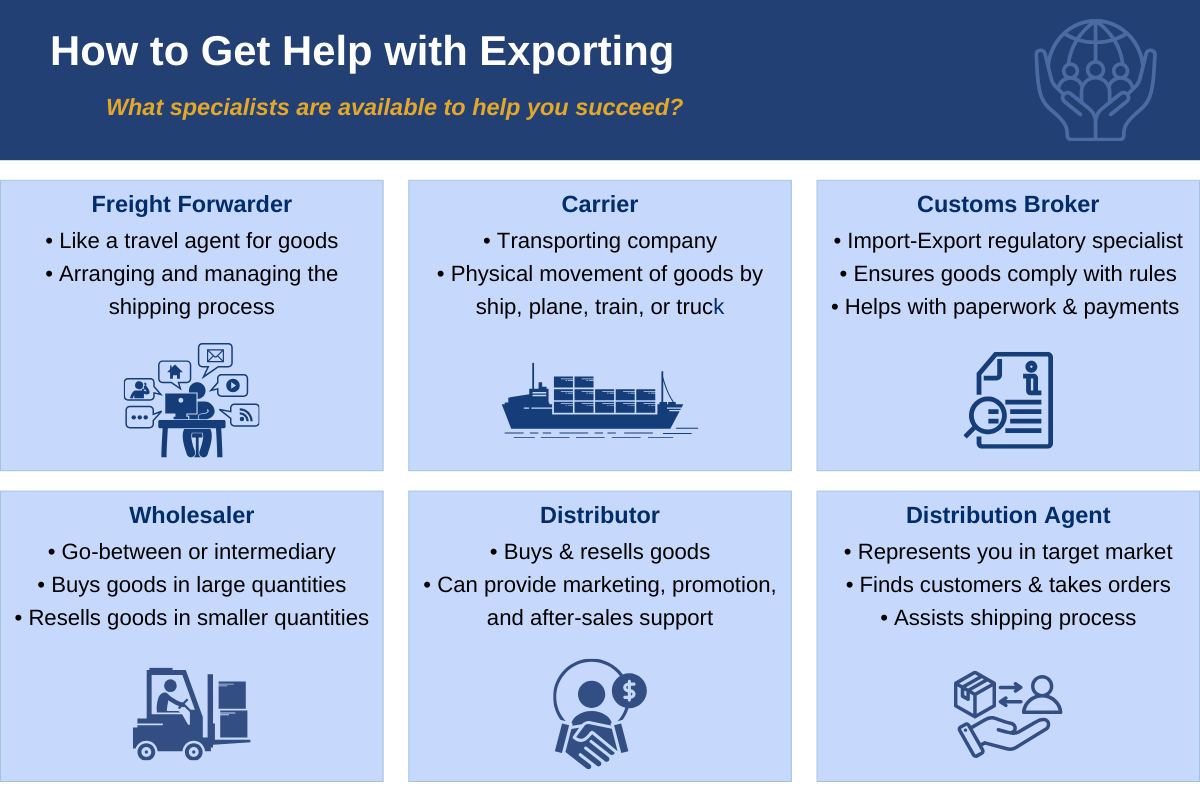
Two helpful types of service providers are freight forwarders and customs brokers.
Freight forwarders take care of all your shipping needs. They also negotiate rates with other service providers. Service providers include:
- Shipping lines
- Airlines
- Trucking companies
- Customs brokers
- Insurance companies
Customs brokers help you manage customs rules, including:
- Rules for exporting from Canada
- Rules for importing to the destination country
See the infographic below for a list of potential service providers:
Regulatory compliance
Navigating complicated legal rules can be intimidating. Check our guide to ensure you discover all the regulatory compliance rules. Make sure you meet each need.
Export regulations
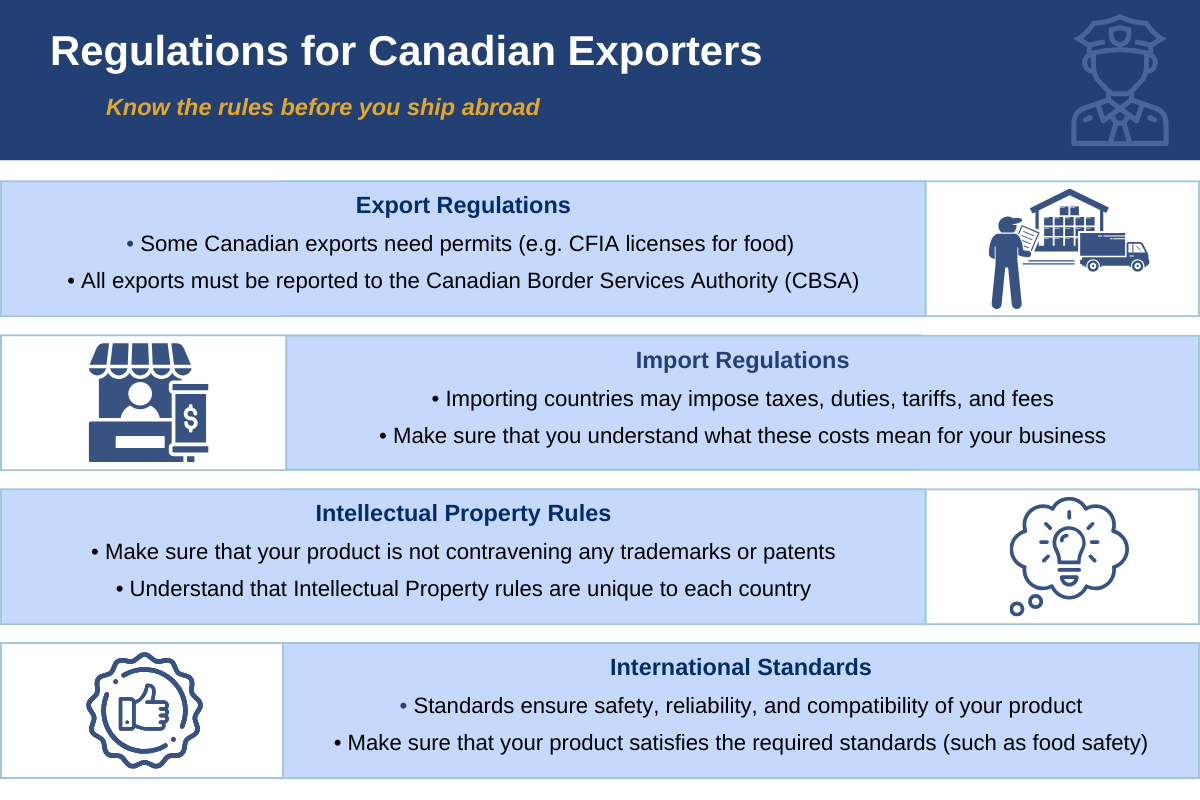
When exporting products from Canada, check if you need an export declaration or permit. You might need a license from the Canadian Food Inspection Agency (CFIA) to export food products.
Canada's Export and Import Permits Act lets you get licenses to export products on the Export Control List (ECL). The ECL includes certain food products, such as sugar-containing products.
All goods exported from Canada must be reported to the Canadian Border Services Agency (CBSA). An export declaration is submitted to the CBSA. This is done via the Canadian Export Reporting System (CERS) or the G7 Electronic Data Interchange Export Reporting System.
Useful links:
- Canadian Food Inspection Agency
- Export and Import Controls
- Canada Border Services Agency
- The Canadian Export Reporting System
- G7 Electronic Data Interchange Export Reporting
Import regulations
Expect various rules for importing into a country. These include regulations that impose taxes, duties, and tariffs on imported foods. They are typically based on the value of the products. You will not pay the taxes, duties and tariffs, but they will affect the final price of your product.
Taxes
Taxes are a required cost added to any imported products. Examples include Value-Added Tax (VAT) and General Sales Tax (GST). These taxes will be added to the product price and paid by the consumer.
Duties
Duties are a type of tax added to the cost of imported products. These are often fixed costs determined by international trade negotiations. They are paid by the person buying your products (either an importer or the final consumer).
Tariffs
Tariffs are a tax added to imports to control how freely a product can be imported into a country. They are often calculated based on the type of product and where it comes from. Tariffs are added to the price of the products and are paid by the final consumer.
Useful links:
Meeting international standards
Standards are documents created by consensus and approved by a recognized body. They ensure that products, services, and systems are safe and reliable. They also make sure everything works as it should.
You need to make sure that you comply with the correct standards that are accepted in your target market. One example is the Canada Good Agricultural Practice Food Safety Initiative, known as CanadaGAP. This standard makes sure food products are produced and handled safely.
The best way to learn about standards is through the Standards Council of Canada (SCC). They coordinate Canada’s participation in standardization, incl. product testing and qualification programs. Canada also follows standards from the International Organization for Standardization (ISO).
Useful links:
Legal compliance
Examples of legal compliance aspects you'll encounter are:
Understanding contracts for selling goods
Business transactions can face issues due to the varying laws of different countries. Legal rights often depend on which law is applied. When concluding a contract with a potential buyer, you need to make sure that you are clear on the rules that apply to the contract.
Meeting international standards
If your product does not comply with the required standards (such as food safety standards), it may be denied access to the market. To avoid costly delays, make sure that your product complies with the required standards.
Intellectual property (IP) rules
You need to make sure that your product is not contravening trademarks or patents that are registered in the importing country. For example, if the name of your product is registered as a trademark in the importing country, you may be subject to legal action. This means that you can be taken to court and pay financial penalties to the owner of the trademark.