
Grazing management guide
 Last updated on April 21, 2026
The B.C. Grazing Management Guide assists B.C. farmers and ranchers in preparing a grazing management plan for their operations. The guide can be used in designing, implementing, and monitoring a grazing management plan.
This guide provides grazing management recommendations and monitoring strategies intended for use on private and deeded leased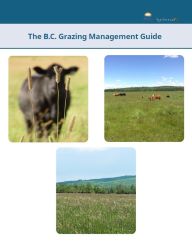 grazing lands. While the principles outlined are broadly applicable to similar sites and landscapes, it is important to recognize that some lands—such as provincial and federal lands—may have distinct objectives and requirements. They may require formal authorization to enable the use of grazing management systems and practices.
This guide is one of a number of publications prepared to support the Canada-British Columbia Environmental Farm Plan Program.
Integrating practices on farm may require the implementation of relevant Legislation and Regulations. It is important to also get proper permits as required. Some factsheets have references to this information, additional information will be added to this page soon.
| Title | Description |
|---|---|
| Title page (PDF 597 KB) | |
| Grazing Management Guide (March 2026) (PDF, 1.9 MB) | Foundation information for grazing management. |
| Factsheet #1– Pasture and Range Assessment. (May 2005) (PDF, 1.3 MB) | This factsheet describes how to assess pasture and range sites by walking you through the process, offering examples to assist and scoring the results. |
| Factsheet #2 – Addressing Pasture and Range Assessment Concerns.(May 2005) (PDF, 162 KB) | Provides guidance and insights into what aspects could benefit from adjustments to current management practices, ideas on options and where to seek additional information. |
| Factsheet #3 – Improving Livestock Distribution.(May 2005) (PDF, 381 KB) | Discusses tools and strategies that can improve livestock distribution and patterns of use on pasture and range areas. |
| Factsheet #4– Components of a Grazing Management Plan.(March 2026) (PDF, 632 KB) | Discusses and describes what elements or topics should comprise a grazing plan and offers some tools to assist in that process. |
| Factsheet # 5– Pasture Design. (March 2026) (PDF, 1.2 MB) | Discusses and describes aspects to consider when designing a grazing management plan or system, (includes stocking rate calculation). Offers some examples, both conceptual and actual, of grazing systems and approaches including a checklist. |
| Factsheet #6– Riparian Pasture Design.(March 2026) (PDF, 481 KB) | Discusses and describes aspects to consider and steps to take in designing a grazing plan for riparian areas. Offers some examples, both conceptual and actual, of grazing systems and approaches. |
| Factsheet # 7– Cost-benefit Analysis of Various Grazing Systems.(March 2026) (PDF, 371 KB) | Discusses and provides analytical guidance and tools with regards to evaluating the costs, benefits and returns associated with investing in rotational grazing practices. |
| Factsheet # 8 – Grazing Frequency and Utilization (March 2026) (PDF, 818 KB) |
Provides further insights into the FIO Principles and timing of grazing as well as some plant species leaf or stubble height guidance to use in conjunction with FIO to quickly monitor grazing impacts and the effectiveness of the rest periods. |
| Factsheet # 9 –Different Livestock Species – Grazing Considerations. (March 2026) (PDF, 705 KB) | Outlines the general characteristics of livestock species as they pertain to grazing management as well as an Animal Unit chart. Species included are: sheep, goats, hogs/pigs, poultry, and horses. |
| Factsheet # 10 –Multi-Species Livestock Grazing. (March 2026) (PDF, 537 KB) | Looks at the basics of multi-species grazing from a pasture and livestock performance perspective. Compliments factsheet # 9. |
| Factsheet #11 – Monitoring Grazing Lands. (March 2026) (PDF, 928 KB) | Discusses monitoring in general, photo-point use and methodology, stubble height rules of thumb, relative use levels, forage production and browse species utilization and trend. Sheets to print for in-field monitoring. |
| Factsheet # 12 – Monitoring Strategies for Extensive and Intensive Grazing Systems.(March 2026) (PDF, 430 KB) | Provides information on various monitoring tools and approaches. Including the Grazing Response Index, Pasture Walks (with silvopasture and cutblock section), soil moisture, record keeping, and a link to the Grassland Monitoring Manual for British Columbia. |
| Factsheet # 13 – Pasture Renovation and Management. (March 2026) (PDF, 161 KB) | Outlines considerations and options associated with forage pasture renovation, species selection and management linked to operational objectives, forage productivity, soil and pasture health and carbon considerations. |
| Factsheet #14 – Seasonal Considerations for Grazing Management.(May 2005) (PDF, 254 KB) | Discusses grazing management and use aspects and consideration points in relation to the seasons of the year. |
| Factsheet # 15 – Managing Grazing Lands During Drought. (May 2005) (PDF, 735 KB) | Discusses some options for herd, forage, and grazing management in times of drought. |
| References (PDF, 78 KB) |
Environmental farm planning helps producers identify both environmental strengths and potential risks on their farms.
Read the guides:
Contact information
Do you have a question? Please contact us.
1-888-221-7141