Canada-B.C. water quality monitoring activities
 Last updated on April 23, 2026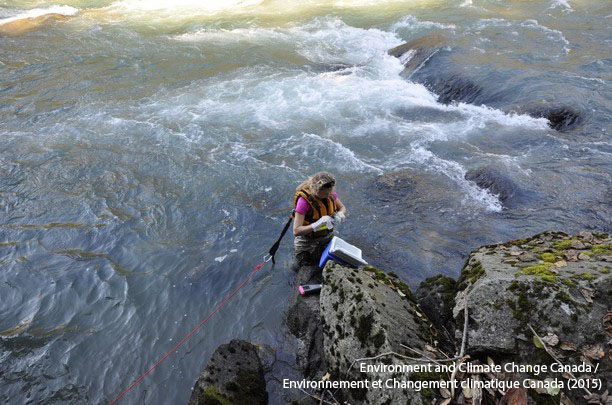
On this page
- Sampling approach
- Water quality parameters
- Biological parameters
- Water quality data
- Water quality trends
British Columbia and Canada work together to monitor the water quality and biological health of various rivers in the province.
Sampling approach
Provincial and federal government staff, First Nations and private contractors collect water samples for this program. Water sampling procedures are standardized. We provide training to all participants and conduct annual check-ins at each station.
Grab samples are collected from under the surface of the water by wading into the river or by lowering a multi-sampler into the river from a bridge. Replicate and field blank samples are collected at each station 2 to 3 times per year for quality assurance.
Benthic macroinvertebrate samples are collected using the Canadian Aquatic Biomonitoring Network (CABIN) sampling method for wadeable streams. We provide training and certification in this method to all biomonitoring samplers.
Water quality parameters
We collect routine water samples from water quality stations and analyze them for a range of water quality parameters.
We have core parameters for every station, including:
- Metals
- Nitrogen
- Phosphorus
- Turbidity
- Specific conductance
- Hardness
- pH suspended sediment
- Colour
- Organic carbon
- Calcium
- Magnesium
- Sodium
- Chloride
- Sulphate
- Potassium, and
- Temperature
These core parameters allow us to compare the data between stations.
We will add parameters if there are specific issues in the watershed.
Biological parameters
We collect samples of benthic macroinvertebrates every 3 years to evaluate the ecosystem health of the river.
Benthic macroinvertebrates are aquatic, bottom-dwelling animals without backbones that live at the bottom of the river.
They're a commonly used in biological monitoring for several reasons:
- Insect larvae
- Aquatic worms
- Crayfish
- Snails
- Shrimps
- Mites
We calculate biomonitoring metrics that describe the numbers of different macroinvertebrates found, diversity of the community and their different ways of feeding and behaviour.
We use biomonitoring metrics and other analyses of the benthic macroinvertebrate community to assess monitoring stations.
Water quality data
We use the water quality data to:
- Track current water quality conditions of rivers
- See if those conditions are changing over time
- Detect emerging issues that may threaten aquatic life
- Support the development of evidence-based guidelines for water, fish and sediment
- Track the results of remedial measures and regulatory decisions
- Further improve the network using a risk-based adaptive management approach
Download water quality data from:
Water quality trends
Pollution from urban, industrial, agricultural areas, mines and climate change pose a threat to water quality and aquatic life.
We assess data from the network for trends to see if water quality is changing over time.
Access the station trend reports.
Learn more about how we calculated the trends.
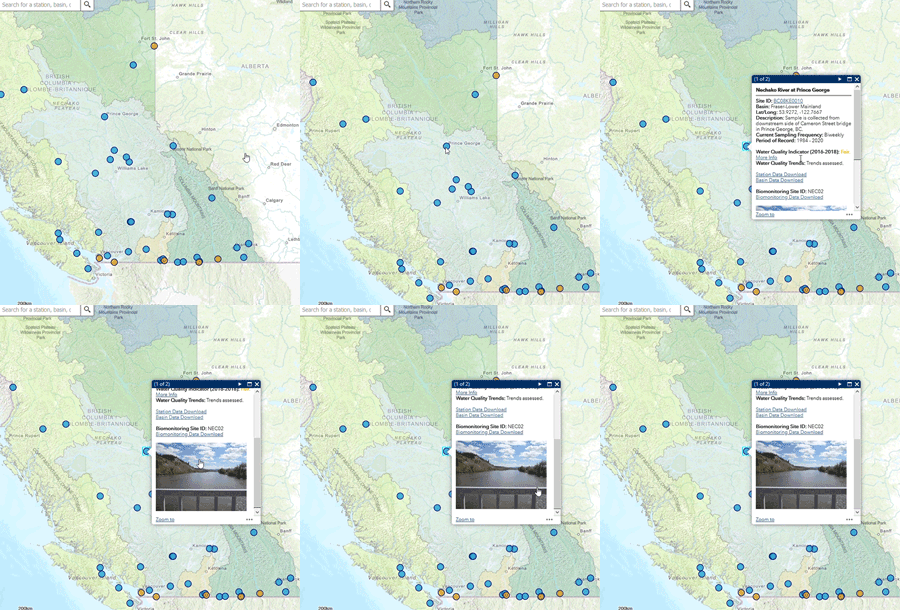
Use our interactive map to explore monitoring stations in the Canada-B.C. Water Quality Monitoring Program.
Guidelines
Other resources
Contact info

For more information, email the water quality scientists at: