
Industrial Electricity Allocation Framework
 Last updated on March 31, 2026
Bill 31
In November 2025, the Government of British Columbia (B.C.) passed the Energy Statutes Amendment Act (Bill 31) to address B.C.’s growing electricity needs by enabling economic growth, reconciliation, and climate goals through new infrastructure and energy management. This amended the Utilities Commission Act (UCA) and enabled the Province to make regulations respecting the provision of electricity services by a public utility for any of the following purposes:
- to store and process electronic data, including data used for artificial intelligence (AI), or
- to produce hydrogen for use outside of Canada.
This amendment allows the Province to establish a new Electricity Allocation Framework (Framework) for industries that provide the most benefits to the people of B.C. and prioritize electricity connections for natural-resource projects.
Emerging Industry Sectors
Emerging sectors, including AI, data centres, and hydrogen for export are driving a substantial increase in electricity demand from BC Hydro and create both opportunities and challenges. These industries often require large-scale power at timelines that challenge traditional utility planning while also providing limited socio-economic and/or environmental benefits to British Columbians when compared to electrifying traditional industries such as oil and gas, mining, and liquefied natural gas production.
Engagement
On October 6, 2025, the Ministry of Energy and Climate Solutions (ECS), with support from BC Hydro, invited First Nation organizations and key industry stakeholders to participate in virtual information sessions on the development of a proposed policy for a new electricity allocation framework for emerging industries in B.C.
In November 2025, ECS and BC Hydro held virtual engagement sessions with B.C. First Nations, affected industries, and other stakeholders ahead of developing regulations. These sessions included discussions on potential criteria for a competitive selection process to support growth‑paced sectors. In total, the Ministry met with 29 First Nations, 34 local governments, and 33 industry stakeholders. Bilateral meetings were also offered to First Nations, as needed, to support reconciliation efforts.
Based on the feedback received, the Ministry refined its proposed regulatory approach. Proponents currently in BC Hydro’s interconnection queue will now be able to participate in the new competitive process while retaining their existing queue positions. Successful projects in BC Hydro’s competitive process will be subject to a lower price premium and reduced curtailment requirements.
BC Hydro Interconnection Queue
BC Hydro has an obligation to serve under the UCA to provide electricity service to any customer that meets necessary conditions with the intention to ensure equal access to electricity for all customers in the province. The Ministry of Energy and Climate Solutions (ECS, the Ministry) supports the development of AI, data centres and hydrogen for export, however, the scale and timing of potential electricity service requests from these emerging industries will challenge BC Hydro’s ability to supply all the requested loads. The New regulation allows changes to this policy by authorizing the Framework to support industry while pacing growth for certain emerging sectors.
Competitive Selection Process
Under the Framework, the Province will require BC Hydro to use a competitive selection process, based on transparent evaluation criteria, to assess AI, data centre, and hydrogen for export projects of 10 MW or larger. Projects selected through this process are able to advance into BC Hydro’s interconnection process. The competitive selection process is not meant to replace the first-come-first served model, but to allow the Province to better pace industrial growth for certain fast-paced sectors.
More information on the competitive selection can be found here: B.C. launching competitive process for clean power in high-demand sectors
Learn more about BC Hydro's 2026 Call for Demand for Emerging Industries opened on February 1, 2026.
Competitive Call for Projects
BC Hydro launched a two-year competitive call to allocate electricity to AI and data centre projects on February 1, 2026. A competitive call to allocate electricity for hydrogen for export projects will be launched at a later date as market conditions warrant. The breakdown of allocation under the Framework will include 300MW for AI projects, 100MW for data centre projects, and 200MW for hydrogen for export projects for the two-year call.
All data centre and AI projects 10 MW and greater will enter the competitive selection process, which includes new projects not yet in the BC Hydro interconnection queue, existing projects in the transmission interconnection process that have not signed a Facility Study Agreement, and existing projects in the distribution interconnection process that have not paid a Design Deposit.
For existing AI and data centre projects in the transmission interconnection queue, BC Hydro will not be obligated to serve these projects if they are not selected as part of the competitive selection process. This allows existing studies to proceed and there is no setback to existing AI and data centre projects that are successful in the competitive process. This process will be applied to all new projects that have not entered into the distribution or transmission interconnection process.
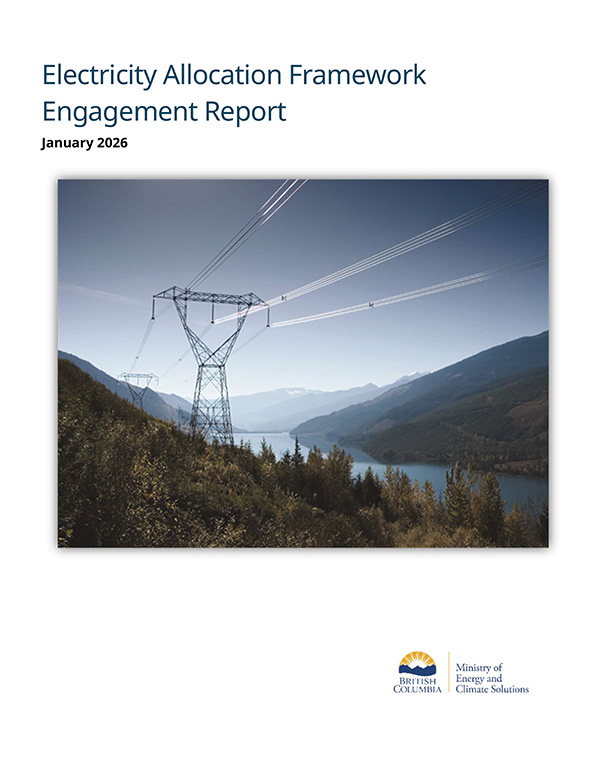
Electricity Allocation Framework Engagement Report