
South Coast - Overview
 Last updated on May 13, 2026
The South Coast is both a significant supplier and consumer of agricultural products, and a major contributor to the province’s economy and food security.
The region is favoured with a large and diverse local market, easy access to the U.S. border and Port Metro Vancouver for international markets. Over half of the province’s population lives in the Metro Vancouver area.
Growing conditions
The South Coast has excellent growing conditions, featuring a cooler, wetter climate and fertile soils. These conditions allow for a broad range of crops and livestock types and are especially suitable for high-value crops that have strong domestic and international markets.
Crops, livestock and food processing
Over 200 commodities are produced commercially in the South Coast, including cranberries, raspberries, blueberries, potatoes, dairy products, poultry and eggs. The region also hosts the majority of the greenhouse businesses in the province.
Local south coast information
Find out more specific information about the South Coast agricultural region:
- South Coast special update: drought preparedness - June 2024
- Industry contacts
- Local planning
- Soil and nutrients
- Regional e-Bulletin
Regional agrologists
View coverage map for agrologists
Central Fraser Valley/SLRD/Sunshine Coast - Township of Langley, Maple Ridge, Squamish-Lillooet Regional District (Squamish, Whistler, Pemberton Valley, Electoral Areas C and D), Sunshine Coast Regional District, Howe Sound (Islands Trust), Bowen Island Municipality.
Jenny Liu
Telephone: 604-743-1959
Email: Jenny.Liu@gov.bc.ca
Fraser Valley Regional District - Municipalities of Abbotsford, Chilliwack, Harrison Hot Springs, Hope, Kent, and Mission and Electoral Areas A (Boston Bar, North Bend, and Canyon Alpine), B (Yale, Choate, Dogwood Valley, Emory Creek, Laidlaw, Othello, Ruby Creek, Spuzzum, and Sunshine Valley), C (Hemlock Valley, Harrison Mills, Lake Errock and Weaver Creek and includes several First Nations including Douglas, Leq'a:mel, Samahquam, Scowlitz, Skatin and Sts'ailes), D (Popkum and Bridal Falls), E (Chilliwack River Valley), F (Durieu, Hatzic Prairie, and McConnell Creek, G (Deroche, Dewdney, Hatzic Island, and Nicomen Island east of Mission), and H (Cultus Lake/Columbia Valley).
Andrew Vogler
Telephone: 604-743-1960
Email: Andrew.Vogler@gov.bc.ca
Metro Vancouver Regional District - Delta, Richmond, Surrey, Pitt Meadows, Burnaby, Electoral Area A, Tsawwassen First Nation, City of Vancouver, Coquitlam, New Westminster, Port Coquitlam, Port Moody, North Vancouver, West Vancouver, White Rock, Anmore, Belcarra, Lions Bay.
Drew Bondar
Telephone: 778-666-0584
Email: Drew.Bondar@gov.bc.ca
Resources
The ministry has developed regional guides as a resource for producers, on-the ground researchers, and consultants to reflect on the climate issues challenging environmental sustainability and local farm businesses and food production.
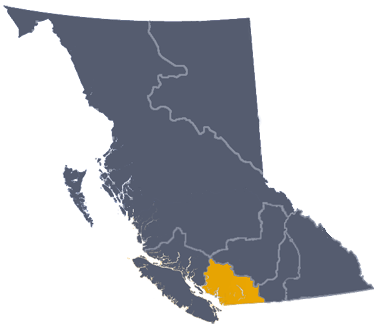
The South Coast region is made up of the Fraser Valley Regional District, Metro Vancouver, and the southern portion of the Sunshine Coast and southwestern portion of the Squamish-Lillooet regional districts.
Contact information
AgriService BC
Have a question? Call or email and a staff person will assist you.
Telephone: 1-888-221-7141
Email: AgriServiceBC@gov.bc.ca