
Stop extortion
 Last updated on July 8, 2026
Working together to stop extortion and keep communities safe.
On this page
Report a threat
If you are being threatened - do not pay. Report it.
- Call 9-1-1 if in danger
- Find other ways to report

What's happening now
The Province of British Columbia, the B.C. Extortion Task Force, police services, federal and municipal partners are working together to investigate, prevent, and stop extortion-related crimes targeting our communities.
Latest news
- July 7, 2026: Statement from the Commissioner of the RCMP on the joint operation taking down leadership of organized crime groups
- July 7, 2026: International Crackdown on India-Based Organized Crime Gangs Results in 24 Arrests in U.S., Canada, and Europe
- July 7, 2026: Surrey Police Service Investigating Shots Fired at Residence
- June 25, 2026: Two Men Charged Following SPS Shooting Investigation
- June 24, 2026: Additional Charges Approved Following Shooting Investigation
- June 10, 2026: Sentences Imposed in SPS Shooting Investigation
- June 4, 2026: SPS Investigating Shooting at a Residence
- June 1, 2026: Additional Extortion Charges Laid Following Shooting Investigation
- May 25, 2026: Extortion Task Force Takes Down International Criminal Group Targeting South Asian Community
- May 19, 2026: Extortion Charges Laid Following December Business Shooting
- May 19, 2026: Man Charged With Firearms and Extortion Related Offences
- May 15, 2026: Chief Lipinski - Extortion Update
- May 13, 2026: Two Men Arrested and Charged Following Shooting
- May 12, 2026: Extortion Virtual Update & Roundtable
- May 7, 2026: One Man Arrested and Charged Following Shooting
- May 4, 2026: Police Release Photo to Help with Extortion Investigations
- March 30, 2026: Charges laid in shooting investigation
- March 30, 2026: SPS Investigate Shots Fired at Residence and Vehicle
- February 25, 2026: B.C. government takes additional actions on extortion
- February 23, 2026: Police Release Photo to Help with Extortion Investigations
- February 19, 2026: Government announces new measures to help protect Canadians and businesses against extortion
- February 18, 2026: Setting up a new community advisory group on extortion crisis
- February 6, 2026: AbbyPD Maintains Focused Response to Extortion-Related Violence in Abbotsford
- February 4, 2026: Premier’s, minister’s statements on combating extortion
- February 3, 2026: Statement from Chief Lipinski on Provincial Action on Extortions
- February 2, 2026: Three Men Arrested and Charged with Firearm Offence
- February 1, 2026: Three Men Arrested Following Early Morning Shots Fired
- January 28, 2026: Police Releasing Photos of Two Accused
- January 27, 2026: Two Men Arrested and Charged with Firearm Offence
- January 22, 2026: Strengthening provincial response to extortion violence
- January 20, 2026: A four-month update from the BC Extortion Task Force
- January 20, 2026: SPS Investigating Early Morning Shooting
- January 19, 2026: Police Investigate Shots Fired at Surrey Business
- January 17, 2026: SPS Investigating Overnight Shots Fired
- January 8, 2026: Langley RCMP respond to a report of shots fired
- January 7, 2026: Shooting at a residence in the northern Delta
- December 31, 2025: Police are investigating a shooting that occurred early this morning in Surrey
- December 19, 2025: UPDATE - AbbyPD Investigates Overnight Shooting on King Road
- December 18, 2025: AbbyPD Investigates Overnight Shooting on King Road
- December 8, 2025: Charge laid in BC Extortion Task Force investigation into a November shooting in Surrey
- December 4, 2025: AbbyPD Launches Project Disengage: A Lifeline for Those Involved—or Being Recruited—Into Extortion-Related Violence
- November 28, 2025: An update from the B.C. Extortion Task Force in relation to ongoing investigations
- November 28, 2025: Trilateral summit brings leaders together to combat extortion and organized crime
- November 17, 2025: A Special Message from Chief Lipinski on Extortions in Surrey
- November 7, 2025: CBSA in British Columbia opens multiple immigration investigations and removes three individuals
- October 27, 2025: Minister Fraser, Premier Eby, and Attorney General Sharma underscore collaboration behind Canada’s new bail and sentencing reforms
- October 6, 2025: Three Charged in Extortion-Related Shooting
- October 1, 2025: One man sentenced, one man outstanding in shooting and arson investigation
- September 29, 2025: Government of Canada lists the Bishnoi Gang as a terrorist entity
- September 17, 2025: New provincial task force will target extortion threats
The Community Advisory Group (CAG) on Extortion was established to strengthen communication and trust between communities impacted by ongoing extortion crimes and law enforcement.
The CAG serves as a resource for residents, businesses, and community organizations to provide feedback and share perspectives on how to combat extortion – including but not limited to prevention, victim supports, enhanced communication, and community safety strategies.
The CAG brings together individuals with backgrounds in:
- Senior law enforcement
- The justice sector
- Victim advocacy & violence prevention
- Business & community leadership
Members draw on their experience and community connections to identify emerging concerns and provide advice to law enforcement and government. Their role is advisory – helping ensure the response to extortion reflects both investigative intelligence and on-the-ground community experience.
The CAG does NOT conduct investigations and does NOT replace reporting to police.
Information shared through this email will be reviewed to help inform advice and recommendations provided to law enforcement and government.
This inbox is not monitored 24/7 and is NOT a police reporting channel. If you are a victim of extortion-related crime you must report it to police for an investigation to be opened.
If you are in immediate danger, call 9-1-1.
To report extortion or criminal activity, please contact your local police or Crime Stoppers.
B.C. actions on extortion
- Specialized B.C. Extortion Task Force to target extortion. Extortion is a national issue. The Province is working to ensure all agencies work together to address extortion threats.
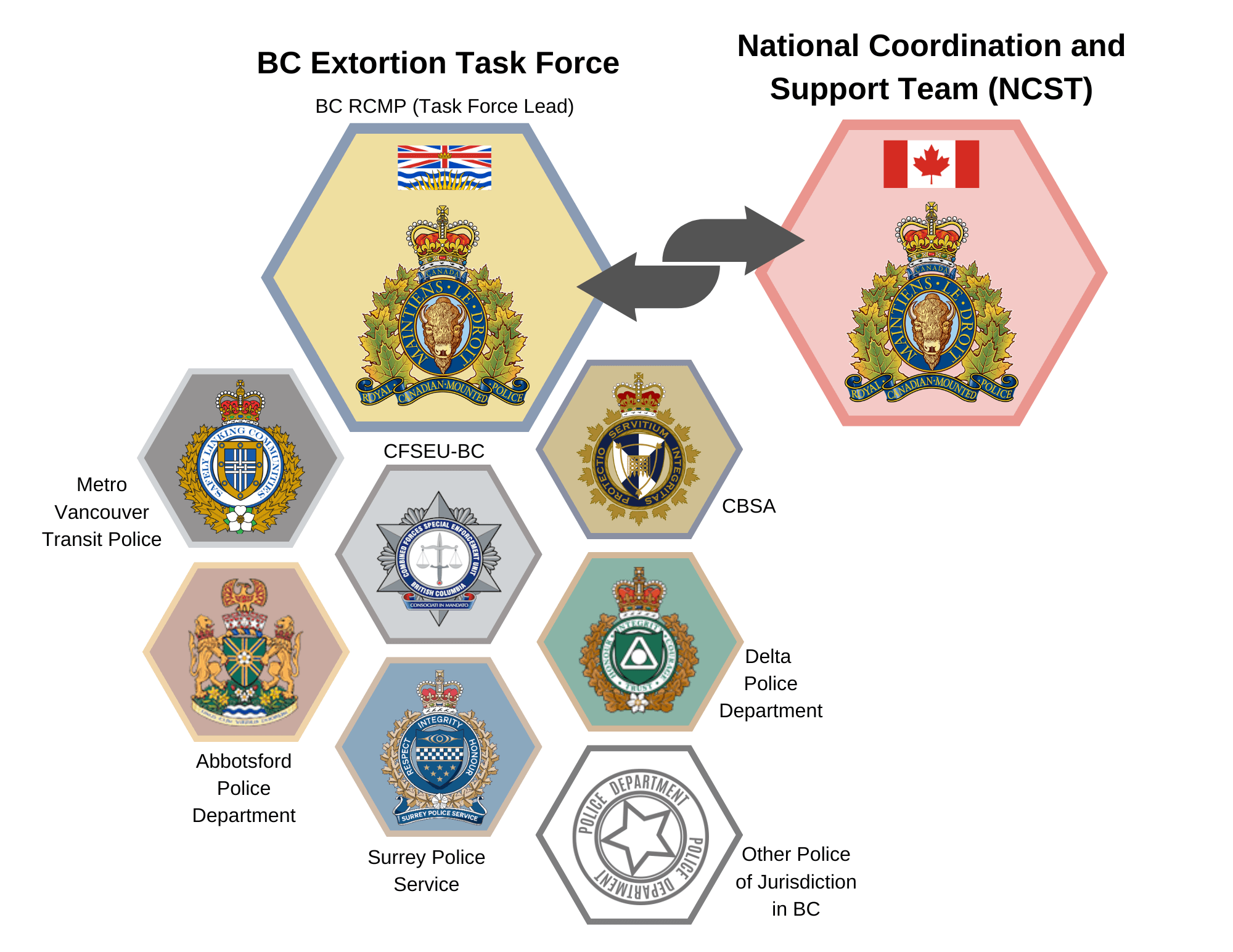
- The Task Force is led by the B.C. RCMP. It also includes:
- Abbotsford Police Department
- Combined Forces Special Enforcement Unit - B.C. (CFSEU-BC)
- Delta Police Department
- Metro Vancouver Transit Police
- Surrey Police Service, and
- Canada Border Services Agency (CBSA)
- The B.C. Extortion Task Force also works closely with law enforcement agencies in other provinces.
- The Task Force is led by the B.C. RCMP. It also includes:
- Established a community advisory group on extortion to close any gaps between community members and police to solve crime. The group will help strengthen trust between the community and law enforcement, including the BC Extortion Task Force and local police. It will listen to community concerns, identify emerging issues and relay them to law enforcement and government so people are heard, supported and safe. It will also help law enforcement communicate information to the community.
- Victims of extortion support funding. Joint funding from the provincial and federal governments is strengthening supports for victims. As part of this effort, the Government of Canada and the B.C. Government are committing $1 million to support victims of extortion. The Province will invest $500,000 for enhanced victim services and community outreach in Lower Mainland communities, particularly Abbotsford, Delta, and Surrey. Funding for police will enhance safety planning and the purchase of equipment to enhance victim safety.
- Annual funding to tackle organized crime. B.C. allocates more than $100 million each year to help keep British Columbians safe from serious and organized crime. This includes specialized enforcement and intelligence programs targeting gangs, guns and organized crime activities like extortion. Additional funding from the federal Gun and Gang Violence Action Fund helps municipal police forces investigate extortion cases that fall outside of the scope of the task force.
- Expanded investigation and enforcement activities. The Province is providing police with tools and resources to expand their investigation and enforcement activities to tackle crime. Funding for the Specialized Investigation and Targeted Enforcement (SITE) program helps police target repeat and violent offenders by strengthening investigations, improving coordination, and closely monitoring high-risk individuals.
- Supporting victims of crime. We’re working with B.C. Crime Stoppers to help people and businesses know the signs of extortion and encourage victims to report threats. This will help police identify and stop those responsible. Victims and their family may also be eligible for benefits to support their recovery.
- Expanding the Provincial Forensic Firearms Lab. Investing $600,000 to make it faster and easier to deliver forensic results, which will help police throughout B.C. reduce gun violence and hold offenders accountable more quickly.
- Hired more police officers. Invested $230 million to hire 256 more BC RCMP officers for rural communities and to increase staffing in specialized units like the Major Crimes Section.
Provincial-federal coordination
- In January 2026, Premier Eby secured support from Prime Minister Mark Carney and federal Public Safety Minister Gary Anandasangaree to:
- Add 20 police officers to join the extortion fight in B.C.
- Enhance RCMP helicopter resources to aid with tactical operations and community surveillance
- Hold a police leadership meeting to discuss the trans-national extortion crisis to ensure police are using all tools available to fight crime
- B.C. has also successfully pushed for federal action on:
- Listing Bishnoi Gang as a terrorist entity under the Criminal Code. This gives police and prosecutors stronger tools to freeze assets and disrupt financing
- New federal bail reforms that create a reverse onus at bail for extortion involving violence. This means the accused must now show why they should be released.
- Requiring courts to impose a condition prohibiting the possession of a firearm or other weapon, unless it is not needed for public safety reasons, when making a release order in respect of an accused person charged with extortion.
- Requiring consecutive sentences when extortion is paired with arson. This means offenders must serve time for both crimes one after the other.
Federal actions on extortion
The B.C. Extortion Task Force receives support from federal policing programs
- Regional Integrated Drug Enforcement Team. The Government of Canada in collaboration with the B.C. government is creating a Regional Integrated Drug Enforcement Team (RIDET). Backed by an investment of $4-million over four years, provided through Canada’s Border Plan, this team will bring law and border enforcement resources together from multiple agencies to fight organized drug crime and combat extortion.
- Yo Bro Yo Girl Youth Initiative. Recognizing the importance of tackling crime before it starts, the Government of Canada is committing $1.5 million through Public Safety Canada’s Crime Prevention Action Fund for the Yo Bro Yo Girl Youth Initiative. The organization will launch a Youth Engagement Hub in Surrey to help divert vulnerable youth from gangs and organized crime through programs, mentorship, employment training, and counselling for up to 1,000 young people.
- RCMP’s National Co-ordination and Support Team (NCST). The team offers co-ordination support and information sharing on extortion cases with law-enforcement agencies in affected provinces including B.C., Alberta and Ontario.
Municipal coordination and support
- The City of Surrey is providing the Surrey Police Service with a $250,000 reward fund for information leading to convictions in the ongoing extortion cases targeting individuals and businesses within the city.
- People who report threats may receive a payment if their tip directly results in identification, prosecution and conviction.
- Abbotsford Police Department has launched Operation Community Shield, a dedicated internal task force working with provincial and federal authorities to investigate all extortion reports and urges residents and businesses to report suspicious activity.
- Delta Police Department investigate all extortion reports through a dedicated team, working closely with the B.C. Extortion Task Force and other partners to respond quickly to threats and support residents and businesses, while encouraging immediate reporting of any suspicious activity.
“Tackling extortion is our government’s top public safety priority, and we are committed to providing police with every resource they need to help bring these criminals to justice.”
- Nina Krieger, Minister of Public Safety and Solicitor General

About the B.C. Extortion Task Force
As part of our investments to counter extortion threats, the Province established a B.C. Extortion Task Force dedicated to advancing investigations and holding those responsible accountable. The B.C. Extortion Task Force brings together law enforcement partners to ensure a cross-jurisdictional approach to support coordinated investigations.
Task force priorities
Since the Task Force was created in September 2025, the team has focused on:
- Investigating those responsible for the highest threats to public safety
- Suppressing the violence throughout affected communities
- Understanding linkages between files
- Establishing investigations series with evidence-based connections
- Identifying suspects and suspect groups
- Coordinating with law enforcement partners across the Province and the country
- Supporting victims and their families and helping to keep them safe
Task force members
The B.C. Extortion Task Force includes more than 40 police representatives from municipal, provincial, and federal agencies, including:
- B.C. RCMP
- Surrey Police Service
- Delta Police
- Abbotsford Police
- Combined Forces Special Enforcement Unit of British Columbia (CFSEU-BC)
- Metro Vancouver Transit Police
- Canada Border Services Agency
They also receive support from B.C. RCMP surge resources, including:
- CFSEU-BC's Uniform Gang Enforcement Team
- B.C. Highway Patrol
- Emergency Response Teams
- Police Dog Services
Investigating extortion threats
Extortion investigations are complex. The B.C. Extortion Task Force uses reactive and proactive enforcement and investigative strategies that are led by intelligence.
These evidence-based investigations rely on information received by the police. The B.C. Extortion Task Force and local police have liaison officers who work with victims, witnesses and local police to collect evidence and put safety plans in place as needed.
The Task Force must limit the information that is shared with the public to protect the integrity and viability of ongoing investigations.
If you are a victim of extortion:
- Report it to police or Crime Stoppers at 1-800-222-TIPS [8477]
- Save all communications and evidence of the threats
- Do not respond to threats
- Do not comply with demands
“The B.C. Extortion Task Force sends a clear and firm message: if you choose to inflict harm in our communities, we will find you and we will hold you accountable.”
- Nina Krieger, Minister of Public Safety and Solicitor General

How to report a threat
If you are being threatened - do not pay. Report it.
Reporting the threat helps to ensure your safety and connect you with resources.
Even if something seems small or insignificant, report it. A single detail can connect major investigations, identify suspects, or prevent another crime.
Steps to take
- Call 9-1-1 if you are in immediate danger
- Save any evidence you may have
- Report to police using one of the options below:
- In Surrey:
- Report extortion threats through non-emergency at 604-599-0502 (9-1-1 if you are in immediate danger)
- If you have information about a Surrey extortion that could assist police, call the Surrey Extortion Tip Line at 236-485-5149 (monitored 7 days a week from 9 am to 5 pm; language services available)
- Other communities: Find your local police detachment here
- Anonymous tips: Contact B.C. Crime Stoppers
- Call: 1-800-222-TIPS [8477]
- Online: bccrimestoppers.com/leave-a-tip
- In Surrey:
- Do not respond to threats or comply with demands
If you’re unsure if you should report a crime, contact VictimLink BC for confidential support.
- Call or text: 1-800-563-0808, available 24/7 in over 240 languages
What happens after you report - how you can help
Information shared with police or Crime Stoppers goes directly to investigators involved in extortion files. Investigators review evidence, coordinate intelligence, and follow up.
Every credible lead helps police connect files, identify suspects, and support justice outcomes.
Learn how crimes are investigated and how charges are assessed:
Resources
- Know the signs of extortion
- What to expect when you report a crime
- Extortion Brochure (PDF, 316KB)
- Surrey Police Service extortion threats videos
Support for victims and families
If you’ve experienced extortion, you might be feeling frightened, overwhelmed, or unsure what to do. You don’t have to face this alone. Support is available to help you.
Victim Services workers have specialized training to provide information and emotional support to those impacted by crime, victimization, and trauma. Services include:
- Crisis response and safety planning
- Information regarding the police investigative process
- Practical assistance completing Crime Victim Assistance Program applications and other related forms
- Information about the criminal justice system, and support through the court process
- Referrals to other community resources
Information for victims of crime:
- Victim of Crime – English (PDF, 220KB)
- Victim of Crime – French (PDF, 230KB)
- Victim of Crime – Punjabi (PDF, 230KB)
Victim supports
- VictimLink BC is a free, confidential service for people across B.C. affected by crime and trauma. They can connect you with trained victim service workers that provide specialized assistance to help victims stay safe and navigate the criminal justice system.
- Call or text: 1-800-563-0808
- Available 24/7 in 240 languages, including Punjabi and Hindi
- Local victim service programs. Many communities offer victim service programs. You can contact them directly for more information or assistance.
- Abbotsford Police Victim Services
- Phone: 604-835-9696
- Email: extortionsupport@abbypd.ca
- Delta Police Victim Services
- Phone: 604-940-5019
- Email victimservices@deltapolice.ca
- Langley RCMP Victim Services
- Phone: 604-532-3214
- Email langleyvictimservices@rcmp-grc.gc.ca
- Surrey Police Victim Services
- Phone: 604-599-7600
- Email: victimsupport@surreypolice.ca
- Locate victim service programs in other communities using the Victim Services Program Directory.
- Abbotsford Police Victim Services
Share Feedback with the Community Advisory Group
The Community Advisory Group (CAG) on Extortion was established to strengthen communication and trust between communities impacted by ongoing extortion crimes and law enforcement.
The CAG serves as a resource for residents, businesses, and community organizations to provide feedback and share perspectives on how to combat extortion – including but not limited to prevention, victim supports, enhanced communication, and community safety strategies.
The CAG brings together individuals with backgrounds in:
- Senior law enforcement
- The justice sector
- Victim advocacy & violence prevention
- Business & community leadership
Members draw on their experience and community connections to identify emerging concerns and provide advice to law enforcement and government. Their role is advisory – helping ensure the response to extortion reflects both investigative intelligence and on-the-ground community experience.
The CAG does NOT conduct investigations and does NOT replace reporting to police.
You may email the CAG at: ExtortionFeedback@gov.bc.ca.
Information shared through this email will be reviewed to help inform advice and recommendations provided to law enforcement and government.
This inbox is not monitored 24/7 and is NOT a police reporting channel. If you are a victim of extortion-related crime you must report it to police for an investigation to be opened.
If you are in immediate danger, call 9-1-1.
To report extortion or criminal activity, please contact your local police or Crime Stoppers.
Crime Victim Assistance Program
Victims of extortion may be eligible for benefits through the Crime Victim Assistance Program including:
- Counselling services
- Protective measures – up to $3,000 may be provided for security devices like new locks or security systems
- Relocation expenses to move to a new location may be considered in certain circumstances
Immediate family members and witnesses may also be eligible for counselling benefits.
For information and to apply, contact the Crime Victim Assistance Program directly.
- Call: 1-866-660-3888, press 5 to speak with a staff person
- Available Monday to Friday, 8:30 am to 4:30 pm
Report suspicious cross border activity
Social media
Contact information
Victim services
1-800-563-0808
211-VICTIMLINKBC@UWBC.CA
http://www.victimlinkbc.ca