Work Environment Survey (WES) Pulse 2026
 Last updated on February 24, 2026
The Work Environment Survey (WES) Pulse will run in early March 2026. Find answers to some commonly-asked questions below.
On this page:
General questions
When does the Work Environment Survey (WES) Pulse 2026 take place?
WES Pulse will be open from March 3 to 24, 2026. Due to the high volume of survey invitations to be delivered, some employees will receive their survey invitation on March 4, 2026.
Who is eligible to complete the survey?
The survey is available to all regular and auxiliary employees who are:
- Active and in-pay on February 15, 2026 (i.e., employees hired prior to this date and not on long-term leave on that date)
- Employees working for an organization whose head reports to the Deputy Minister to the Premier and who are covered under the BC Public Service Act
Am I required to complete the survey?
The survey is voluntary, but you are strongly encouraged to complete it. The more completed questionnaires received, the more accurately your work environment will be represented. Your executives and strategic human resource groups use this information to direct resources and identify areas for development and improvement.
If you choose to not complete the survey, you don’t need to inform BC Stats unless you want to be removed from the reminder list.
Which workplace should I be thinking about when I respond?
Answer the survey questions based on where you were working on February 15, 2026.
If you are in a temporary role, or new to your current position, your feedback will be connected to the role that you were in on this date.
If you have multiple positions in different workplaces within government, answer based on the position you work the most hours at.
I am a member of the Executive – how should I respond to questions about my Executive?
Consider the other members of the executive team when responding to questions in this section (i.e., don’t evaluate yourself).
Troubleshooting
Why wasn’t I sent an invitation?
If you were employed on February 15, 2026 and did not receive an invitation, please contact BC Stats.
I cannot find my invitation to the survey. What should I do?
If you have misplaced your invitation, first search your inbox for “Invitation” or “Work Environment Survey (WES) Pulse 2026.” These phrases are in the subject line of your email invitation. The email will be addressed from Deb Godfrey.
If you cannot find your invitation and believe that you are eligible to participate, please contact BC Stats to have another invitation sent.
Why doesn’t my userID work?
If your browser window reads: “The userID supplied is not valid. Please try again,” try re-typing the userID in again. Note there are no letters in the userID; only numbers.
If your browser window reads: “Already submitted. Thank you for your participation! This survey is already completed,” we have received your completed survey. If you did not complete your survey, contact BC Stats.
What if I lose my connection or receive an error message while taking the survey?
If you leave the survey, lose your internet connection or receive an error message, you can return to the survey using the link in your email invitation. You will be able to resume the survey from where you left.
Protecting your privacy
Is the Work Environment Survey Pulse anonymous?
The survey is confidential, not anonymous.
What’s the difference?
With anonymous surveys, we don’t know who completed the survey, or how many times they completed it. To group results in meaningful ways — for example, by ministry, work unit, or according to job type or tenure — we need to know who completed each survey and can ensure it was completed only once by an eligible respondent. This enables BC Stats to summarize results by ministry, work unit, or job type. Any information collected by BC Stats is protected under the Statistics Act.
How is my data protected?
Your responses are not shared outside of BC Stats and therefore cannot be connected in any way to your personnel record.
Your answers are kept confidential in accordance with the Statistics Act and are only used for statistical and research purposes. When survey results are published, your responses are combined with the responses of others so that you cannot be identified.
Section 30 of the Freedom of Information and Privacy Protection Act (FOIPPA) requires us to protect personal information by making reasonable security arrangements against such risks as unauthorized access, collection, use, disclosure or disposal. BC Stats policies and procedures, as well as technical and physical security measures, are in place to protect against these risks.
WES Pulse results
When can I expect to see the survey results?
The survey results are planned to be available in Summer 2026.
How are my responses summarized for reporting?
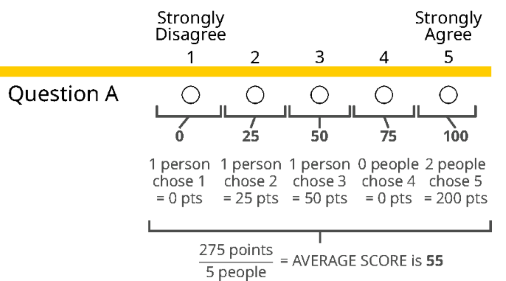
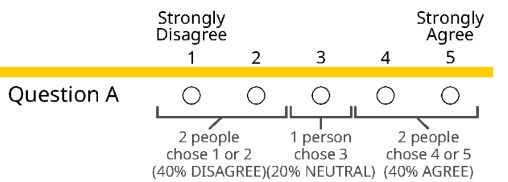
Employee responses are shown as both percentages to highlight the distribution of responses per question, and as average scores to provide a single measure for comparability.
Percentages show the proportion of employees who disagreed (answered 1 or 2), agreed (answered 4 or 5) or provided a neutral response (3), as the figure below displays:
Average scores range from 0 to 100 points and represent the full range of responses to each question. Scores are calculated by converting the five-point survey scale into a 100-point scale and dividing by the number of respondents, as displayed in the figure below: