
BCAB 1991 - Energy efficiency requirements for windows and doors in a house
 Last updated on September 15, 2026
Energy efficiency requirements for windows and doors in a house
Project Description
The project is the construction of a house under Part 9 of the Code and located in Climate Zone 6. According to a bylaw of the local authority in force at the time of building permit issuance, the house is required to conform to Step 4 of the Energy Step Code.
Windows and doors consist of aluminum frames, glazing, and hardware. All components were sourced from different and international manufacturers, shipped to a local shop, assembled into windows and doors, and then transported to the site for installation.
U-values for the products were “calculated with WINDOW 7/Therm 7 software” and are reported to range between 0.787 and 1.583. Values for solar heat gain coefficients and visible transmittance have not been provided.
Applicable Code requirements (BCBC 2018, effective December 12, 2019 to April 30, 2023)
Article 9.7.3.2., Division B, Heat Transfer Performance
(1) Windows, doors and skylights and their components described in Sentence 9.7.1.1.(1) shall be designed, constructed and installed to
(a) minimize surface condensation on the warm side of the component (see Note A-9.7.3.2.(1)(a)), and
(b) ensure comfortable conditions for occupants.
(2) Compliance with the heat transfer performance requirements described in Sentence (1) shall be demonstrated by
(a) complying with the requirements in Article 9.7.3.3., or
(b) design and construction conforming to Part 5.
Sentence 9.7.3.3.(1), Division B, Thermal Characteristics of Windows, Doors and Skylights
(1) Except as permitted in Sentence (2), metal frames and sash of windows, doors and skylights shall incorporate a thermal break.
Sentence 9.36.1.3.(1), Division B, Compliance and Application
(See Note A-9.36.1.3.)
(1) Except as provided in Sentences (2) to (8), buildings shall comply with
(a) the prescriptive or trade-off requirements in Subsections 9.36.2. to 9.36.4.,
(b) the performance requirements in Subsection 9.36.5.,
(c) notwithstanding Article 1.1.1.1. of Division A of the NECB, the NECB, or
(d) Subsection 9.36.6.
Sentence 9.36.2.2.(3), Division B, Determination of Thermal Characteristics of Materials, Components and Assemblies
(3) The thermal characteristics of windows, doors and skylights shall be determined by calculation or testing in accordance with
(a) CSA A440.2/A440.3, “Fenestration Energy Performance/User Guide to CSA A440.2-14, Fenestration Energy Performance,” for the reference sizes listed therein, or
(b) NFRC 100, “Determining Fenestration Product U-factors,” and NFRC 200, “Determining Fenestration Product Solar Heat Gain Coefficient and Visible Transmittance at Normal Incidence,” for the reference sizes listed therein.
(See Note A-9.36.2.2.(3).)
A-9.36.2.2.(3) Calculation Tools.
The thermal characteristics of windows, doors and skylights can be calculated using software tools such as THERM and WINDOW.
Sentence 9.36.2.7.(1 and 3), Division B, Thermal Characteristics of Fenestration, Doors and Skylights
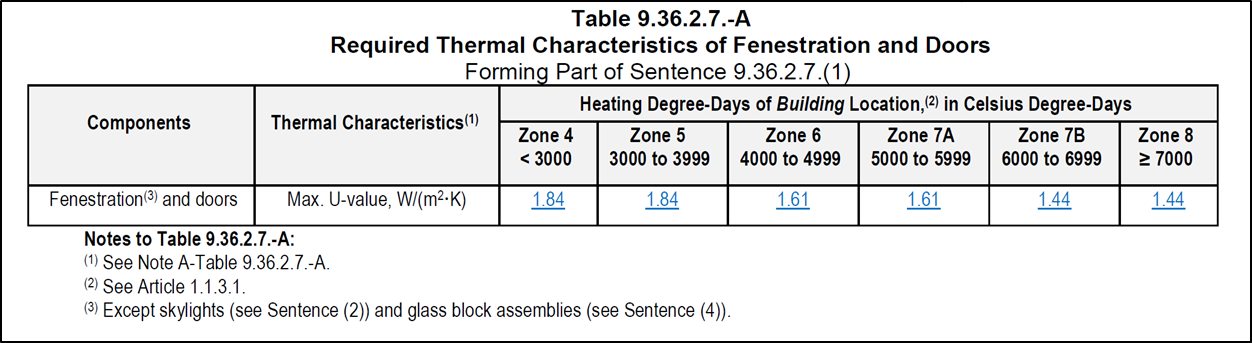
(1) Except as provided in Sentences (2) to (11) and Article 9.36.2.11., fenestration and doors shall have an overall thermal transmittance (U-value) not greater than the values listed in Table 9.36.2.7.-A for the applicable heating-degree day category. (See Note A-9.36.2.7.(1) and (2).)
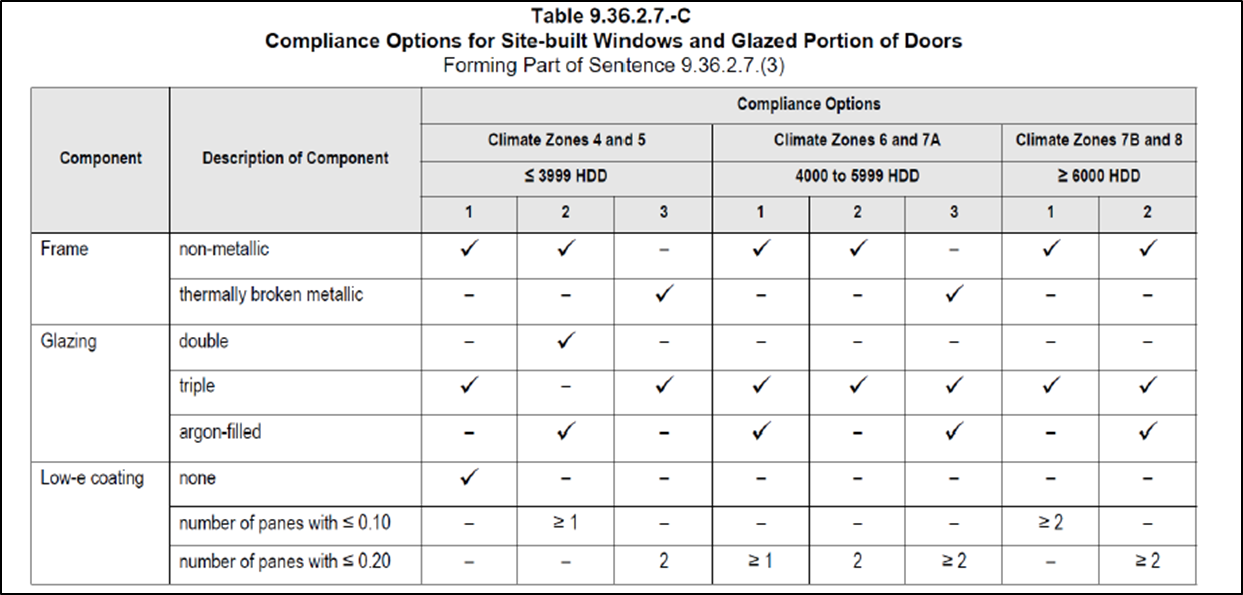
(3) Except for site-assembled or site-glazed factory-made fenestration products, curtain wall construction, and site-built windows and glazed doors that are tested in accordance with Sentence 9.36.2.2.(3), site-built windows and glazed doors need not comply with Sentence (1), provided they are constructed in accordance with one of the options presented in Table 9.36.2.7.-C for the applicable climate zone. (See Note A-9.36.2.7.(3).)
A-9.36.2.7.(3) Site-built Windows.
Site-built windows are often installed in custom-built homes or in unique configurations for which manufactured units are not available. Article 9.7.4.1. requires windows, doors and skylights to conform to either the standards referenced in Article 9.7.4.2. or to Part 5. Regardless of the compliance path chosen, the requirements of Section 9.7. and 9.36. must also be met. Windows, doors and skylights and other glazed products that comply with Part 5 and are installed in a Part 9 building may use the site-built provisions of Sentence 9.36.2.7.(3) rather than complying with the requirements in Sentence 9.36.2.7.(1).
Clause 9.36.6.3.(2)(a), Division B, Energy Performance
(2) Except as permitted by Sentence (3),
(a) energy performance shall be calculated in conformance with Article 9.36.6.4., . . .
Sentence 9.36.6.4.(2), Division B, Energy Modelling
(2) Energy modelling shall conform to
(a) Subsection 9.36.5.,
(b) the EnerGuide Rating System, version 15 or newer (see Note A-9.36.6.4.(2)(b)), or
(c) Clauses 10.2.3.4.(1)(a) and (b) and Sentences 10.2.3.4.(3) and (4). (See Note A-9.36.6.4.(2)(c).)
Decision being appealed (Local Authority’s position)
Energy efficiency requirements for the building are based on the Energy Step Code (Sentence 9.36.1.3.(1)(d), Division B) and the energy performance of building was modelled using the EnerGuide Rating System (Sentence 9.36.6.4.(2)(b), Division B).
The EnerGuide Rating System does not contain any guidance for the thermal performance of windows and doors. Therefore, based on Sentence 9.36.1.3.(1)(a), Division B, and Sentence 9.36.2.2.(3), Division B, thermal characteristics of the windows and doors must be determined by calculation or testing in accordance with either:
- CSA A440.2/A440.3, or
- NFRC 100 (related to U-values) and NFRC 200 (related to solar heat gain coefficients and visible transmittance).
The Code does not define the terms “site-assembled”, “site-glazed factory-made”, or “site-built” windows and glazed doors. These products are interpreted to be “site-assembled” or “site-glazed factory-made”, and Sentence 9.36.2.7.(3), Division B, requires the products to be tested.
Appellant's position
Sentence 9.36.1.3.(1)(a), Division B, applies to the supply of the windows and doors. The Code’s energy efficiency requirements related to the windows and doors are, according to Sentence 9.36.2.7.(3), Division B, satisfied because the windows are site-built and their construction complies with Compliance Option 3 in Table 9.36.2.7.-C for Climate Zone 6.
Appeal Board Final Decision #1991
The Board reverses the decision of the local authority.
It is the determination of the Board that the thermal characteristics of the windows and doors need not be determined by calculation or testing in accordance with either:
- CSA A440.2/A440.3, or
- NFRC 100 (related to U-values) and NFRC 200 (related to solar heat gain coefficients and visible transmittance).
Reason for Final Decision
For a Part 9 house, the Code outlines energy efficiency requirements. The four Clauses in Sentence 9.36.1.3.(1), Division B, set out four compliance pathways. The Energy Step Code pathway, located in Subsection 9.36.6., Division B, is identified in Clause (d).
Where a building designer elects, or is required by bylaw, to use the Energy Step Code compliance pathway in Clause (d), there is no requirement to comply with some requirements from the other pathways found in Clauses (a), (b), or (c) unless those other requirements are specifically referenced within the Energy Step Code pathway in Subsection 9.36.6., Division B.
In this case, the window performance requirements, located in Subsection 9.36.2., Division B and cited by the local authority, form part of the “prescriptive or trade-off” pathway in Clause (a), and they do not apply within the Clause (d) pathway.
The thermal performance requirements for the windows in this case are limited to those outlined in Section 9.7., Division B.
Additional Note Regarding Compliance
Outside agencies have notified the Board that readers of this Final Decision should be aware that residential windows in BC are regulated by the Energy Efficiency Standards Regulation (EESR) in addition to the requirements of the Code. The EESR applies to the manufacturing, sale, and transfer of windows in BC and information about the EESR can be found here.
Don Pedde
Chair, Building Code Appeal Board
Dated: April 2, 2026
Amended: September 3, 2026. The Final Decision was amended to add the additional note regarding compliance.