Pharmaceutical Care Management Strategy
 Last updated on January 1, 2026
The Ministry of Health’s Health System Policy and Oversight (HSPO) division oversees the BC PharmaCare program. HSPO is also responsible for overseeing the provisioning, management and optimal use of pharmaceuticals, and the pharmaceutical-related systems and services that improve client outcomes in the B.C. health system.
Jump to: Complexity | Key capability areas | Strategic areas of focus
The Pharmaceutical Care Management Strategy (PCMS) was developed in 2020 through consultation and collaboration with a broad range of health sector partners. At the time, pharmaceutical care management was the responsibility of the now-renamed Pharmaceutical, Laboratory and Blood Services Division (PLBSD).
This strategy identifies:
- Provincial pharmaceutical care management capabilities
- Key themes across the pharmaceutical care management landscape in B.C.
- Strategic areas of focus, with goals and timelines
- Target governance and operating models
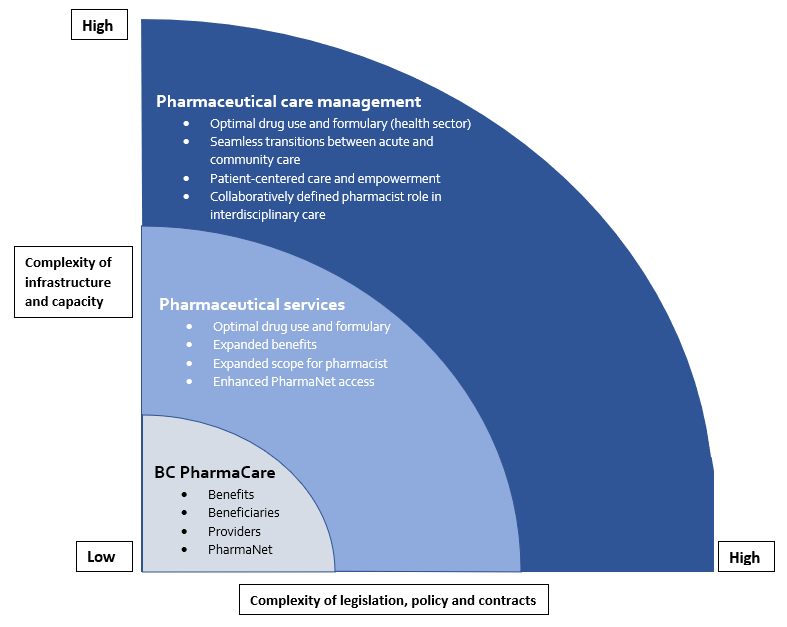
From low to high complexity
Low complexity of infrastructure, capacity, legislation, policy and contracts:
BC PharmaCare
- Benefits
- Beneficiaries
- Providers
- PharmNet
Medium complexity of infrastructure, capacity, legislation, policy and contracts:
Pharmaceutical services
- Optimal drug use and formulary
- Expanded benefits
- Expanded scope for pharmacist
- Enhanced PharmaNet access
High complexity of infrastructure, capacity, legislation, policy and contracts:
Pharmaceutical care management
- Optimal drug use and formulary (health sector)
- Seamless transitions between acute and community care
- Patient-centred care and empowerment
- Collaboratively defined pharmacist role in interdisciplinary care
Read the Pharmaceutical Care Management Strategy (PDF, 3.64MB) report for full details.
Key capability areas
The PCMS focuses on the strengths necessary to deliver on HSPO’s mandate while offering the greatest value to citizens. More than 50 partners who play key roles in pharmaceutical care management across the health sector were engaged to share perspectives on key capabilities, challenges and opportunities to deliver on the mandate. This included representatives from the Ministry of Health, the Provincial Health Services Authority, health authorities, regulatory colleges, research and academic institutions, health associations, health professionals, including family medicine and nursing, and community pharmacists.
These key capability areas were identified:
- Public and population health
- Policy and funding
- Design and delivery of pharmaceutical services
- Design and delivery of pharmaceutical care
- Human health resources management
- Monitoring, reporting and evaluation
- Digital IMIT, health technologies and infrastructure
Strategic areas of focus
To meet the needs of clients and populations, the PCMS aims to achieve the best possible patient outcomes from pharmaceutical care in nine strategic areas of focus:
- Integrated health systems planning and governance for pharmaceutical care management
- Primary care integration and collaboration
- Leveraging of community pharmacists
- Continuity of care re-design
- Provincial digital solutions that support access and integration of pharmacy care across the patient care trajectory
- Improved population health planning to support targeted interventions and optimal drug use
- System-level monitoring, evaluation, and performance measurement
- Citizen-centric digital tools, e.g. access to PharmaNet profile, mobile applications
- People and culture
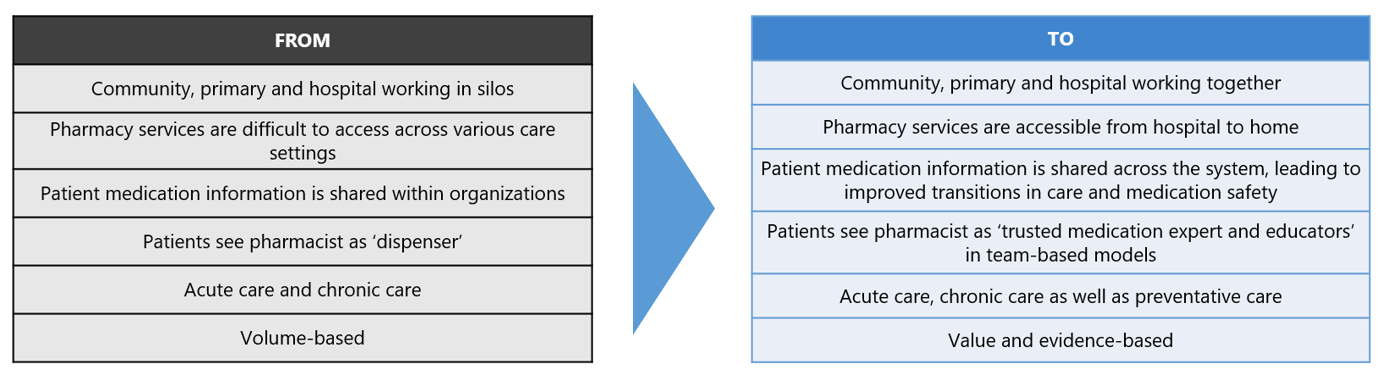
Implementing these strategic areas of focus will produce key shifts across the province: