
Mushroom compost facilities
 Last updated on April 13, 2026
Facilities producing mushroom compost (also called growing substrate) are regulated by the Mushroom Compost Facilities Regulation (MCFR) under the Environmental Management Act (EMA).
On this page
Mushroom Compost Facility Regulation (MCFR)
The MCFR has rules for managing:
- Discharges into the air (emissions)
- Solid wastes, and
- Liquid wastes (referred to as 'goody water' in the regulation)
Review the Mushroom Compost Facility Regulation (MCFR).
The MCFR regulates air emissions from the production of mushroom compost (Phase 1: Composting, followed by Phase 2: Pasteurization).
A site-specific waste discharge authorization is required to allow discharges of liquid or solid waste from Phases 1 and 2 into the environment.
Once the mushroom growing starts (Phase 3: Inoculation), the operation must follow the Code of Practice for Agricultural Environmental Management, or other applicable regulatory authorization (for example, a waste discharge permit), depending on the specific operations and discharges of the facility.
Municipalities may have bylaws that regulate mushroom compost facilities.
These bylaws may regulate a variety of different activities, including solid and liquid (effluent) waste management.
Municipalities should be contacted for more information.
Requirements summary
Amendments to the MCFR became effective in November 2013.
This regulation applies to facility operators who produce mushroom compost using a composting process and have discharged into the environment. The regulation covers requirements for managing emissions, the solid or liquid wastes from the composting process, and storage.
Solid or liquid waste discharges into the environment are not authorized under this regulation.
The liquid waste must be collected, contained, and not allowed to be discharged into the environment unless site-specific authorization is obtained. For example, leachate from the composting process and site-surface water from rain, or wash-down water (also known as 'goody water').
'Goody water' is named for its beneficial reuse in moistening compost piles.
Emissions
When compost materials (feedstock) are mixed and ready for the composting process, they must be moved into an enclosed facility.
The enclosed facilities 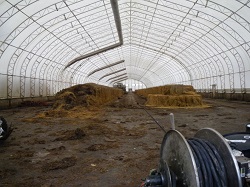 must be kept under negative pressure to prevent emissions from escaping to the outside.
All emissions from the enclosed composting process and the 'goody water' storage must be collected, contained, and treated through a biofilter because they may contain air contaminants.
The main air contaminants of concern are ammonia and hydrogen sulphide. WorkSafeBC lists the occupational exposure limits (OEL) for ammonia to be 25 parts per million, and for hydrogen sulphide to be 10 parts per million over a specified time.
Emissions of ammonia and hydrogen sulphide above these OEL limits can cause adverse health effects. Therefore, the emissions coming from the biofilter should be at or below these levels. These levels are measured as the emissions exit the biofilter, which indicate how well the biofilter is working.
The 'goody water' storage must be actively aerated. This means that air must be continuously forced into the 'goody water' through a submerged pipe, and the whole volume of 'goody water' must be mechanically agitated so that the aeration moves throughout the 'goody water' in storage.
Forced or active aeration has been shown to reduce emitted hydrogen sulphide and ammonia levels by 88% to 90% [1].
The aim of actively aerating the 'goody water' is to keep the ammonia and hydrogen sulphide levels below the level at which adverse health effects can occur.
[1] Noble et al. Aerated Recycled Water on Mushroom Composting Sites Affect Its Chemical Analysis and the Characteristics of Odour Emissions. 2009. J. Environ. Qual. 38:1493
Liquid waste
All leachate, wash-down water, and rain or stormwater landing on-site that comes into contact with the leachate must be collected and contained.
No discharge of the liquid waste is allowed, unless specifically authorized. This means that runoff is not allowed to move off-site or off any concrete pads onto the ground or into watercourses.
All liquid waste should be collected and directed into screened drains and piped to the 'goody water' storage. The screens should be cleaned regularly, and whenever there's debris blocking the liquid waste from entering drains and pipes.
All piping and pumps should be monitored and cleaned on a regular basis to ensure the liquid waste can flow easily into the 'goody water' storage.
Solid waste
All solid feedstocks, wastes and small particles should be contained and not allowed to escape off-site or be discharged directly into watercourses.
Solids that contain nutrients (for example, manure) must be protected from rain or stormwater to reduce leachate generation.
No discharge of solid waste is allowed, unless specifically authorized.
Outdoor composting
If the composting process and/or the 'goody water' storage are not in an enclosed facility, a site-specific authorization must be obtained under Section 3(5) of the regulation.
Pollution prevention plan
A pollution prevention plan must take into consideration all sources of contaminants and wastes (air, liquid, solid) from the facility. The plan must identify and explain how pollutants will be managed in detail.
An agrologist or professional engineer must review and confirm that the pollution prevention plan considers all air contaminants, and solid and liquid waste sources. It must also include a plan for operation and maintenance, a program for monitoring and reporting, and active aeration of the 'goody water.'
Submission of plans
Designs and construction plans for the facility must be submitted to the ministry 45 days prior to being implemented.
These plans must include:
- An air emission collection and treatment system, and
- A leachate and 'goody water' collection and treatment system
