
Biological parameters
 Last updated on February 27, 2026
On this page
Biomonitoring metrics
We compare the benthic macroinvertebrate communities found at each station to those found in rivers with the same habitat types and little or no human activity.
If a station’s biomonitoring metrics are similar to the metrics from undisturbed sites, it’s considered ecologically healthy. If they’re different, some environmental disturbance might be affecting the ecological health of the station.
The biological status reports may include the following analyses and biomonitoring metrics.
CABIN assessment
A CABIN assessment compares the macroinvertebrate community at a station to those at similar, undisturbed (reference) sites by plotting them all as dots on a graph (Reynoldson et al. 1995, 1997).
Sites with similar communities will have dots close together. Sites with different communities will have dots farther apart. If the station’s dot is far away from the group of reference dots, its macroinvertebrate community is different from the reference ones.
We assume the communities at the reference sites are healthy, so if the community at a station is very different from the reference sites, it may not be healthy.
Bray-Curtis dissimilarity
Bray-Curtis dissimilarity shows how different two macroinvertebrate communities are (Bray and Curtis 1957). It looks at which macroinvertebrates are in each community and how many there are.
Values can range between 0 and 1. A value of 0 means the communities are identical (0% dissimilarity). A value of 1 means the communities are completely different (100% dissimilarity).
RIVPACS
River InVertebrate Prediction and Classification System (RIVPACS) predicts which benthic macroinvertebrates are expected at a station if the river is healthy and is reported as a ratio of observed to expected macroinvertebrate families (Wright 1995) .
The O:E (observed to expected) ratio is the number of families you found divided by the number of families you expected.
A low ratio, near 0, indicates poor ecosystem health because the families that were expected at a station were missing.
A high ratio, near 1, indicates good health because the expected families were present.
A very high ratio, well over 1, means you found more families than expected, which could suggest a biodiversity hotspot or nutrient enrichment.
Abundance metrics
Abundance metrics tell us how many benthic macroinvertebrates were found at a station (Mazor et al., 2019, Resh et al., 2000).
Total abundance counts all macroinvertebrates found in a sample. Percentage abundance metrics for any type of macroinvertebrate tell us the proportion of a sample made up of those animals. For example, we calculate % Plecoptera (stoneflies) by counting all the stoneflies in a sample and then dividing by the Total Abundance to give the proportion of the sample made up of stoneflies.
Biotic index metrics
A biotic index measures the health of an ecosystem by looking at how different benthic macroinvertebrates respond to pollution (Mazor et al., 2019, Resh et al., 2000).
If pollution-sensitive macroinvertebrates are missing from a station, pollution may be affecting the river ecosystem. The Hilsenhoff Biotic Index (HBI) gives a score based on the types of macroinvertebrates found and how well they handle pollution (Hilsenhoff 1988). The scores range from 0 to 10 with a lower number indicating better water quality.
Metrics like Intolerant family richness and % Tolerant family abundance measure the portion of pollution tolerant or pollution intolerant macroinvertebrates in the community.
Functional group metrics
Functional group metrics tell us about how different types of benthic macroinvertebrates eat or behave (Mazor et al., 2019, Resh et al., 2000).
For example, shredders eat by shredding up organic matter like leaves, and clingers live by clinging onto rocks in fast flowing water. A healthy ecosystem should have a variety of macroinvertebrates living in a variety of habitats and feeding in different ways.
Richness metrics
Family richness is the number of different macroinvertebrate families (groups of macroinvertebrates that share similar characteristics) found in a sample (Mazor et al., 2019). Sometimes, only specific families are counted. For instance, Plecoptera families only counts the number of different stonefly families present.
Some richness metrics count the number of families that have certain traits such as Long-lived family richness. Generally, richness decreases with habitat disturbances, but some metrics, like Diptera families, might increase.
Richness is also combined with abundance to report Simpson’s Diversity and Simpson’s Evenness.
References
References
Bray, J. R. and J.T. Curtis. 1957. An Ordination of the Upland Forest Communities of Southern Wisconsin. Ecological Monographs 27(4):325–349.
Hilsenhoff, W. L. 1988. Rapid field assessment of organic pollution with a family-level biotic index. Journal of the North American Benthological Society 7(1):65–68.
Mazor, R.D., D.M. Rosenberg, and V.H. Resh. 2019. Chapter 7: Use of aquatic insects in bioassessment In: An introduction to the Aquatic Insects of North America 5th Edition (Merritt, R, Cummins, K. Berg, M.B. Eds.). Kendall Hunt Publishing Company, Duburque, 1498 pgs.
Resh, V.H., D.M. Rosenberg, and T.B. Reynoldson. 2000. Chapter 13: Selection of benthic macroinvertebrate metrics for monitoring water quality of the Fraser River, British Columbia: Implication for both multimetric approaches and multivariate models. In: J.F. Wright, D.W. Sutcliffe, and M.T. Furse (editors). Assessing the biological quality of fresh waters: RIVPACS and other techniques. Freshwater Biological Association, Ambleside, UK.
Reynoldson, T.B., R.C. Bailey, K.E. Day, and R.H. Norris. 1995. Biological guidelines for freshwater sediment based on BEnthic Assessment of SedimenT (the BEAST) using a multivariate approach for predicting biological state. Australian Journal of Ecology 20:198-219.
Reynoldson, T.B., R.H. Norris, V.H. Resh, K.E. Day and D.M. Rosenberg. 1997. The reference condition approach: A comparison of multimetric and multivariate approaches to assess water-quality impairment using benthic macroinveterbates. Journal of the North American Benthological Society 16(4):833-852.
Wright, J.F. 1995. Development and use of a system for predicting the macroinvertebrate fauna in flowing waters. Australian Journal of Ecology 20:181-197.
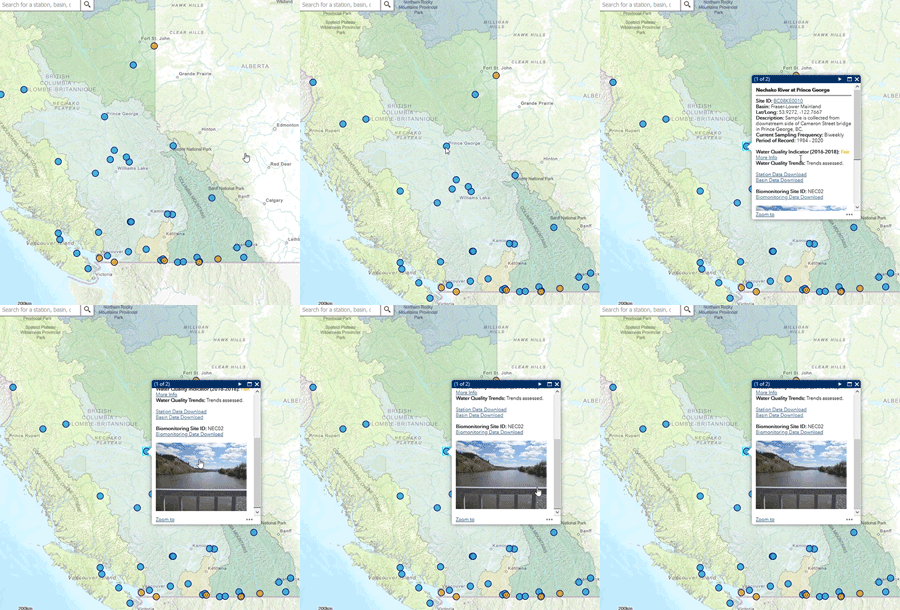
Use our interactive map to explore monitoring stations in the Canada-B.C. Water Quality Monitoring Program.
Related resources
Contact info

For more information, email the water quality scientists at: