
Snow conditions commentary
 Last updated on June 1, 2026
A bi-weekly commentary of snow conditions based on readings from the B.C. Automated Snow Weather Station (ASWS) network is published during the snow season. This is not the snow bulletin and the values listed are not the official snow basin indices.
June 1, 2026
Temperatures cooled during mid-May before warm weather returned and accelerated the melt of the remaining mountain snowpack toward the end of the month.
A complete listing of Automated Snow Weather Stations (ASWS), expressed as a percent of the long-term median for each station’s entire period of record, is available in the ASWS Weekly Summary (PDF, 385 KB)*. Hyperlinks to interactive plots are provided for each station within the table.
Note: These values are not the official snow basin indices.
The provincial average across all ASWS sites is 90% of the period-of-record median for June 1, 2026, a decrease from 95% on May 15. Stations within the Fraser River basin average 75% (May 15: 83%). On average, by June 1 approximately 55% of peak snowpack melts. This year, approximately two-thirds of this year's peak mountain snowpack melted by June.
A provincial composite graph of automated stations with relatively long-term records (beginning in 1988) is provided below.
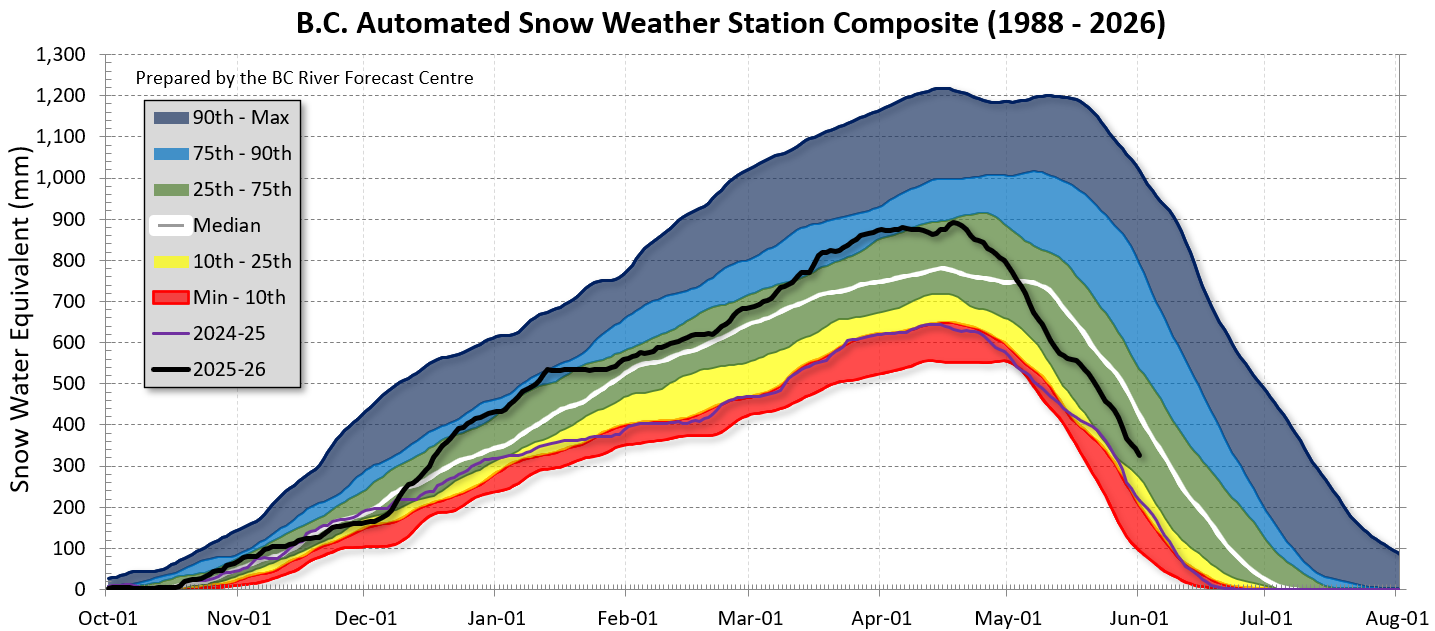
Based on this composite, the June 1st percentage of median is 73% (May 15: 81%), placing current conditions at approximately the 39th percentile (May 1: 33rd percentile).
The June 1, 2026 Snow and Water Supply Bulletin is scheduled to be released June 9th or 10th, 2026, or earlier, based on data availability. The bulletin will provide a more comprehensive summary of the June 1 snowpack conditions and will include the official Snow Basin Indices.
Snow Links
Contact information
For media inquiries please contact Government Communications and Public Engagement (WLRS) at 250-896-7365
For other contacts, please check the B.C. Government Directory.