
Floodplain mapping
 Last updated on June 9, 2026
A floodplain is an area of low-lying land that is susceptible to flooding from a neighboring watercourse, ocean, lake or other body of water. This page provides information about floodplain maps: what they are, how they are used and the programs that support them.
On this page
- About floodplain maps
- Floodplain maps and flood hazard information
- How floodplain maps are developed
- Understanding flood scenarios
- How floodplain maps are used
- Flood Hazard Identification and Mapping Program
- Guidelines that support the use of floodplain maps
About floodplain maps
Floods are natural processes and are an important aspect of healthy ecosystems but become a concern when they result in negative impacts to people, the environment, infrastructure and communities.
Floodplain maps outline areas that are highly susceptible to flooding. However, flooding may still occur outside of these areas.
Why we need floodplain maps
Floodplain maps provide information that help us understand where flood waters could hit, how those areas could be affected and how we can mitigate those potential impacts.
Flood hazard and flood risk
Floodplain maps show where flooding could occur and the potential hazards it may pose. A flood hazard refers to a flood event that could cause harm, including impacts on people and communities, the economy and the environment.
Flood risk considers a combination of the hazard, how likely a flood is to happen and how vulnerable people and places are to its effects.
How flood hazard information informs floodplain maps
Flood hazard information is created to help people understand where flooding can occur and what it might look like. This can include details on how deep, fast or extensive floodwaters may be, land erosion and debris flows. This information helps communities plan and make informed choices about living, working and building in areas that may be affected by flooding.
Floodplain maps and flood hazard information
A key use of flood hazard information is the creation of floodplain maps. These maps show areas that may flood and are widely used to support land‑use planning, development decisions and floodplain management. They may also include information on flood construction levels and setbacks to help guide safer development and reduce flood risk.
How floodplain maps are developed
A floodplain map is developed with guidelines from the Federal government and Engineers and Geoscientists British Columbia, and may include:
- The flood construction level (FCL) - The minimum elevation used to reduce flood damage to habitable buildings and other structures. A detailed technical description of FCL is available in B.C.’s Flood Hazard Area Land Use Management Guidelines (PDF, 1.9MB)
- Setback: The minimum distance required between future development and a river, stream, or shoreline to reduce the risk of erosion and other hazards
- Flood extent: The area that may be reached or inundated by floodwater during a design flood or design event
- Design flood (or design event): A hypothetical flood scenario representing a specific magnitude with a defined probability of being equaled or exceeded in any given year (refer to the annual exceedance probability and return period table.) This scenario is used to determine the flood construction level (FCL)
Understanding flood scenarios
Floods are often described by the likelihood that a flood of a given size will occur in any year, known as flood frequency.
Two terms are used to describe flood frequency: annual exceedance probability (AEP) and return period. While these terms both describe how likely it is that a given flow will occur, or be exceeded, in a single year, they break down the likeliness in different ways:
- Annual exceedance probability (AEP) is expressed as a percentage (for example, 5 percent)
- Return period is the inverse of AEP and is expressed as a ratio (for example, 1:20) or in years (for example, a 20-year event)
For example, a flood with a 5 percent AEP has a 1-in-20 (or 1:20) chance of occurring or being exceeded in any given year.
It is important to note that floods can occur at any time, may exceed the estimated level, and some areas of the floodplain may experience flooding more frequently than indicated by the mapped flood scenario.
|
Annual Exceedance Probability (AEP) |
Return period |
|---|---|
|
5% |
20 year |
|
2% |
50 year |
|
1% |
100 year |
|
0.5% |
200 year |
|
0.2% |
500 year |
A common misunderstanding is that if a 1 in 20-year flood event has occurred, then it will not occur for another 19 years, which is incorrect. Given the AEP, a 1 in-20-year flood event has a 5 percent chance of occurring in any given year, regardless of when the last flood occurred.
How floodplain maps are used
Floodplain maps provide the basis for many flood risk reduction activities that statutory decision makers, local governments and policy makers can undertake, including:
- Establishing flood construction levels (FCLs) for bylaws, subdivision approvals, and local planning
- Land use planning to mitigate flood risk in high‑risk and flood‑prone areas, including the development of setback bylaws where appropriate
- Supporting resilient development, including designs that are adaptable to or capable of accommodating flood risk
- Providing design guidance for infrastructure located in flood‑prone areas
- Identifying priority areas for investment in structural flood protection (for example, dikes) or nature‑based solutions
- Informing emergency planning, including evacuation routes, emergency service access (ambulance and fire), safe assembly areas, and preparedness and recovery measures before and after flood events
The use of floodplain maps in conjunction with the Flood Hazard Area Land Use Management Guidelines (PDF, 1.9MB) helps to support flood risk reduction planning. Under the Local Government Act, these provincial guidelines must be considered by local governments when instituting bylaws.
History of floodplain mapping in B.C.
A provincial floodplain mapping program began in B.C. in 1974 to identify flood hazard areas. From 1975 to 2003, the B.C. government managed development in designated floodplain areas under the Floodplain Development Control Program.
From 1987 to 1998, floodplain mapping was a shared responsibility between the federal and B.C. government under the Canada-B.C. Floodplain Mapping Agreement. From 1987 to 2003 the Provincial Flood Plain Mapping Program operated parallel to the Canada-B.C. Agreement, producing floodplain maps and design brief reports.
In 2003, the Flood Hazard Statutes Amendment Act shifted the authority for most floodplain development decisions from the B.C. government to local governments. This change enabled local governments to designate floodplains and regulate floodplain development provided that provincial guidelines are considered.
Floodplain maps from both the 1974-2003 Floodplain Development Control Program and the 1987-1998 Canada-B.C. Floodplain Mapping Agreement are publicly available in the ClimateReadyBC - Flood Study Explorer.
The Flood Hazard Identification and Mapping Program
High-quality and up-to-date flood mapping helps governments, communities and individuals understand flood hazards. This is the foundation for actions to reduce the impacts of flooding.
In 2021, Natural Resources Canada launched the Flood Hazard Identification and Mapping Program (FHIMP) to create up-to-date flood maps of higher-risk areas in Canada and make this flood hazard information accessible in support of land use planning, flood mitigation, climate change adaptation and emergency response.
FHIMP program funding
The FHIMP offers 50 percent federal matching funding to provinces for eligible activities through to 2028. The B.C. government is participating in the FHIMP by cost-sharing on flood mapping and other eligible activities in many high-risk areas of B.C.
FHIMP mapping projects in B.C.
Work is underway to complete flood mapping in 6 study areas, covering 72 communities in Phase 1:
- Coquihalla and Fraser rivers from Yale to Mission
- Nicola and Coldwater rivers, near the Merritt area
- Fraser and Nechako rivers around Prince George
- Bulkley and Skeena rivers from Houston to downstream of Terrace
- Shuswap Lake and the mainstem rivers that drain into it
- Upper Columbia and Kicking Horse Rivers, including near Golden and Invermere
These study areas include the main rivers and some tributaries. In addition to data collection, flood mapping and engagement with communities, the FHIMP projects have included the development of the ClimateReadyBC - Flood Study Explorer to share data and flood maps as they are completed.
The B.C. government continues to work with Natural Resources Canada on the FHIMP through the completion of additional flood mapping studies, eligible projects and engagement with communities.
This project directly aligns with the B.C. Flood Strategy, working to progress Pathway 1: Understanding Flood Risks.
FHIMP Phase 1 study areas map
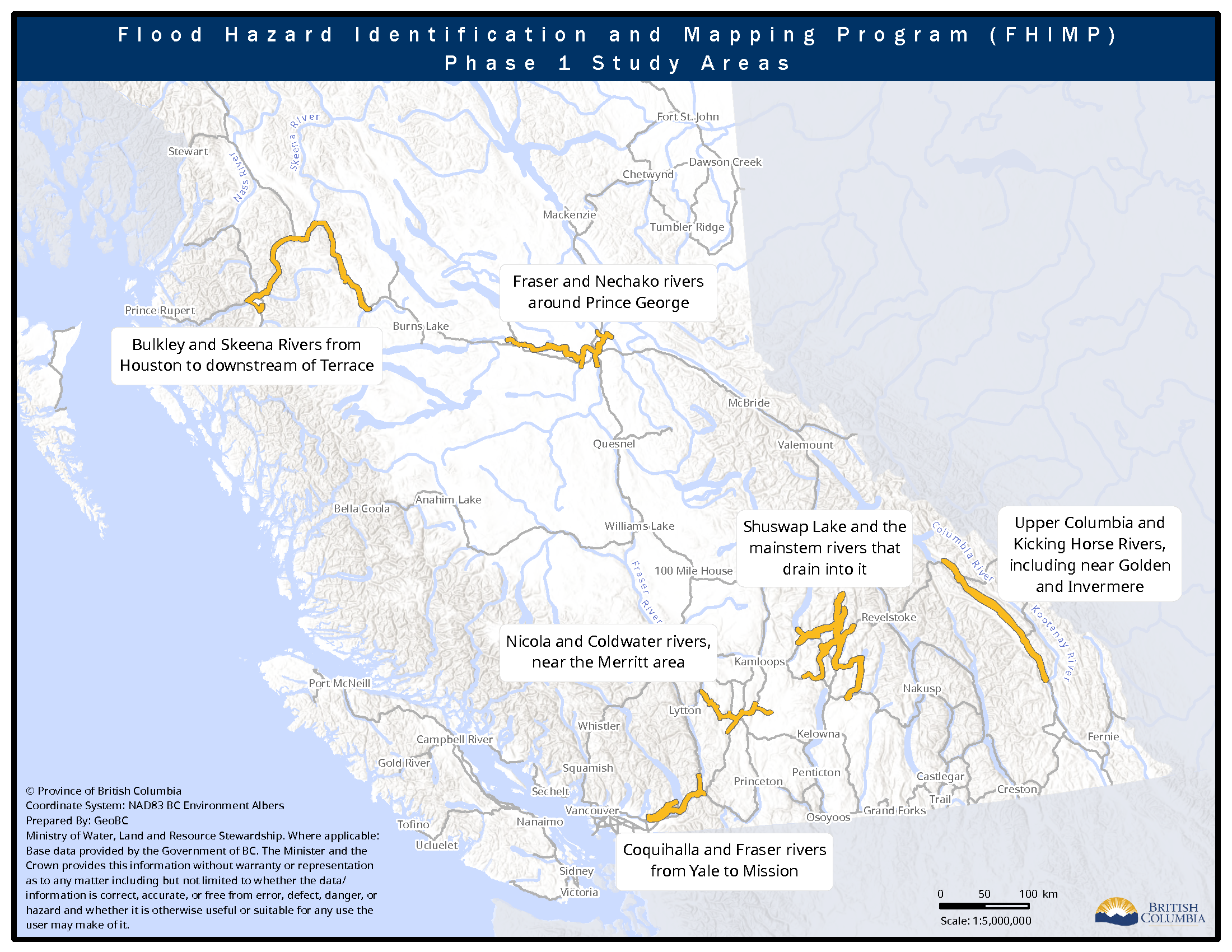 Select the map above to expand.
Download the FHIMP Phase 1 Study Areas Map (PDF, 1.8MB).
Guidelines that support the use of floodplain maps
Information that supports the use of floodplain maps and flood risk reduction efforts includes:
- The Flood Hazard Area Land Use Management Guidelines (PDF, 1.9MB) provide provincial guidance intended to help local governments, land use managers and approving officers develop and implement land use management plans and make subdivision approval decisions for flood hazard areas
- The Dike Design and Construction Guide has been developed by the B.C. government to present basic principles used in the design and construction of dikes
- The Coastal Floodplain Mapping Guidelines and Specifications (PDF, 9.1MB) provide a technically sound basis for local governments to develop coastal floodplain maps, including an estimation of Flood Construction Levels based upon best mapping and engineering practices. Coastal floodplain mapping can identify coastal flood hazards, such as sea level rise, and provides valuable information for land use planning, bylaw development and sea level rise adaptation strategies
- The Sea Level Rise Adaptation Primer (PDF, 3.3MB) is a toolkit for local governments to help identify and evaluate options for adapting to the impacts of sea level rise and associated hazards
- Engineers and Geoscientists BC Professional Practice Guidelines Flood Mapping in B.C. provides a common level of expectation for various stakeholders with respect to the level of effort, due diligence and standard of practice to be followed when carrying out flood mapping in B.C.
- Engineers and Geoscientists BC Professional Practice Guidelines Legislated Flood Assessments in a Changing Climate in BC V.2.1. offers guidance on professional practice for flood assessments, identify the circumstances when risk assessments are appropriate, and emphasize the need to consider climate change and land use changes in such assessments