
Safe Access to Places of Public Worship Act
 Last updated on May 1, 2026
On this page
- What the Act does
- Eligible places of public worship
- Sign requirements
- Sample signs
- What happens if people contravene the Act
What the Act does
The Safe Access to Places of Public Worship Act allows certain areas around places of public worship to be protected from certain behaviours. These areas are called access zones. An access zone exists only if the place of worship has put up the required signs. Access zones do not include private residences or areas that are not normally open to the public.
While inside an access zone, people are not allowed to:
- Block someone from entering or leaving the place of worship
- Disrupt services or other activities at the place of worship
- Try to persuade someone to not take part in an activity at the place of worship, including by saying or shouting things, or by holding signs with words or images (this is defined as “interference” in the Act)
- Intimidate someone or do anything that could reasonably make them fear for their physical or mental safety
- Participate in a group of people who are doing any of the things listed above
These rules do not apply to:
- Activities approved by the owner or occupier of the place of worship
- Lawful strikes, lockouts or picketing
Eligible places of public worship
A place of public worship can set up an access zone only if it is exempt from taxation under the following:
- Section 220 (1) (h) of the Community Charter
- Section 396 (1) (c) (iv) of the Vancouver Charter
- Section 15 (1) (d) of the Taxation (Rural Area) Act
Places of public worship are responsible for finding out if they meet this requirement. They may wish to get legal advice if they are unsure.
Sign requirements
A place of public worship that wants an access zone must post signs that:
- Are easy to see in daylight and normal weather
- Include clear text or graphic representations
- Can be seen from specific locations (see sample signs for details)
- Identify the place of worship
- Define the areas included in the access zone
- List the behaviours that are not allowed under section 2 of the Act
An access zone is active at all times while signs are posted. Only the owner or occupier may remove or change signs. It is an offence for anyone else to remove, damage or alter them.
Other than what is described above, there are no additional sign requirements in the Act.
Sample signs
For convenience, sample signs are provided below. These samples must be customized for each place of worship.
Sample sign for a place of public worship on a single parcel
Some places of worship are on their own parcel of land, and the land is not shared with other tenants or owners. For these locations, signs must be visible from the usual entry points to the parcel.
The access zone for a place of worship on its own unshared parcel includes:
- The entire parcel on which the place of worship is located
- An area extending 20 metres in all directions from the parcel
ParcelMap BC is a helpful source for a map of the parcel to include on a sign.
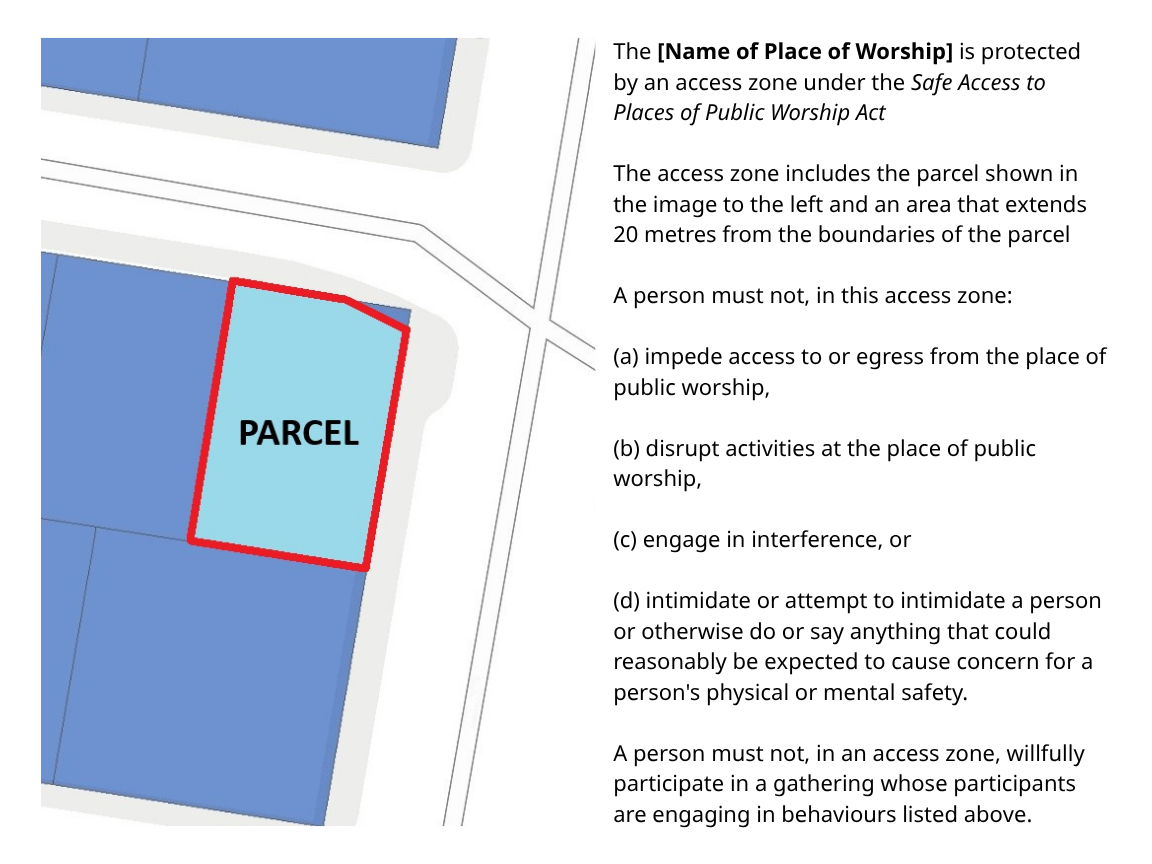
See the sample sign for a place of worship on a single parcel.
(Please note this is an example and will need to be customized to a place of worship.)
Sample sign for a place of public worship in a multi-use building
Some places of worship are located on parcels shared with other owners or tenants, such as malls, multi-storey buildings or developments that contain multiple buildings. These are called multi-use buildings in the Act.
Some of these places of worship may not want, or may not be allowed, to put up signs at the shared entrance to the multi-use building. If so, signs may be placed only at the entrances to the place of worship itself. Places of worship must determine whether their building has any rules about where signs can be posted on the parcel.
The location of the signs determines what is included in the access zone.
Signs at each entrance to the multi-use building and each entrance to the place of worship
If signs can be seen when approaching each entrance to the place of worship and each entrance to the multi-use building, the access zone includes:
- The place of public worship
- Areas extending 20 metres from each entrance and exit of the building or development
- 20‑metre‑wide paths connecting the place of worship to the building’s entrances and exits

See the sample sign for this type of access zone.
(Please note this is an example and will need to be customized to a place of worship.)
Signs only at each entrance to the place of worship in a multi-use building
If signs can be seen when approaching each entrance to the place of public worship only and not from the shared multi-use building entrances, the access zone includes:
- The place of public worship
- Areas extending 20 metres from each entrance and exit of the place of worship
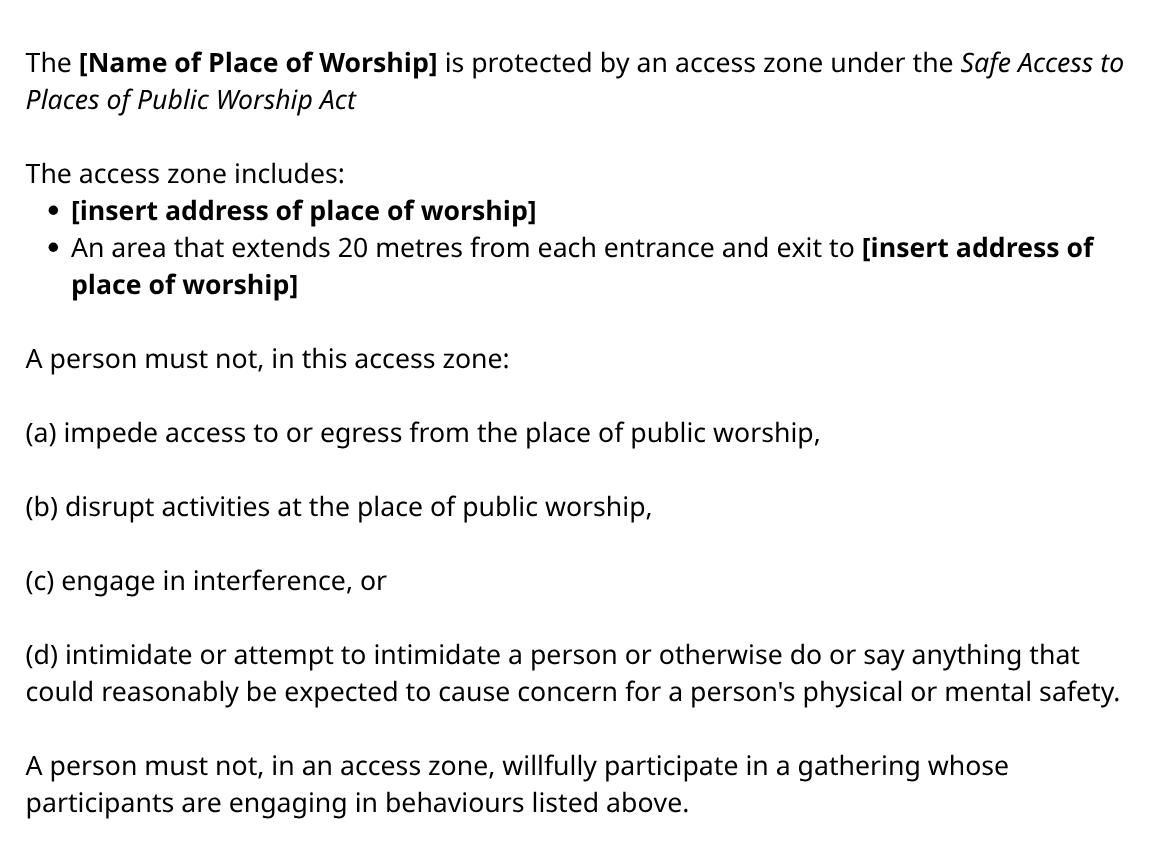
See the sample sign for this type of access zone.
(Please note this is an example and will need to be customized to a place of worship.)
What happens if people contravene the Act
People who contravene the Act may face:
- Arrest without a warrant
- A violation ticket with a $2,000 fine, plus a required victim surcharge levy (an amount added to provincial fines and used to fund victim services)
Places of public worship can also apply for an injunction, which is a court order to stop someone from contravening the Act. Under the Act, the court can make this order without notice, and even if the person also faces other penalties.