
Smoking and vaping-free places
 Last updated on July 24, 2026
On this page
- Indoor use
- Outdoor buffer zones
- School properties
- Exceptions
- Exemption for prescribed medical products
Indoor use
People cannot smoke or vape inside indoor public places or workplaces, such as:
- Offices
- Malls and stores
- Cafes
- Indoor places open to the public
- Where people work
- Breakrooms and bathrooms of public places or workplaces
- Common areas of hotels, apartments and condominiums (like hallways, laundry rooms and party rooms)
Fully or substantially enclosed
Smoking and vaping is not permitted in any fully or substantially enclosed public places and workplaces. This includes both permanent structures and temporary ones such as marquee tents.
Places are considered fully or substantially enclosed if they have a roof or other type of covering, and more than 50% of the “nominal wall space” prevents the air from easily flowing through it.
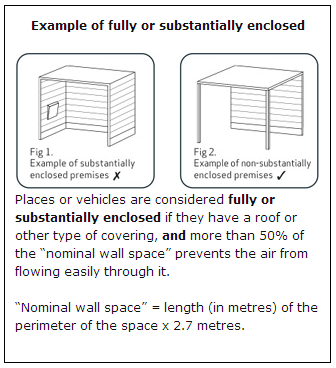
If you need more guidance on whether your premises are enclosed or substantially enclosed, please contact an enforcement officer at your health authority.
Many places have their own policies that go beyond provincial laws and create 100% smoking and vaping-free places.
See the exceptions to where limited indoor usage may be allowed.
Vehicles
You may smoke or vape in a personal vehicle unless someone under the age of 16 is inside.
It is a violation of the Motor Vehicle Act to smoke or vape in any vehicle when youth under 16 are present.
Work vehicles
You may not smoke or vape in a work vehicle.
The Tobacco and Vapour Products Control Act bans smoking and vaping inside all workplaces. If you are using a work vehicle, then it is a workplace and you cannot smoke or vape inside it, even if you are the only one inside.
Homes
You may smoke or vape in a home unless it is another person’s place of work. WorkSafeBC notes that smoking must stop one hour before workers or service providers come to work inside your home. Service providers can be homecare workers and trades people.
Multi-unit buildings
Many buildings have smoke-free and vapour-free policies. If you live in a multi-unit building, like an apartment, condominium or townhouse, keep in mind:
- You cannot smoke or vape within six metres of the doorways, open windows or air intakes connected to common areas (for example, lobbies, laundry rooms and hallways)
- Your building can ban smoking inside units, outside balconies and the whole property
For more information on smoke-free homes, see Smoke-Free Housing BC and Clean Air Coalition BC.
Rental units
Municipal governments set standards of maintenance for landlords to follow under the Residential Tenancy Act. In B.C., landlords must provide rental accommodations that are healthy and safe for tenants.
If you are concerned your rental is not meeting the law’s health and safety standards, contact the Residential Tenancy Branch or BC Housing. You can also contact the Tenant Resource & Advisory Centre at 1-800-665-1185 to get free legal education and advocacy for B.C. tenants.
Hotel rooms
Check with your hotel to learn about their smoking or vaping policies.
You cannot smoke or vape:
- In hotel common areas, such as lobbies, hallways and restaurants
- Within six metres of doorways, open windows or air intakes around the hotel
Many communities have bylaws with larger buffer zones. Check with the local community for laws in the area.
Outdoor buffer zone
The Tobacco and Vapour Products Control Act and Regulation sets a six-metre buffer zone around all doorways, air intakes or open windows to any public place or workplace where no one can smoke or vape. This protects against smoke and vapour from coming indoors and protects people as they enter or exit.
Places that are considered public places or workplaces can include:
- Stores
- Offices
- Entrances to condominiums and apartment buildings
- Work vehicles (for example, delivery vans)
- Public transit and taxis
- Cafes
- Casinos
- Pubs and bars
Buffer zone exception
You may smoke or vape on an outdoor hospitality patio that is within a buffer zone if there are no open windows, doors or active air intakes between the patio and the hospitality venue. This can include the patio of a bar, casino or café.
For example, you can vape on a casino’s patio if the:
- Doors are closed except for exiting or entering
- Windows to the casino are closed
- Air intake is not operating
Community or municipality regulations
You may be in a community or municipality that has greater regulations on outdoor smoking and vaping. Some communities in B.C.:
- Ban smoking or vaping on hospitality patios
- Have buffer zones larger than six metres
- Ban smoking or vaping in outdoor spaces such as beaches or playgrounds
You must follow the bylaws that are more restrictive.
For example, the provincial legislation allows smoking and vaping on a hospitality patio. However, your municipality bans it through a bylaw. Therefore, you must follow the municipality bylaw.
Enforcing the buffer zone
Owners and managers must take reasonable steps to prevent people from smoking and vaping within the six-metre buffer zone on their property.
They do not need to enforce the law on public property such as sidewalks, unless the person is a customer or patron, or is their employee. For example, if you place a bench at the doorway to your store, you must make sure people do not smoke or vape while sitting there.
You can print your own no smoking or vaping sign (PDF, 152KB).
Many local governments have more restrictive laws in place. Check with your local government before making any changes to your property. Also check with WorkSafeBC for any other requirements that may affect your property.
School properties
All public and private kindergarten to Grade 12 schools in B.C. are tobacco and vapour product-free under the Tobacco and Vapour Products Control Act and Regulation. This ban applies to all school property 24 hours a day, 7 days a week, every day of the year. The ban also includes:
- Parking lots
- Sports fields
- Driveways
- Courtyards
- Vehicles parked on parked on school property
Ceremonial use exemption
The ceremonial use of tobacco is exempted from the ban on tobacco and vapour product use in schools as long as:
- The ceremonial use is pre-approved by the school board
- It is performed for a traditional Indigenous activity
Exceptions
There are places where limited indoor smoking or vaping may be allowed.
Health authority properties
Health authorities may have indoor and outdoor smoking areas that allow smoking or vaping.
You can only use tobacco and vapour products on health authority sites:
- In a hospital or residential care facility if there is a designated room that meets the standards set by WorkSafeBC. Only residents and patients can smoke or vape in this room. Visitors and staff cannot
- If a designated outdoor use area is provided, health authorities may designate the area as:
- Tobacco use only
- Vapour product use only
- Both tobacco and vapour product use
Health authorities are not required to have these areas.
If patients and residents are concerned about how they will cope without smoking or vaping while on site, they should speak to facility staff. Nicotine medication can regulate nicotine levels and make adjustments easier.
Testing in adult-only vapour product stores
Adult-only stores can show customers how to use vapour products and test products that they want to buy, with the following conditions:
- Retailers and employees can hold and activate vapour products only to show customers how to use the product
- Retailers and employees cannot use the vapour product
- A customer can sample an e-substance in the store if:
- They are testing or sampling products that they intend to buy and use off-site
- There is a maximum of only two customers sampling vapour products at any time in a retail store
- Retailers must ensure the second-hand vapour does not escape to neighbouring properties or public areas
Exemptions for prescribed medical products
Section 2.41 of the Tobacco and Vapour Products Control Act notes exemptions from the ban on indoor use for vapour products approved by Health Canada.
Currently, there are no exempted products.