
Supporting B.C.’s softwood lumber industry
 Last updated on August 11, 2026
British Columbia is defending our forest sector from economic threats and seizing new opportunities to find new markets, create jobs and get more value for our wood products.
On this page
Get updates
- Sign up to stay updated on the work underway to grow B.C.’s forest sector
Overview
B.C.’s softwood lumber is in high demand for building everything from furniture to homes in countries around the world.
As the United States continues to impose new and unpredictable duties and tariffs on our softwood, the Government of B.C. is taking action to protect businesses and workers and keep these good-paying jobs in communities throughout our province.
Supporting forest workers, businesses and communities
B.C. is the third largest exporter of softwood lumber in the world. The industry supports nearly 100,000 jobs, operates more than 2,000 facilities, and contributes almost $13 billion to the economy each year.
We are building a stronger forest industry that is less dependent on a single trading partner. We’re finding new opportunities to make more wood products, create more jobs, and keep more value here at home.
B.C. Softwood Lumber Advisory Council
The advisory council was formed in January 2025 to advocate for forestry workers, help navigate the impact of unjustified trade actions, and support our response to tariffs.
Members include forestry sector leaders, labour representatives and experts on U.S. relations. The council meets regularly to provide ongoing advice to the Minister of Forests.
Roles and responsibilities
- Support diplomatic and trade strategies and measures to defend B.C.’s interests
- Recommend actions B.C. can take to eliminate current softwood lumber duties
- Help the Province advocate to the federal government for support for the forest sector
Council members
- Ravi Parmar, Minister of Forests, Chair
- Harry Bains, former Minister of Labour, Government of B.C.
- Dan Battistella, former president, Interior Lumber Manufacturers’ Association
- Linda Coady, former president and CEO, BC Council of Forest Industries
- Geoff Dawe, national president, Public and Private Workers of Canada
- Rick Doman, chairman, Boreal Carbon Corporation and former forestry executive
- Scott Lunny, western director, United Steelworkers
- Gavin McGarrigle, western regional director, Unifor
- Ric Slaco, former vice-president and chief forester, Interfor
- Dallas Smith, president and CEO, Na̲nwak̲olas Council
Learn more
- New B.C. Council will advocate for forestry workers (Feb. 5, 2025)
- History of Softwood Lumber Trade Dispute (April 15, 2026)
Forest Sector Strategy for Canada
The federal government is working with provinces and industry to develop a Forest Sector Strategy for Canada.
The objective is to transform the sector by making Canada the world leading supplier of traditional and advanced forest products and maximizing the value and sustainability of its forest assets.
The work to develop the strategy is being done in stages.
- Canadian Forest Sector Transformation Task Force. The task force completed their 90-day mandate in April 2026 to deliver a report and roadmap on ways to restructure, retool and transform Canada’s forest sector for long-term competitiveness and sustainability.
- Draft Action Plan to Transform Canada’s Forest Sector. Natural Resources Canada is engaging with provinces, territories and Indigenous organizations on a draft action plan that will form the basis of the new strategy.
- Forest Sector Strategy for Canada. The federal government is expected to release the final strategy in late 2026.
Learn more
Federal-provincial forestry programs
B.C. has been working with the federal government on forestry-specific programs to provide more support to protect people’s livelihoods.
Programs and initiatives
- Liquidity support. Financial support for mills and wood-product companies to manage cash flow pressure caused by softwood lumber duties, market volatility or tariff-related costs.
- Transformation and market diversification support. Funding for businesses to innovate, diversify products and grow in new markets.
- Worker support. Programs that provide training, income support and resources for affected workers and communities.
- Prioritize Canadian wood. The federal government changed federal procurement processes to require contracted companies to source Canadian wood and engineered wood products.
How to access
- Submit a request online to connect to a service navigator. Experts can help you find the programs you or your business may be eligible for.
Learn more
Regional Tariff Response Initiative in British Columbia
The Regional Tariff Response Initiative (RTRI) is part of a coordinated effort to protect Canadian businesses, workers and supply chains from the impact of tariffs.
The one-billion-dollar RTRI fund includes $300 million to support the transformation of Canada’s forest sector. Businesses in B.C. can access funding to help pivot operations to new pathways for growth.
How it works
- Small- and medium-sized enterprises (SMEs) facing trade and tariff disruptions can apply for funding for projects that:
- boost productivity and reduce costs
- build more resilient supply chains
- reach new markets
- Eligible organizations include:
- Incorporated for-profit businesses with 10-499 full-time employees
- Not-for-profit organizations that support SMEs
- Funding of $200,000 to $10 million per project is available through interest-free repayable and non-repayable contribution streams
How to access
- Apply online through the online application portal. Applications are still being accepted.
Successful applicants
- 24 businesses and organizations in B.C. received $30.5 million in the first wave of RTFI funding in August 2026
Learn more

Support for workers and businesses
Find more provincial supports for forestry workers, businesses and communities.

Building B.C.'s economy stronger
Learn more about the work we’re doing to build an economy that makes our country stronger and works better for people.
B.C.’s response to unjustified tariffs
Learn how we’re standing strong for British Columbians in the face of economic threats.
Expanding to new trade markets
We continue pursuing growth for B.C. wood products both at home and abroad by expanding trade relationships with global markets and promoting the merits of wood use.
B.C.’s market development agency, Forestry Innovation Investment, provides support through market initiatives, funding programs and industry resources.
Built a renewed trade presence in Europe
We opened a new forestry trade office in the United Kingdom in 2025 to position B.C. as a preferred supplier of wood building materials. It joins an international network of offices in China, India, Vietnam, Japan and South Korea.
Assembled the largest forestry trade mission in B.C.’s history
Targeting Japan and South Korea, this trade mission to Asia in 2025 resulted in several signed memoranda of understanding, powerful international partnerships, and sought significant investments for B.C. businesses.
Secured agreement with China for B.C. wood
In 2026, the governments of B.C. and Canada signed a 5-year agreement with China’s Ministry of Housing and Urban-Rural Development to use more Canadian wood in housing construction in China.
Promoting innovation and new wood products
Thanks to our strength in technology and research, B.C. is becoming a hub for advanced manufacturing and mass timber construction. We’re seizing this opportunity to create more jobs in local communities and get more value from our forest products.
Make More in B.C. project
With support from FPInnovations, the Make More in B.C. project supports the development of regional economic hubs to grow the forestry sector and unlock more value from our forest products.
Make More in B.C. goals
- Foster collaboration among forestry businesses, local manufacturers, contractors and First Nations partners
- Support long-term strategies and solutions that strengthen local forest economies
- Increase production of B.C. wood products, from mass timber to pulp and paper products
- Create more jobs and get more wood products to markets at home and abroad
Learn more
- Make More in B.C. project will protect, create forestry jobs (May 12, 2026)
Advancing construction innovation
B.C. is shaping the future of construction in Canada. We are driving economic growth by pioneering smart construction solutions from robotics and AI integration and creating advanced building technologies at leading research hubs.
Construction innovation will help build more homes and infrastructure faster, strengthen supply chains, and create new opportunities for B.C. wood products.
Through the Look West strategy, B.C. aims to triple the amount of B.C. wood used in construction by 2035.
Look West goals
- Leverage federal investments in housing and defence infrastructure projects to use B.C. wood
- Boost value-added products and speed throughput by factory construction
- Streamline processes, policy and regulations to enable use of B.C. products
- Apply digital tools and innovation to increase productivity
Learn more
Shifting to value-added wood manufacturing
B.C. is shifting from selling raw logs to making high-value mass timber and engineered wood products used for pre-fab housing, millwork, furniture, cabinets and more.
We are committed to growing this sector to unlock more value from every tree we harvest. It also creates more jobs, lowers building costs and supports a sustainable forest economy.
Supports available
- Value-Added Accelerators: A collaborative initiative designed to grow and strengthen the wood manufacturing sector in B.C.
- Value-Added Manufacturing Program: BC Timber Sales introduced category 4 and 5 programs designed to provide a dedicated supply of fibre to value-added manufacturers and custom cutters and processors.
- Value-Added Sectors Strategies Branch: Regional specialists connect manufacturers with producers, tenure holders and First Nations to enhance local fibre flow. They also support pilot projects, policy solutions and tool development.
Learn more
Leading mass timber construction
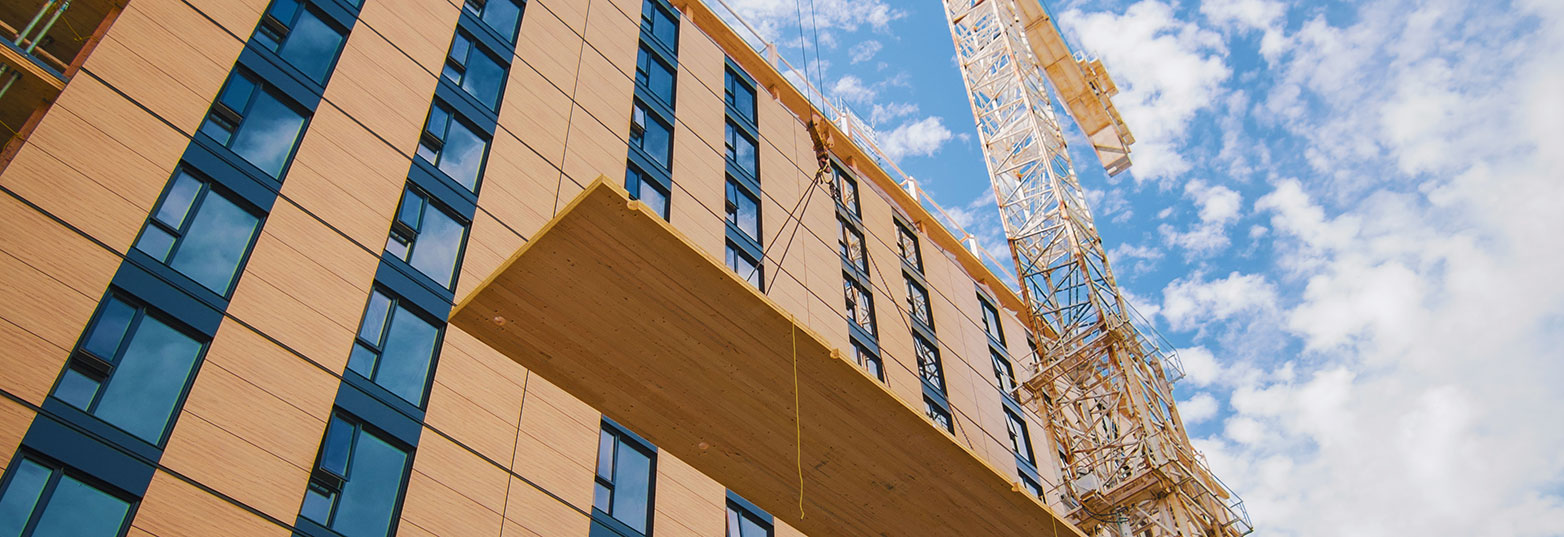
B.C. is positioning itself as a global leader in mass timber construction. Our building designers, manufacturers and builders are sought after around the world.
B.C. was the first in Canada to permit six-storey wood-framed residential buildings – unlocking a wave of mid-rise development now common across the country. We have the highest number of mass timber buildings per capita in North America.
Competitive advantages of mass timber
- Sustainable: Aligned with green-building practices to lower emissions
- Strength: Light but strong enough to supplement or replace structural steel or concrete
- Minimal waste: Uses advanced, high-tech manufacturing techniques to maximize the use of wood
- Building codes: Updated building codes allow for wooden buildings up to 18 storeys, and the use of mass timber in more building types including schools, retail, care homes and industrial facilities
Learn more
Defending against U.S. trade actions
The United States uses more softwood lumber than it can produce. It relies on Canada to provide stable, quality lumber to help meet demand for housing and other uses.
For more than 25 years, the American lumber industry has lobbied the U.S. government to impose duties, tariffs and laws to restrict Canadian imports. It unfairly claims Canadian lumber is subsidized and dumped into the U.S. market at lower prices than local products. These allegations are unfounded.
B.C. is working with the federal government and other provinces to defend the forest sector in ongoing trade litigation. We are also challenging decisions through the US Court of International Trade, the World Trade Organization, and under the Canada/U.S./Mexico Agreement (formerly NAFTA) to determine if the U.S. breached their obligations and applied their trade laws incorrectly.
Past dispute settlement panels have consistently ruled in Canada’s favour, confirming B.C.’s forest policies comply with international agreements.
- Softwood lumber trade dispute
- Trade litigation timeline and records
- Appeals, challenges and decisions
- Canada-U.S. softwood lumber trade (Government of Canada)
Important Information
This page provides high-level summaries of Softwood Lumber developments and included links to key Lumber V dispute documents. While best efforts are taken to keep this page up to date, information on this site should not be relied upon for comprehensiveness or used in place of legal advice.
Get updates
Stay up to date on the work underway to grow B.C.’s forest sector and how it's making a difference for British Columbians.
- Read Ministry of Forests news releases
- Sign up to receive forestry news as it happens
- Subscribe to get alerts when we update this page using the form below
Subscribe
Enter your email address to subscribe to updates of this page.