Collaborative Stewardship Framework
 Last updated on June 2, 2026
The Collaborative Stewardship Framework (CSF) represents the B.C. government’s partnership-based approach to natural resource stewardship in British Columbia.
On this page
About CSF
Through CSF, the B.C. government works with partner First Nations as well as industry, interested parties and the public to advance a regional approach to environmental stewardship and resource management. Regional forum collaboration tables co-led by First Nations and B.C. government representatives deliver stewardship projects and plans, each tailored to local needs and priorities.
Through this collaborative regional approach, CSF has successfully advanced land and resource management goals that serve all people living in British Columbia, including:
- Field-based monitoring and ecosystem enhancement
- Improving permitting efficiencies
- Providing central collaborative tables for engagement
- Informing planning processes and major projects with trusted data and information
- Cumulative effects assessments
- Advancing the United Nations Declaration on the Rights of Indigenous Peoples and the delivery of Action 2.6 of B.C.’s Declaration Act Action Plan
- First Nations Guardians programs
CSF started with one pilot collaborative forum in 2012, after which it expanded to two programs (the Environmental Stewardship Initiative and the Collaborative Stewardship Framework) that brought more B.C. regions on board. This initiative has now grown to 15 regional forums joined under CSF.
CSF now spans more than 80% of the province’s land base and involves over 150 First Nations. Find out more about this work in the additional materials and forum descriptions below.
Additional materials
To find out more about CSF review the additional materials:
- Collaborative Stewardship Framework Overview (PDF, 90KB)
- Collaborative Stewardship Framework 101 (PDF, 1MB)
- Video: Collaborative Environmental Stewardship with First Nations (YouTube)
- 2024 Annual Stewardship Forums Gathering Summary (PDF, 5.7MB)
Forums and regions
CSF work happens through regional forums which are partnerships of First Nations and B.C. government representatives. Each forum collaboratively identifies the teams, decision-making structures, projects and scope of work best suited to regional priorities.
This flexible and collaborative approach allows new projects and partnerships to continue to be explored based on the readiness and interest of First Nations, other partners and the B.C. government. It means that forums, participants, and their work are continuously evolving to suit the needs of participants and those who they represent, and to respond to regional priorities as they arise.
The collaborative stewardship forums include:
- 3 Nations
- Cariboo
- Ktunaxa
- Nicola Water Governance Partnership
- North Coast
- Omineca
- Qwelmínte Secwépemc
- Skeena
- S’ólh Téméxw Stewardship Alliance
- Saanich Inlet
- Syilx
- Treaty 8
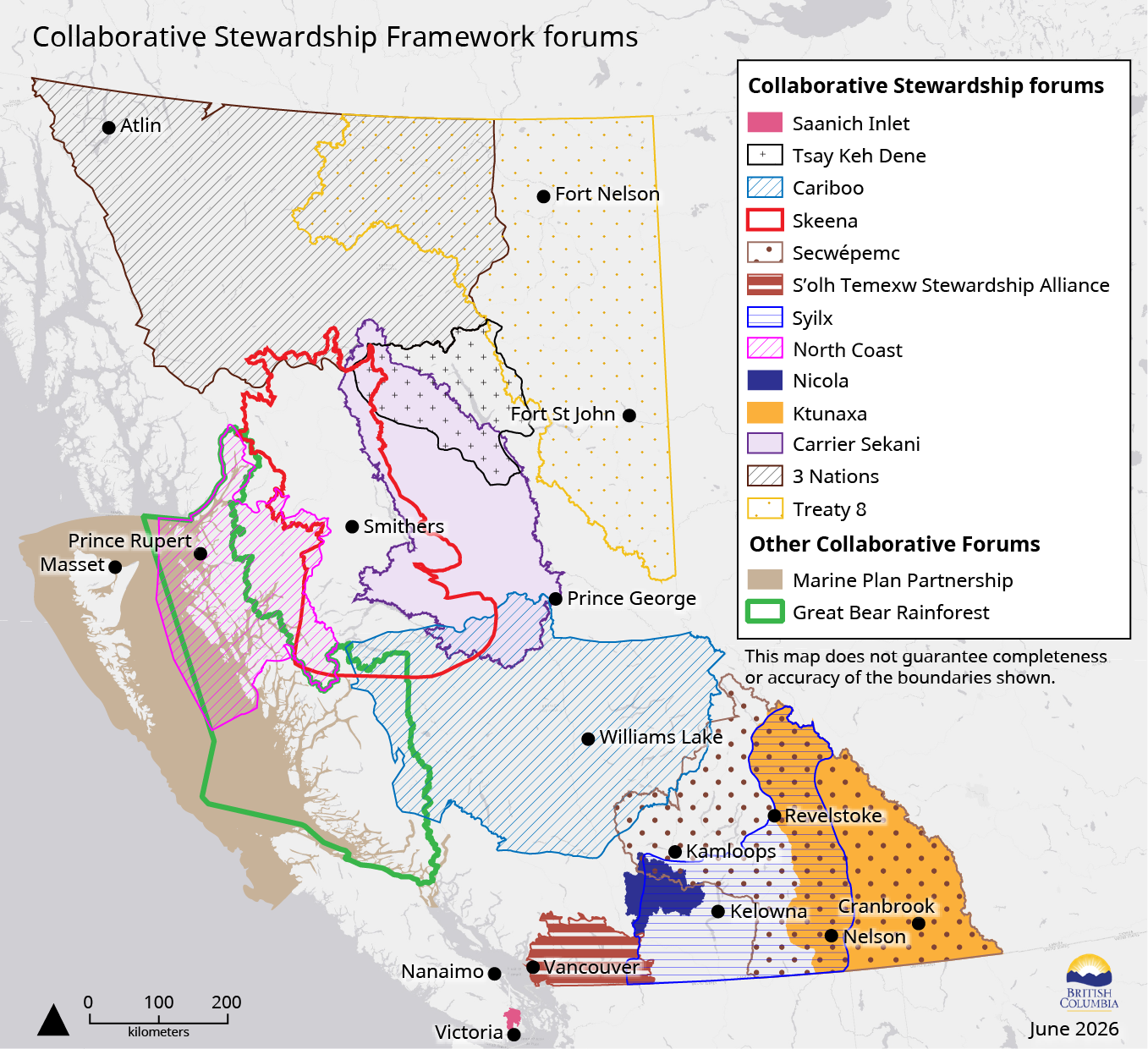
To learn more, review the descriptions and map below. More information will be added as this work continues to evolve.
3 Nations
Located in the northern Skeena region, the 3 Nations - B.C. Forum brings together the 3 Nations Society (Tahltan, Kaska, and Taku River Tlingit Nations) and the B.C. government to co-design an approach to shared management of land and resource values across their collective territories. A key focus is collaborative wildlife management and inventory, as well as monitoring of water quality and other priority values. The forum also advances governance and capacity building, decision-making informed by Indigenous knowledge, and a growing Guardians program supporting land use monitoring, data collection, and community engagement.
To learn more visit the 3 Nations website.
Cariboo
The Cariboo Forum is located in central B.C. and consists of Lhoosk’uz Dené Nation, Lhtako Dené Nation, Nazko First Nation and Ulkatcho First Nation. Together this forum and the B.C. government, through the Hubulhsooninats’Uhoot’Alh: Foundation Framework Agreement, are working collaboratively on key initiatives related to land stewardship and economic development in their territories. The Southern Dakelh Land Stewardship Plan, the Ungulate Working Group and the Southern Dakelh Stewardship Guardian Program are three key stewardship initiatives underway. The forum’s progress as part of this program also includes other work related to forestry, economic development and integration of health and wellness.
Ktunaxa
The Ktunaxa Nation Council is working with the B.C. government in southeast B.C. to inform stewardship decisions on environmental and cultural values. The Ktunaxa Nation Council represents the communities of ʔaq̓am (St. Mary’s Band), ʔakisq̓nuk First Nation, Yaqan Nukiy (Lower Kootenay Band) and Yaq̓it ʔa·knuqⱡiʾit (Tobacco Plains Band). Past forum projects include collaborative wildlife stewardship, huckleberry stewardship and the development of a Ktunaxa Guardian program.
Nicola Water Governance Partnership
The Nicola Watershed Governance Partnership (PDF, 16KB) is a collaborative forum focused on sustainable water governance in the Nicola River watershed in the Nicola Valley. It brings together the Upper Nicola Band of the Okanagan (Syilx) Nation and the Lower Nicola, Coldwater, Nooaitch and Shackan Bands of the Nlaka’pamux Nation (collectively the Nicola Five Bands) working alongside the B.C. government.
Initiated in 2018 through a Memorandum of Understanding, the partnership is guided by Syilx and Nlaka’pamux values, language and knowledge, together with provincial legislation. Originally launched as a pilot project supported by the B.C. government and the BC Freshwater Legacy, the partnership became part of the Collaborative Stewardship Framework, enabling longer‑term initiatives.
This forum’s work includes water management, governance, and capacity‑building projects supported by a Core Council, a secretariat and the ongoing development of a Nicola Forum Elders’ Advisory Council, with a shared objective of benefiting future generations.
North Coast
Located on the North Coast of British Columbia south of coastal Alaska, the North Coast Collaborative Stewardship Forum brings together six Nations, Kitsumkalum, Kitselas, Metlakatla, Haisla, Gitxaala, and Gitga’at, and the B.C. government, to advance habitat health and address cumulative effects within their territories. The forum supports Nation‑led ecosystem enhancement projects with collaboration through shared data, methodologies and site visits. It also aligns with the North Coast sub‑region of the Marine Plan Partnership (MaPP) to co‑develop assessment, management and monitoring for priority values including estuaries, food security, access to resources and salmon, reducing duplication and strengthening shared outcomes.
Additional information:
Omineca
Omineca Forum
Located in central B.C., the emerging Omineca Forum builds on previous work completed through the Carrier Sekani First Nations and Tsay Keh Dene Nation Environmental Stewardship Initiative forums. Collaborative stewardship will shift to a regional approach that is intended to be inclusive to all First Nations in the Omineca. This will be implemented in phases. First Nations across the region and the government of B.C. will initially join together to reflect on the learnings from past forums and refresh the approach to collaborative stewardship in the Omineca region.
Below is some information about past forums. The Omineca Forum is carrying forward these forums and their work.
Tsay Keh Dene (TKD)
Located in Tsay Keh Dene Nation (TKDN) territory in northern British Columbia, spanning the Omineca and Rocky Mountains, the Tsay Keh Dene Environmental Stewardship Initiative (TKD ESI) brought together TKDN and the B.C. government in a government‑to‑government collaboration. The forum focused on developing trusted data to assess current condition of values linked to TKDN Indigenous rights, including moose, caribou, grizzly bear, marmot, forest biodiversity, and freshwater fish and habitats. Indigenous knowledge and Western science were integrated to build trusted information that could be used to support natural resource planning and decision-making for both governments.
Carrier Sekani First Nations
Since 2015 the seven Carrier Sekani First Nations, Nadleh Whut'en, Nak'azdli Whut’en, Saik'uz First Nation, Stellat'en First Nation, Takla Nation, Tl'azt'en Nation and Ts'il Kaz Koh, and the B.C. government, have worked collaboratively through the Carrier Sekani First Nations Environmental Stewardship Initiative (CSFN ESI).
The CSFN ESI agreements were designed to:
- Support mutually trusted cumulative effects assessments
- Jointly identify valued ecosystem components of shared interest
- Consider broader ecological, cultural, and socio-economic implications
- Develop a monitoring framework to guide ongoing stewardship
Through this work, cumulative effects models have been completed identifying key areas of importance for CSFN ESI’s values: moose, forest biodiversity and freshwater, and anadromous fish. The models and findings provide a shared evidence base to inform future stewardship and decision-making across the area.
Qwelmínte Secwépemc
Located within Secwépemcúl’ecw in southeastern B.C., the Secwépemc Collaborative Stewardship Forum (PDF, 39KB) brings together the B.C. government and seven Secwépemc communities across four Ancestral Campfires to transform stewardship of tmicw (land and resources):
- Pespésellkwe te Secwépemc (PteS) Campfire division includes Adams Lake Indian Band (Sexqeltqin), Skwlāx te Secwepémcúl’ecw (formerly known as Little Shuswap Lake Band), and Splatsin
- Stk’emlúpsemc te Secwépemc (SSN) Campfire division comprises Tk’emlúps te Secwépemc and Skeetchestn Indian Band
- Cariboo/Fraser River Campfire division comprises High Bar First Nation (Llenlleney’ten) and Whispering Pines / Clinton Indian Band (Pellt’iq’t)
The forum supports a “Walks on Two‑Legs” approach toward co‑management that upholds inherent rights and stewardship responsibilities. With an initial focus on forest landscape planning, the forum works collaboratively to identify shared values, assess cumulative effects, and inform management, restoration and enhancement of forest values to support informed stewardship decisions.
Skeena
Located in the Skeena region in west-central B.C., the Skeena Sustainability Assessment Forum (SSAF) brings together 10 Skeena Nations and the B.C. government to advance collaborative environmental stewardship. Participating First Nations include the Gitanyow Hereditary Chiefs, Gitwangak Hereditary Chiefs, Gitxsan Nation, Lake Babine Nation, Witset First Nation, Nee Tahi Buhn Band, Office of the Wet’suwet’en (representing Wet’suwet’en Hereditary Chiefs), Hagwilget Village Council, Skin Tyee Nation and Wet’suwet’en First Nation.
The forum focuses on environmental monitoring and assessment of shared resource values, including medicinal plants, grizzly bear, fish and fish habitat, moose and wetlands. SSAF supports Indigenous perspectives, knowledge and science by monitoring conditions and trends, analyzing data and providing trusted information to inform stewardship and decision‑making across the region.
Review the Enabling Agreement (PDF, 6.1MB) for the Skeena forum.
S’ólh Téméxw Stewardship Alliance
The S’ólh Téméxw Stewardship Alliance Forum (PDF, 45KB), which operates in the Lower Fraser River Watershed in southwest B.C., includes 17 member First Nations united under the Stó:lō Strategic Engagement Agreement. This forum and the B.C. government are approaching projects with the shared vision of collaboration using the term Lets’emó:t (meaning “one mind” in Halq’emeylem, language of the Stó:lō) to guide actions with Stó:lō worldview values.
This approach informs provincial interests and objectives to shape a common stewardship vision for Stó:lō Téméxw (Lower Fraser River Watershed) and co-create trusted data to inform decisions. It takes a holistic, interconnected approach that links themes and over 40 initiatives.
Saanich Inlet
Located in and around the Saanich Inlet area of Vancouver Island, the Saanich Inlet Collaborative Stewardship Forum is made up of four W̱SÁNEĆ Partner First Nations, Tsartlip, Tsawout, Malahat and Pauquachin First Nations, along with the B.C. government.
Initiated in 2024, the forum recognizes the Partner First Nations’ sacred responsibility to be guardians of their territory and works with the B.C. government to understand past, present and future cumulative effects on the Saanich Inlet.
The forum serves as a foundation for information sharing and advancing stewardship objectives, with cumulative effects assessments informing shared stewardship actions as well as other decisions that affect the Saanich Inlet.
By following the voices of the Elders and applying their teachings to the technical work of caring for the territory, the Saanich Inlet will return to a thriving, clean environment that sustainably supports the ecological, cultural, social and economic interests of the Partner First Nations and others.
Syilx
Located in Syilx Okanagan territory, the Syilx‑B.C. Collaborative Stewardship Forum brings together the B.C. government and the syilx Okanagan Nation Natural Resource Committee, representing seven Syilx communities. The forum advances a holistic, values‑based approach to stewardship grounded in equal and inclusive participation and respect for Syilx authorities and responsibilities. Work is organized through four technical planning tables, including water (siwɬkʷ), land (tmxʷúlaʔxʷ), all living things (tmixʷ), and hazards. It includes projects such as wildlife health analyses, cumulative effects assessment, conservation tools training, and broader data sharing and data governance.
Treaty 8
Located in northeast British Columbia, the Treaty 8 Collaborative Stewardship Forum brings together Treaty 8 First Nations, Blueberry River, Doig River, Halfway River, Prophet River, Saulteau, West Moberly, Fort Nelson and McLeod Lake, and the B.C. government. The forum provides a collaborative approach to assessing cumulative effects of natural resource development on Treaty 8 rights, particularly within the Montney area. Work focuses on priority values, including disturbance analysis, old forests and biodiversity, water, moose, peaceful enjoyment and environmental livelihoods, with results used to inform management responses that appropriately address identified effects on the exercise of Treaty 8 rights.
CSF forum regions map
Contact information
CSF@gov.bc.ca