
Drought information
 Last updated on May 6, 2026
Drought is a naturally reoccurring period of abnormally dry conditions that may result in water scarcity or other adverse impacts on people, aquatic ecosystems, wildlife or vegetation.
Water scarcity is when there is not enough water to meet the needs of people and ecosystems.
On this page
- Understanding drought and water scarcity
- Drought monitoring and drought levels
- Assessing water scarcity risk during drought
- Water management during drought and water scarcity
Understanding drought and water scarcity
Drought may be caused by combinations of insufficient snow accumulation, earlier or rapid snow melt, prolonged hot and dry weather, or a delay in rainfall.
Drought can be characterized according to the state of dryness (for example, meteorological or hydrological drought), or the effects of that dryness (for example, ecological, agricultural or socio-economic drought). Each definition implies different impacts.
While there are many types of drought, they all occur as a temporary deviation from normal or expected conditions. Individual drought events vary in their magnitude and duration. While most droughts develop slowly and have no obvious start and end dates, rapid-onset flash droughts can also occur.
Water scarcity occurs when there is not enough water to meet the needs of people or ecosystems. Water scarcity is influenced by both climate conditions and human activity. It can occur in the absence of drought or be introduced or made worse by drought.
Drought monitoring and drought levels
Drought conditions are monitored as one risk factor for water scarcity across B.C. Knowing when and where drought occurs helps inform when and where actions may be needed to avoid or reduce water scarcity and support preparedness and response.
Provincial drought levels provide a snapshot of drought hazard, describing the severity and spatial extent of climate-driven dryness relative to the historical record.
The B.C. government uses a six-level classification system to assess drought conditions (Level 0 to Level 5). Provincial drought levels are set by the River Forecast Centre to ensure a consistent assessment of drought conditions across B.C., using indicators and methods described in the British Columbia Drought and Water Scarcity Operations Plan 2026 (PDF, 997KB).
Drought levels:
- Represent how dry it is, relative to the historical record
- Tell us how common or rare a given level of dryness is
- Reflect conditions at a point in time
- Help us understand natural drought patterns
The graphic below illustrates how drought levels are classified:
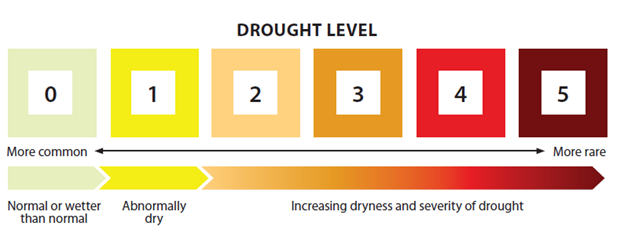
As drought conditions occur at Level 1 and escalate in severity towards Level 5, the drought level also represents how often drought conditions are expected to occur based on the historical record, with Level 1 being more common and Level 5 being more rare.
Note: In 2026, the drought level colour palette was updated to better emphasize its purpose as a source of statistical information, rather than an alert for action. This update also ensures the colour palette meets accessibility standards. The updated colour palette does not change the meaning of drought levels or how drought conditions are assessed.
A drought level is assessed based on how key drought condition indicators, such as precipitation and natural streamflow, differ from normal values.
The main drought indicators currently used to monitor drought levels in B.C. are:
- Precipitation percentiles (various timescales)
- Standardized Precipitation Index (SPI) (various timescales)
- Standardized Precipitation Evapotranspiration Index (SPEI) (various timescales)
- 7-Day average streamflow percentiles
- 7-Day average lake level percentiles
- Daily groundwater level percentiles
Drought conditions are typically monitored following spring freshet until the onset of winter conditions. This timing can vary considerably for different areas of the province from year to year depending on conditions. When drought conditions are actively monitored, drought levels are typically set weekly or biweekly.
To learn more about drought conditions, patterns and trends:
- Visit the Drought Information Portal
Assessing water scarcity risk during drought
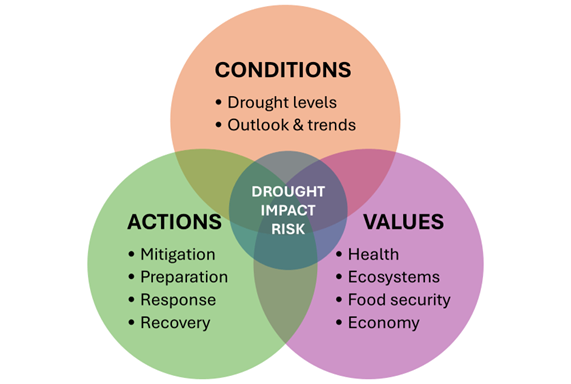
There are three main factors that contribute to the risk of experiencing water scarcity:
- Physical conditions: whether water demand is likely to exceed supply, including the presence and severity of drought, current hydrologic conditions, and near-term trends
- Values at risk: the significance, exposure and sensitivity of assets such as human health, aquatic ecosystems, infrastructure, food security and cultural practices
- Actions taken: the effectiveness of mitigation, preparedness, response and recovery measures in reducing exposure and vulnerability and building resilience
Together, these factors help explain why water scarcity may emerge at different drought levels in different watersheds and support informed decision-making about preparedness and management actions.
The diagram below illustrates the key factors that contribute to water scarcity risk:
Drought can introduce or worsen water scarcity across various sectors and values. The B.C. government is working to evaluate water scarcity risks to individuals, communities, industry and the natural environment.
Impacts to communities
Severe drought conditions pose significant risks to people and communities. Drought can lead to reduced water availability for household and business use.
The B.C. government, in partnership with regional health authorities, are working with select drinking water suppliers across the province (for example, municipalities, private water utilities and improvement districts) to collect information about the status of their drinking water supply.
In partnership with Indigenous Services Canada, the B.C. government also reaches out to First Nation water suppliers. The information gathered supports an assessment of which communities are at risk of water supply issues and where additional support may be needed if and when drought occurs.
If drought threatens a community’s water supply, emergency supplies will be provided to protect public health and safety.
Impacts to agriculture and food production
Drought can strain water resources. This impacts both irrigated and dryland production by reducing crop yields, lowering crop quality, and increasing pest and other pressures. Less water may be available for irrigation and for animal care. Hotter temperatures that coincide with a lack of rainfall may lead to early crop maturity or ripening.
Drought impacts on agriculture are highly variable, influenced by farm practices and on-farm water management, making them subjective and difficult to assess, even among neighboring farms. The B.C. government provides advice and drought management tools to those affected by drought or loss of water in agriculture.
Impacts to fish and aquatic ecosystems
Drought conditions pose risks to fish and fish habitat. This includes Pacific salmon and other aquatic species at risk.
Drought impacts fish, fish habitat, and aquatic ecosystems by causing:
- Dewatering of fish streams
- Low stream flows
- High stream temperatures
Drought conditions can lead to:
- Fish strandings
- Death of fish
- Delayed movement of migrating fish into spawning streams
- Losses in biodiversity
The B.C. government is working with Fisheries and Oceans Canada, First Nations, non-governmental organizations, and others to support priority fish populations affected by drought.
This work includes:
- Relocating stranded salmon in dewatered streams
- Providing or improving fish passage in low flow streams
- Creating cold water refuge habitats
- Implementing and enforcing fisheries closures to protect at-risk stocks
During severe drought, the B.C. government works to identify, monitor, and where possible, reduce the impacts of drought on fish, fish habitat and aquatic ecosystems, particularly in streams that support Pacific salmon or aquatic species at risk.
Specific areas of collaboration include:
- Establishing priorities for streams and fish populations at greatest risk of drought impacts
- Monitoring stream flows and stream temperatures
- Monitoring fish numbers, distribution and responses to drought and flow management
- Defining critical flow thresholds for priority watersheds and fish populations at greatest risk due to combined effects of drought and water use
- Advising when curtailment of water use should be considered to limit impacts to fish and aquatic ecosystems
Fish populations that are vulnerable to drought conditions often have significant:
- Economic, social and cultural importance to people, including Indigenous Peoples. Examples include chinook salmon, coho salmon, pink salmon, kokanee salmon, bull trout, rainbow trout and steelhead
- Conservation concerns, such as endangered Nooksack dace and Salish sucker
B.C.’s Biodiversity and Ecosystem Health Framework outlines the B.C. government’s commitment to protecting biodiversity.
To learn more about nature and wildlife in B.C.:
- Visit the Plants, animals and ecosystems page
Water management during drought and water scarcity
The British Columbia Drought and Water Scarcity Operations Plan 2026 (PDF, 997KB) outlines provincial roles, responsibilities and actions related to drought and water scarcity. Provincial monitoring and communications are intended to support local water scarcity risk assessment and readiness. This information helps guide both provincial and local management actions.
Water users should use water as efficiently as practicable. When voluntary conservation measures are not sufficient to support all water use on a stream system, or to protect critical environmental flows or the survival of a fish population, the Water Sustainability Act (WSA) provides authority under specified conditions to regulate water diversion use (and storage) by users of both stream water and groundwater.
- Learn more about water use management during scarcity
- Learn about temporary protection orders under the WSA
Low stream flows and hot, dry weather can result in high stream temperatures and the need for angling closures.
For more information on angling closures:
- Visit the Freshwater Fishing Regulations page for current in-season restrictions and notices