
B.C. Outdoor Recreation Economic Indicators
 Last updated on September 17, 2026
The B.C. Outdoor Recreation Satellite Account (B.C. ORSA) is a new data tool that measures the economic contribution of outdoor recreation in the province.

On this page
- Strengthening the outdoor recreation sector
- Measuring the economic impact
- Making informed decisions
- Advancing rural growth
- Building healthy communities and a strong economy
- Exploring available resources
Strengthening the outdoor recreation sector
The B.C. Outdoor Recreation Satellite Account (B.C. ORSA) dataset is now available. The launch of B.C. ORSA is an important step in strengthening the outdoor recreation sector. It provides data collected in partnership with recreation organizations, businesses, communities, Indigenous partners and other sector partners to provide insight into the economic impact of the outdoor recreation sector.
B.C. ORSA was developed in collaboration with key sector partners, including the Sea to Sky Outdoor Adventure Recreation Enterprise (SOARE), the Kootenay Outdoor Recreation Enterprise (KORE) and the Outdoor Recreation Council (ORCBC), which help support innovation, business growth and economic development in B.C.'s outdoor recreation sector.
Measuring the economic impact
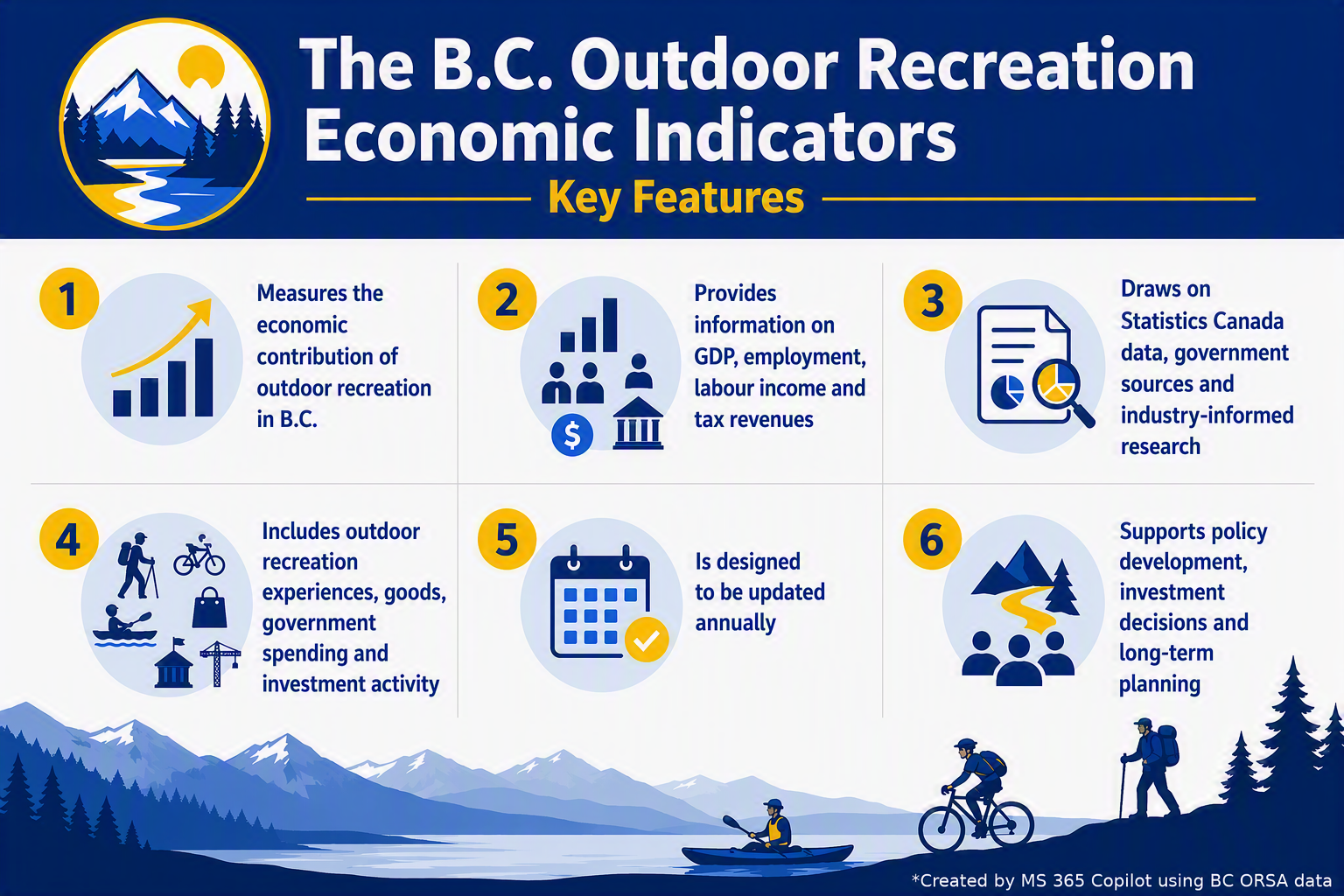
The B.C. ORSA dataset provides reliable information about how outdoor recreation supports the provincial economy. It delivers consistent measures of:
- Gross domestic product (GDP)
- Employment
- Labour income
- Tax revenues
It offers data on outdoor recreation experiences, equipment and goods, government spending, and investment to provide a comprehensive picture of the sector.
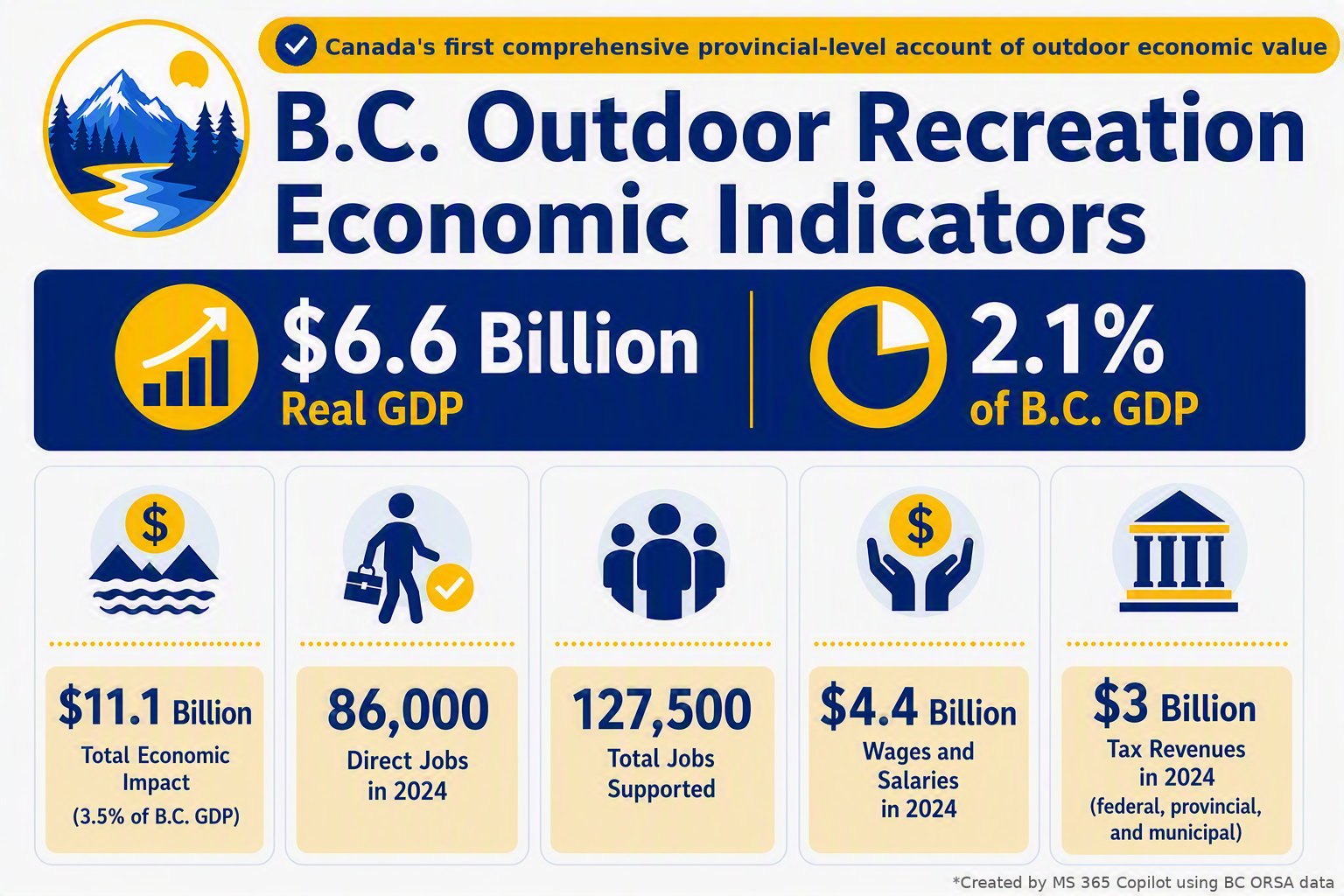
- B.C. ORSA dataset is Canada’s first comprehensive provincial measurement of the economic value of the outdoor recreation sector
- In 2024, B.C.’s outdoor recreation sector directly contributed an estimated $6.6 billion to the provincial economy, representing 2.1% of B.C.’s gross domestic product (GDP)
- When direct, indirect and induced impacts are included, the sector contributed nearly $11.1 billion to the economy, representing 3.5% of B.C.’s GDP
- The sector directly supported approximately 86,000 jobs in B.C. in 2024
- Including indirect and induced impacts, the sector supported an estimated 127,500 jobs across the province
- Outdoor recreation businesses and organizations paid approximately $4.4 billion in wages and salaries in 2024
- The sector generated approximately $3 billion in tax revenues in 2024, including federal, provincial and municipal taxes
Making informed decisions
B.C. ORSA gives communities, businesses, recreation partners, Indigenous partners, and government access to evidence-based information to help guide policy, planning and investment decisions.
Sustainable outdoor recreation requires co-ordinated leadership. This dataset provides a shared source of information to help partners plan for the future and support long-term growth in the sector.
B.C. ORSA will help track trends over time and improve understanding of how outdoor recreation contributes to communities across B.C.
Advancing rural growth
Outdoor recreation is an important economic opportunity for many rural communities across B.C. The data from B.C. ORSA helps communities identify strengths, support local planning and attract investment.
B.C. ORSA complements earlier work supported through the Rural Economic Diversification and Infrastructure Program (REDIP), including the Outdoor Recreation for Community and Economic Development Toolkit (PDF, 5.2MB) developed by the Outdoor Recreation Council of BC.
Also, this work aligns with the Province's Rural Initiative, which encourages partners to consider the needs of rural communities when developing programs, policies and investments. It also supports efforts to strengthen local economies, improve resilience and create opportunities for sustainable growth in rural and remote areas.
Outdoor recreation offers a unique opportunity for rural communities to diversify their economies, attract visitors and businesses, and create jobs while protecting the natural places that make these communities special.
Building healthy communities and a strong economy
Outdoor recreation is an important part of life in B.C. People participate in outdoor activities year-round, supporting healthy communities, local businesses and strong connections to the places they live and visit.
B.C. ORSA is a deliverable of B.C.'s Outdoor Recreation Strategy. It supports the growth of a strong outdoor recreation economy that creates jobs, generates revenue and contributes to the province's GDP and tax base, and creates vibrant communities.
This work also supports B.C.'s Look West Strategy by strengthening local economies, supporting resilient communities and encouraging sustainable growth throughout B.C.
Exploring available resources
Data source
Access the B.C. ORSA raw data in XLSX or CSV formats
Learn about the data
What is the B.C. Outdoor Recreation Satellite Account (ORSA) dataset?
The Province of B.C. built the B.C. ORSA dataset to comprehensively measure how much outdoor recreation contributes to the economy, GDP and jobs. It isolates outdoor recreation from the broader economy and organizes it into a structure to calculate economic indicators.
Where does the data come from?
The dataset draws primarily from Statistics Canada sources, including supply and use tables, travel surveys, household spending data, and capital investment data, and is informed by interviews with select B.C. companies and organizations within the outdoor recreation sector. Finally, it incorporates relevant government administrative data, such as provincial and federal spending on parks and recreation programs.
How were these data sources chosen?
The methodology prioritizes publicly available data sources, particularly Statistics Canada, because they are standardized, regularly updated, transparent, and compatible with economic modeling frameworks such as input-output analysis. This approach ensures the dataset can be updated consistently over time and supports reliable year-over-year comparisons.
How current is the data?
The dataset primarily relies on recent available data, including 2022 supply and use tables and 2023 survey and household spending data. These values are adjusted to a common price year of 2024 using inflation factors to ensure consistency.
How often will the dataset be updated?
The dataset is designed to be updated annually. The structure of the model and its reliance on regularly released data sources allow updated data to be incorporated each year with minimal changes to the methodology.
Can this data be compared to U.S. ORSA results at the national or state level?
Both frameworks aim to measure the economic contribution of outdoor recreation using national accounting principles. The B.C. model is built using Canadian data sources and the BC Stats Input-Output Model, while the U.S. ORSA is based on U.S. national accounts, methodologies developed by the Bureau of Economic Analysis and proprietary industry data.
Related links
Contact information
We're here to help! Send an email to: EconomicDevelopment@gov.bc.ca